
The Charleston HVAC Maintenance Checklist Nobody Reads Until It Is Too Late
August 8, 2026
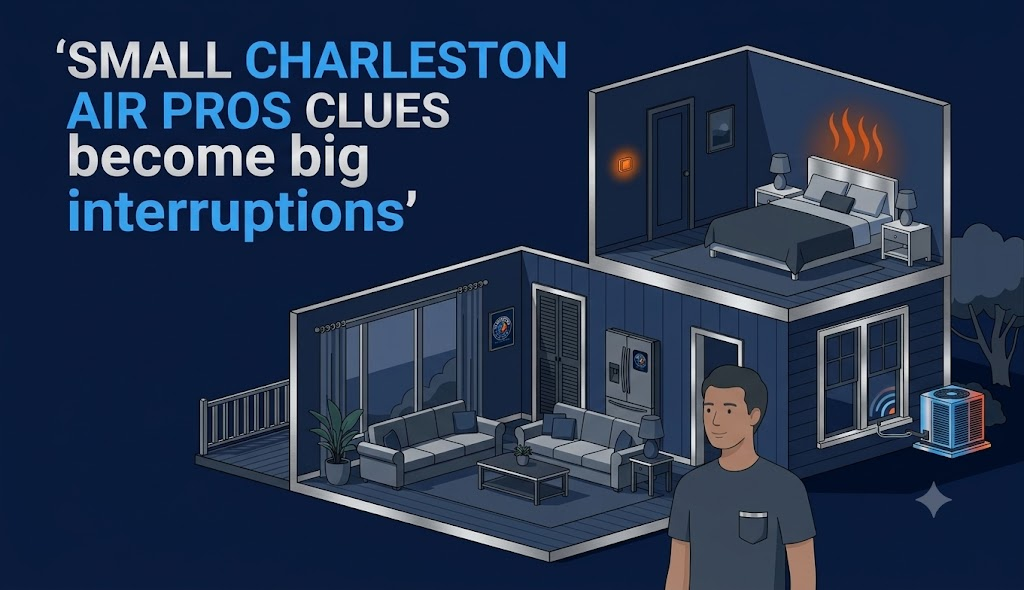
It is late afternoon in Charleston, the thermostat is set correctly, and the air conditioner is still running. Nothing sounds dramatic. Then someone notices a faint water mark below the air handler, one bedroom feels warmer than the rest, and the outdoor unit seems to run longer than usual. The system has not failed, but it is no longer giving quiet reassurance either.
That is when an HVAC maintenance checklist becomes useful. It is not a shopping list for unnecessary work, and it is not a promise that every breakdown can be prevented. It is a disciplined way to separate ordinary homeowner care from technical inspection, catch small warning signs before peak weather, and make sure a maintenance visit ends with the equipment operating safely and normally.
| The system may still be running, but small clues often deserve attention before peak weather. |
Key Takeaways
- Homeowners can protect airflow, drainage visibility, and outdoor clearance without opening sealed or electrical components.
- Professional maintenance should inspect, clean, test, document, and restore the system, not simply look at it.
- Charleston humidity makes condensate drainage and moisture clues especially important.
- A diagnosis-first approach helps distinguish routine care from repair, airflow work, or replacement.
What Does an HVAC Maintenance Checklist Actually Protect?
An HVAC maintenance checklist protects the conditions a heating and cooling system needs in order to operate normally: clean airflow, controlled drainage, sound electrical connections, clean heat-transfer surfaces, accurate controls, and a complete operating test. It also creates a record of what was checked, what was found, and what still needs attention.
That matters because heating and cooling are not a small part of home operation. ENERGY STAR notes that nearly half of the energy used in a home goes to heating and cooling. A filter that restricts airflow, a coil covered with debris, or a thermostat that does not read accurately can therefore affect more than comfort; each can influence run time, operating strain, and the clarity of the next repair decision.
A useful checklist does not treat every discoloration, sound, or age-related mark as an emergency. Instead, it connects evidence to action. A dated filter shows when it was changed. A clear drain outlet shows that water has a path out. A recorded temperature difference, pressure reading, or electrical measurement gives a technician something concrete to compare later. That is the practical value behind questions about HVAC tune up cost: the visit should produce information, not just a receipt.
Why Charleston Systems Need More Than a Generic Checklist
Charleston equipment works in a climate where long cooling seasons and heavy moisture removal are normal. The air conditioner is not only lowering temperature; it is also collecting water from humid indoor air and sending that water through a pan and drain line.
A partial blockage, poor drain pitch, failed float switch, or disturbed trap can turn a routine cooling issue into staining, overflow, or an unexpected shutdown.
Coastal air adds another layer. Salt-laden moisture can contribute to corrosion on exposed outdoor metal, fasteners, coil surfaces, wiring protection, and line-set insulation.
The right response is not aggressive cleaning by the homeowner. It is regular visual attention, gentle debris removal around the unit, and professional inspection when corrosion, damaged insulation, missing screws, or exposed wiring appears.
Humidity can also create confusing visual clues. Growth or dark staining on the outside of a supply plenum may come from condensation on a cold exterior surface rather than contamination moving through the duct interior.
A careful technician should inspect both conditions before making an indoor air quality recommendation. That distinction is one reason local context matters when searching for HVAC Charleston SC service: a coastal diagnosis should explain what the evidence means, not simply attach the most alarming label to it.
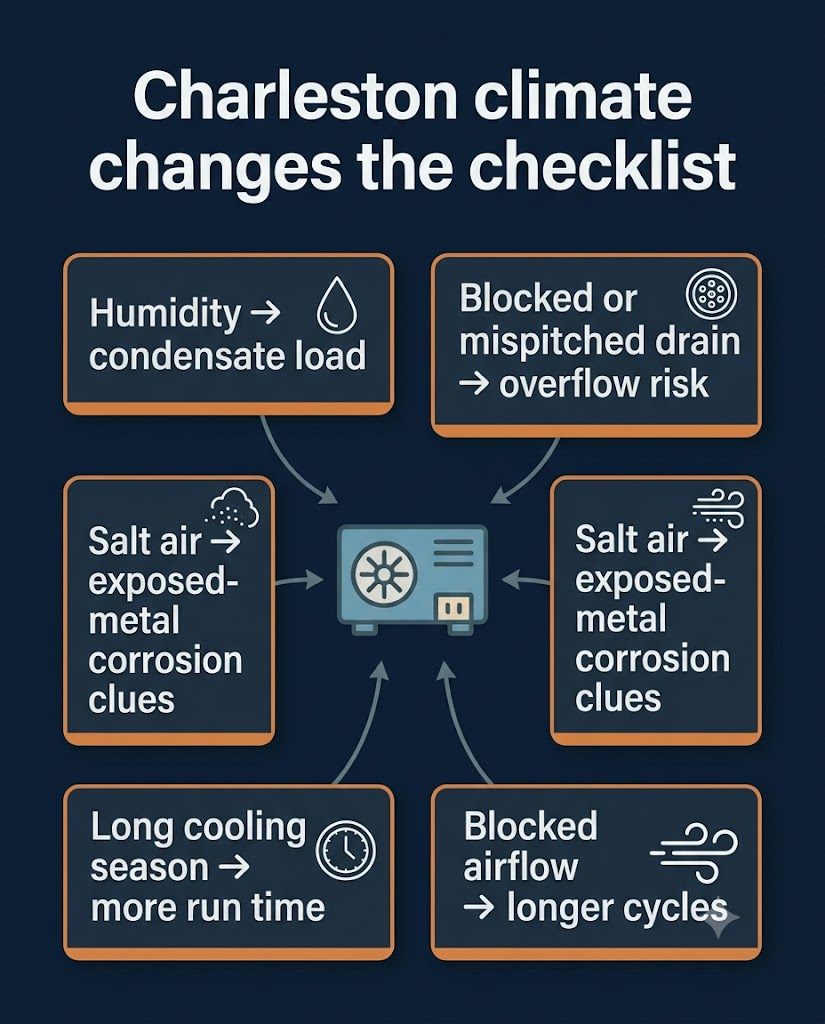
Local climate does not change the basic system, but it changes which clues deserve faster attention.
How Often Should HVAC Be Serviced in Charleston?
A practical schedule combines frequent homeowner observation with professional pre-season service. Homeowners can look at the filter, vents, thermostat, drain outlet, and outdoor clearance throughout the year. A professional should inspect the cooling system before sustained summer demand and the heating side before colder weather, particularly when the property uses a heat pump or gas heat.
The exact answer to how often should HVAC be serviced depends on equipment type, property use, filter size, pets, renovation dust, occupancy, and the manufacturer’s requirements. A one-inch filter in a busy household may need attention sooner than a larger media filter in a lightly occupied property. A rental that changes tenants, a commercial space with long operating hours, or a home near active construction also deserves closer observation.
The CLEAR Framework for Dependable Maintenance
The most useful checklist can be remembered through five actions: CLEAR. The framework keeps maintenance focused on system conditions and evidence rather than on selling a predetermined repair.
- Clean the airflow path. Check the filter, return grilles, supply vents, blower area, and coils for restrictions or debris.
- Look for water and air leaks. Inspect the condensate pan, drain, trap, float switch, plenum seams, and visible duct connections.
- Examine electrical and control components. Verify safe connections, wire condition, thermostat response, disconnects, and operating controls.
- Assess performance. Test the system through a full cycle and evaluate airflow, temperature response, refrigerant operation, noises, and shutdown behavior.
- Record and restore. Document findings, replace caps and panels, return switches and thermostat settings to normal, and explain any recommendation in plain language.
CLEAR also protects the customer from a weak maintenance visit. Cleaning without testing can leave a breaker off. Testing without documenting can make the next technician start from zero. Recommending replacement without measuring performance can turn uncertainty into an expensive decision. A complete visit connects each step.
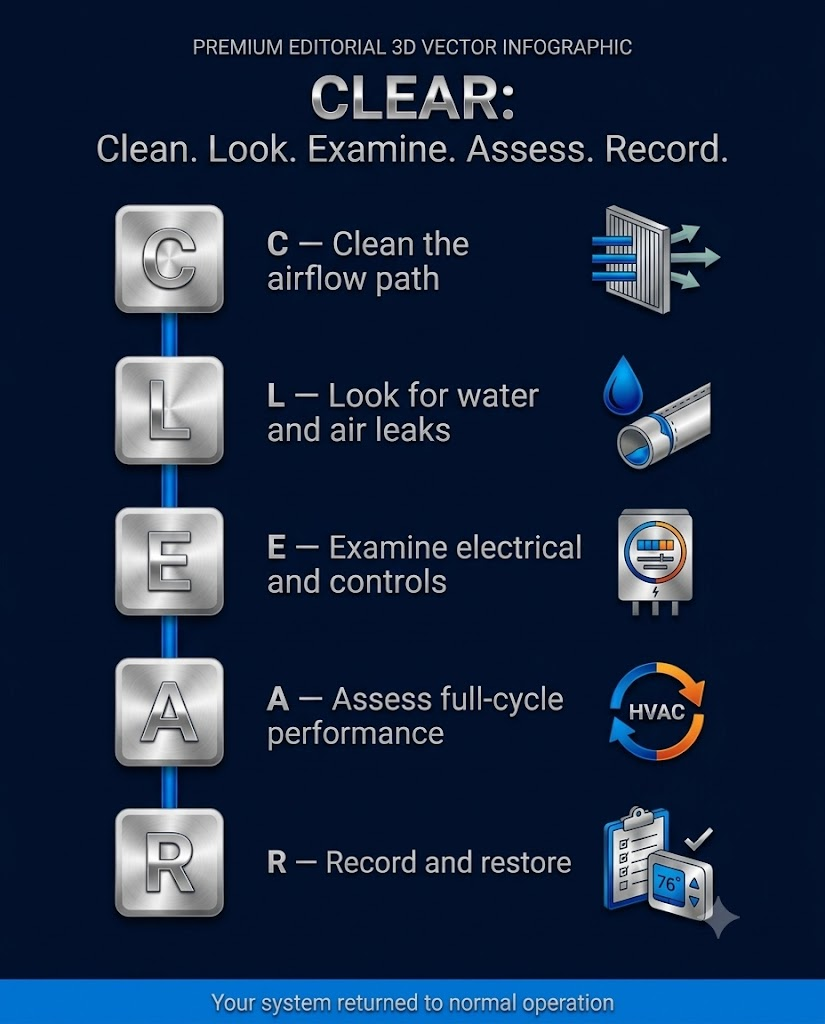
A complete visit connects cleaning, inspection, testing, documentation, and proper handoff.
Which HVAC Tasks Can a Homeowner Safely Handle?
Homeowner maintenance should stay on the visible, low-risk side of the system. Anything involving live electrical parts, refrigerant circuits, combustion equipment, internal coil access, or dismantling should be left to a qualified professional.
1. Check and date the air filter
The filter is the easiest maintenance record in the home. The homeowner should confirm the correct size, airflow direction, fit, and visible condition. Writing the installation date on the frame creates a simple breadcrumb for future troubleshooting. A dirty or collapsed filter can restrict airflow, but replacing it does not automatically solve every airflow problem.
2. Keep returns and supply vents open
Furniture, rugs, storage, and closed grilles can interfere with the designed airflow path. Closing vents in unused rooms does not turn off the system for that room; it changes pressure and can add strain elsewhere. The better approach is to keep grilles open and unobstructed, then investigate persistent room-to-room imbalance rather than hiding it.
3. Clear the outdoor unit’s breathing space
Leaves, clippings, vines, and stored objects should not crowd the condenser or heat pump. Homeowners can remove loose debris from around the cabinet and trim nearby vegetation without bending fins, opening panels, or spraying high-pressure water. Damaged line insulation, loose panels, missing screws, or visible corrosion should be photographed and shown to the technician.
4. Observe the thermostat and a full operating cycle
The thermostat should respond to a reasonable setting change, the system should start without repeated clicking, and conditioned air should reach the rooms. A homeowner can note unusual run time, uneven temperatures, new odors, water, ice, or noises. These observations are more useful than repeatedly changing the setpoint in an attempt to force faster cooling.
5. Look at the condensate exit, not inside the drain system
During humid cooling weather, a functioning system usually produces condensate. A homeowner can look for water where the drain is intended to discharge and inspect the surrounding area for overflow or staining. Clearing internal traps, applying chemicals, testing float switches, or correcting drain pitch belongs in professional service unless the manufacturer and contractor have provided a specific safe procedure.
| Homeowner check | What it can reveal | Stop and call for service when |
|---|---|---|
| Filter condition and date | Visible loading, wrong direction, poor fit | The filter is wet, collapsed, repeatedly dirty, or icing persists |
| Open returns and supply vents | Blocked airflow or room imbalance | Airflow remains weak or temperatures stay uneven |
| Outdoor clearance | Leaves, vines, damaged insulation, loose panels | There is corrosion, exposed wiring, ice, or unusual noise |
| Thermostat response | Whether the system starts and completes a cycle | It short-cycles, will not start, or does not shut down normally |
| Visible drain area | Overflow, staining, or missing condensate flow | Water backs up, a safety switch trips, or ceilings/walls become damp |
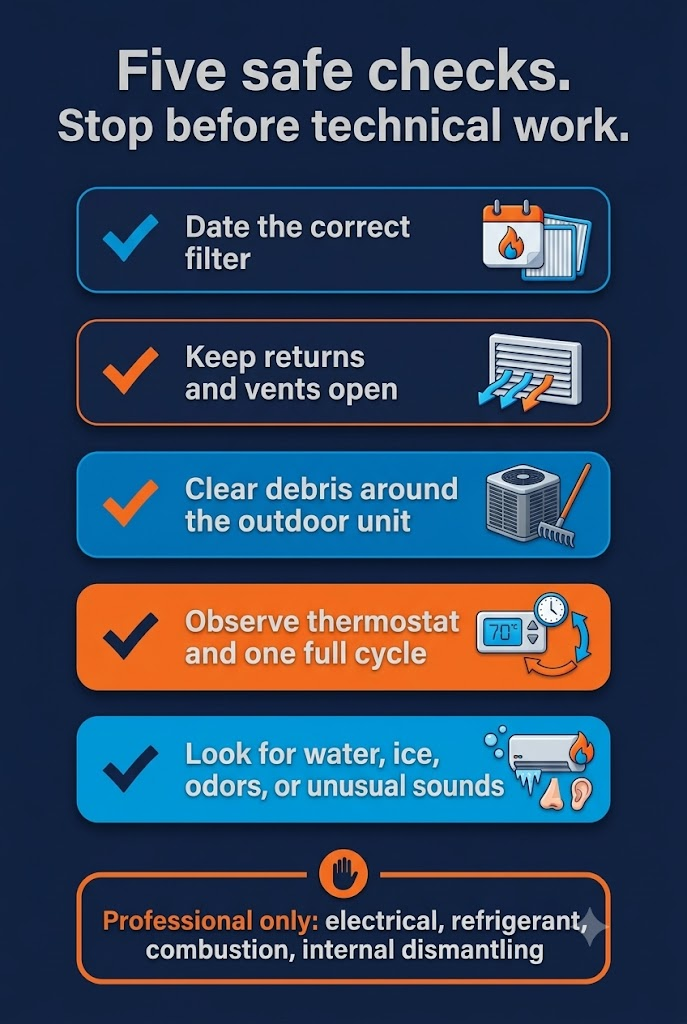
Simple observation can make a service call more accurate without asking the homeowner to open the equipment.
What Should Professional HVAC Maintenance Include?
A professional visit should go beyond changing a filter. The technician should arrive with a repeatable process, inspect the indoor and outdoor equipment, and leave the customer with evidence. The exact tasks vary by system, but the following categories form a dependable core.
Drainage and water safety
The condensate pan, drain line, trap, pitch, and float switch deserve deliberate attention. A drain can appear clean and still fail if its slope or trapping is wrong. A technician should confirm that water moves as intended, that the safety control functions, and that the work itself has not disturbed the drain alignment.
Indoor airflow components
The evaporator coil, blower wheel, cabinet, filter rack, and visible plenum connections should be inspected for debris, restriction, leakage, condensation patterns, and deterioration. Cleaning should be appropriate to the material and operating season. Strong chemical odors after service are not a sign of better maintenance; they can indicate that a product was applied without considering how the system would be operated afterward.
Outdoor coil and refrigerant circuit
The outdoor coil should be cleaned in a way that removes embedded debris without damaging fins or electrical components. Refrigerant performance should be evaluated as part of system operation, not treated as an automatic invitation to add refrigerant. Missing service caps, damaged seals, or recurring low charge require attention because a sealed system should not need routine topping off without a reason.
Electrical, controls, and heating safety
Connections, wire condition, current draw, capacitors or other starting components where applicable, disconnects, breakers, thermostat operation, and safety controls should be checked by a qualified technician. Heating equipment requires its own inspection, including combustion or gas-related components where present. The goal is safe operation through start-up, run, and shutdown, not a quick visual glance.
Final test, documentation, and handoff
The system should complete a test cycle after the work. Panels, screws, caps, insulation, disconnects, breakers, and thermostat settings should be returned to their proper condition. Photos and written notes can show the customer what changed. In practical terms, if a maintenance step is not documented, the property owner has little way to confirm it or use it as a future comparison. A commercial HVAC maintenance checklist should apply the same discipline across every labeled unit and zone.
What Do Homeowners Commonly Get Wrong?
Do this, not that
- Do keep vents open and investigate imbalance; do not close multiple vents to force air elsewhere.
- Do describe symptoms and ask for measurements; do not accept an automatic replacement recommendation without a diagnosis.
- Do keep the condenser area clear; do not pressure-wash coils or open electrical panels.
- Do ask why refrigerant is low; do not treat recurring refrigerant additions as ordinary maintenance.
- Do ask whether exterior staining is condensation-related; do not assume visible growth outside a plenum proves contamination inside the ducts.
- Do confirm the system was tested and restored; do not let the visit end with a disconnect off, panel open, or thermostat left in a test setting.
The point is not to turn every homeowner into a technician. It is to make the service conversation more precise. A property owner who knows what a complete process looks like can ask better questions without diagnosing the equipment from the hallway.
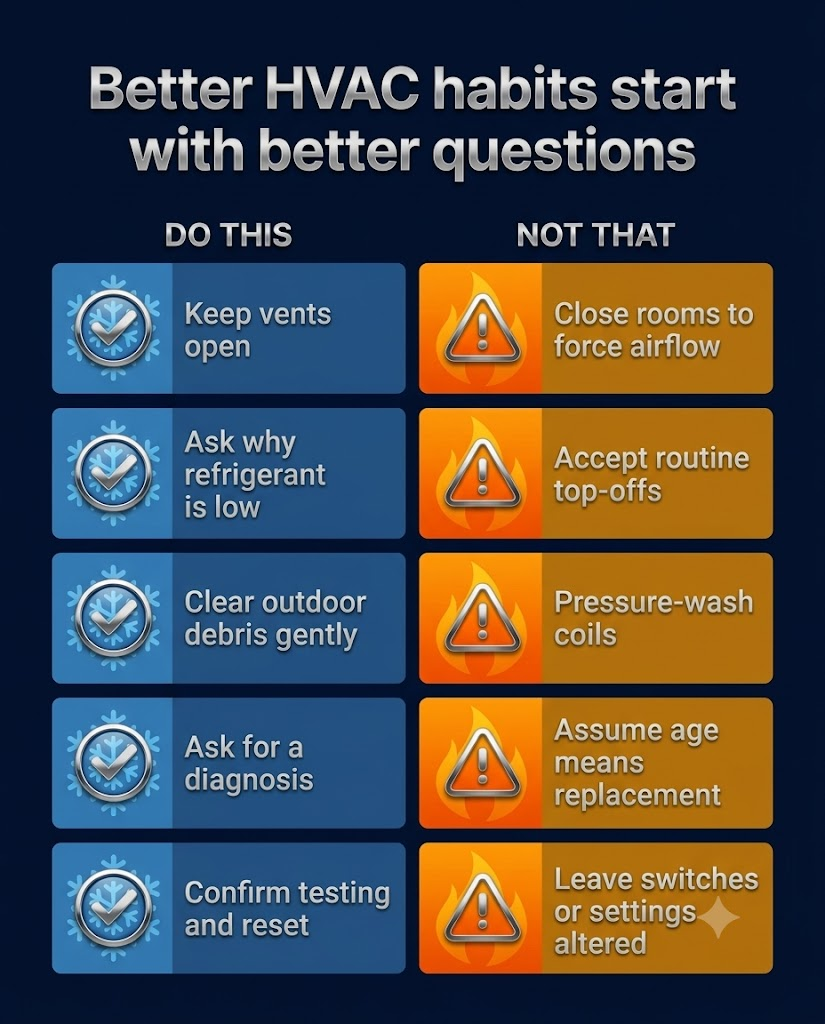
The goal is not DIY diagnosis; it is a clearer, safer service conversation.
| “An ounce of prevention is worth a pound of cure.” – Benjamin Franklin |
The quote fits HVAC maintenance only when prevention is careful. A rushed drain cleaning, loose cap, altered switch, or incomplete final test can create the callback the visit was meant to avoid.
When Does Maintenance Become a Repair Call?
Maintenance becomes a repair call when inspection finds a failed component, unsafe condition, leak, damaged wiring, blocked or incorrectly configured drain, persistent airflow defect, control failure, refrigerant problem, or performance issue that routine cleaning and adjustment cannot correct. The next step should be based on the cause, not on the age of the equipment alone.
Warning signs include repeated drain trips, water around the indoor unit, weak airflow after a clean filter, ice, unusual electrical smells, burning odors that do not quickly clear at seasonal start-up, short-cycling, a system that will not reach the setpoint, or major temperature differences between rooms. Gas odor, smoke, sparking, or an active electrical hazard requires immediate safe shutdown and emergency assistance.
Repair-versus-replacement decisions should consider the specific failure, equipment condition, service history, comfort problems, efficiency, availability of parts, and whether the system was properly sized and installed. A diagnosis-first HVAC Charleston SC provider should be able to explain what failed, what can be repaired, what remains uncertain, and why replacement is or is not the practical choice.
A Familiar Charleston Scenario
Consider a two-story rental that cools downstairs but leaves the upper bedroom warm. The filter was replaced recently, so the owner assumes the system is simply old. During inspection, the technician finds that a return grille is partly blocked, the blower area needs cleaning, and the condensate drain has sagged enough to create an unwanted trap. The equipment itself still runs, but airflow and drainage are both compromised.
A weak service call might quote a larger unit immediately. A better visit restores the airflow path, corrects the drain configuration, confirms float-switch operation, tests the full cooling cycle, and documents temperatures before discussing larger decisions. The lesson is not that every old system should be repaired. It is that the owner deserves a clear cause before choosing a costly solution.
A Maintenance Routine That Is Easy to Keep
The best routine is simple enough to survive busy months. A homeowner or property manager can use three recurring moments: a quick monthly glance, a pre-season professional visit, and a brief post-service verification.
1. Monthly glance: check the filter date, open vents, thermostat behavior, visible drain area, and outdoor clearance.
2. Pre-season service: schedule cooling and heating checks before demand is at its highest, allowing time for measured repairs.
3. Post-service verification: review photos or notes, confirm the system completed a cycle, and make sure panels, switches, caps, and settings were restored.
4. Property record: keep filter dates, invoices, model information, and unresolved recommendations in one place.
5. Decision checkpoint: when a problem returns, compare current findings with the record before authorizing repeat work or replacement.
This routine answers how often should HVAC be serviced without pretending that every property is identical. It also gives the owner a fair way to compare recommendations and understand why one visit costs more than another. The value is not the number of boxes checked; it is whether those checks reveal the system’s real condition.
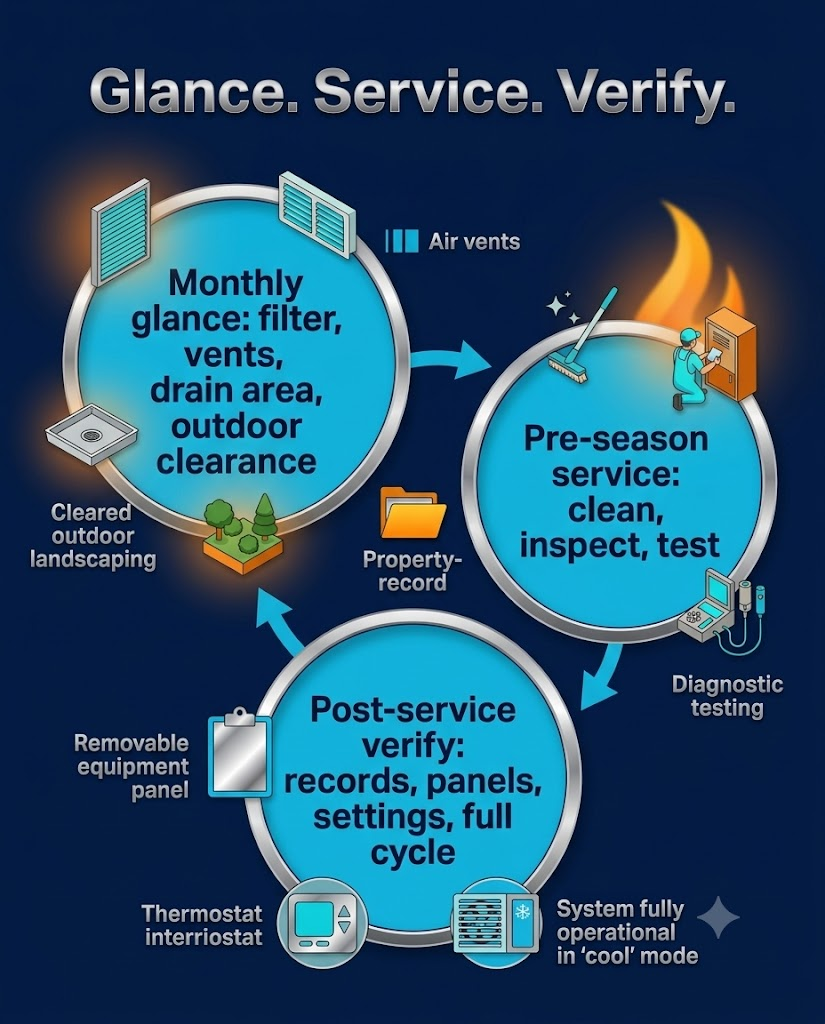
A routine works when it is easy to repeat and leaves a useful record.
Conclusion: Read the Checklist Before the System Forces the Issue
An HVAC maintenance checklist is most valuable before there is water on the ceiling, a silent outdoor unit, or a packed schedule disrupted by an emergency call. In Charleston, the checklist should respect humidity, drainage, airflow, coastal exposure, and the long cooling season. It should also respect the property owner by separating safe homeowner care from technical work and by explaining recommendations without pressure.
For a diagnosis-first maintenance visit, Charleston Air Pros can help evaluate repair, preventive maintenance, airflow, indoor humidity, installation, replacement, and commercial HVAC needs. Visit Contact Us page or email info@charlestonairpros.com to request service.
Frequently Asked Questions
What makes a good HVAC maintenance checklist?
A good checklist separates homeowner tasks from technician work and covers airflow, drainage, coils, controls, electrical safety, performance testing, documentation, and final system restoration.
What are the best practices for HVAC maintenance in a humid climate?
Prioritize filter condition, condensate drainage, float-switch function, coil cleanliness, visible moisture clues, and a complete cooling-cycle test before peak summer demand.
How can a homeowner maintain an HVAC system safely?
A homeowner can change the correct filter, keep vents open, clear debris around the outdoor unit, observe thermostat response, and report water, ice, odors, or unusual sounds.
When should a professional be hired?
Hire a professional for electrical work, refrigerant concerns, internal coil or blower cleaning, gas or combustion inspection, drainage correction, persistent airflow problems, and repeated shutdowns.
What services may be recommended after maintenance?
Findings may support repair, drain correction, airflow improvement, thermostat work, duct sealing, indoor humidity support, coil cleaning, or a measured repair-versus-replacement discussion.
Is custom maintenance useful for landlords and businesses?
Yes. Multi-unit and commercial properties benefit from unit labels, filter schedules, operating-hour notes, photos, drain records, and clearly assigned follow-up work.
What should a professional maintenance report include?
It should identify what was checked, measurements or observations, cleaning performed, parts or safety issues found, photos when helpful, and whether the system was tested and restored.
How does a diagnosis-first local service approach help?
It connects symptoms to evidence before recommending repair or replacement, which helps the owner understand the real problem and compare practical options.
How can a Charleston property owner request maintenance?
Use the website or email listed in the conclusion and provide the property type, equipment symptoms, service history, and any photos of water, ice, corrosion, or thermostat behavior.