
Tenant Complaints Start Months Before the System Actually Quits
August 12, 2026

A tenant says the back office is warm every afternoon. Another says the air feels sticky even though the thermostat reads normally. A third reports a rattle that disappears before maintenance arrives. The system is still running, but the complaints have already started.
Commercial HVAC problems often show up as comfort, airflow, humidity, noise, odor, or cycling complaints before equipment stops. A commercial hvac maintenance checklist should therefore connect what occupants feel with what the system is doing.
That diagnosis-first mindset fits Charleston especially well. Hot, humid conditions put comfort, moisture control, airflow, and system performance under steady pressure, so the goal is not to jump from complaint to replacement.
The goal is to identify the real cause, explain it clearly, and choose the most practical long-term response for the property.
That approach closely reflects the service philosophy supplied for this brand: diagnose first, communicate clearly, and avoid pushing unnecessary work.
Key Takeaways
- Tenant complaints can be early operating clues, not just customer-service noise.
- A useful hvac maintenance checklist connects complaints to filters, airflow, drainage, controls, coils, electrical components, ducts, and system condition.
- Repeat complaints should trigger root-cause review, not another identical work order.
- A consistent vendor process makes multi-property maintenance easier to compare, document, and budget.
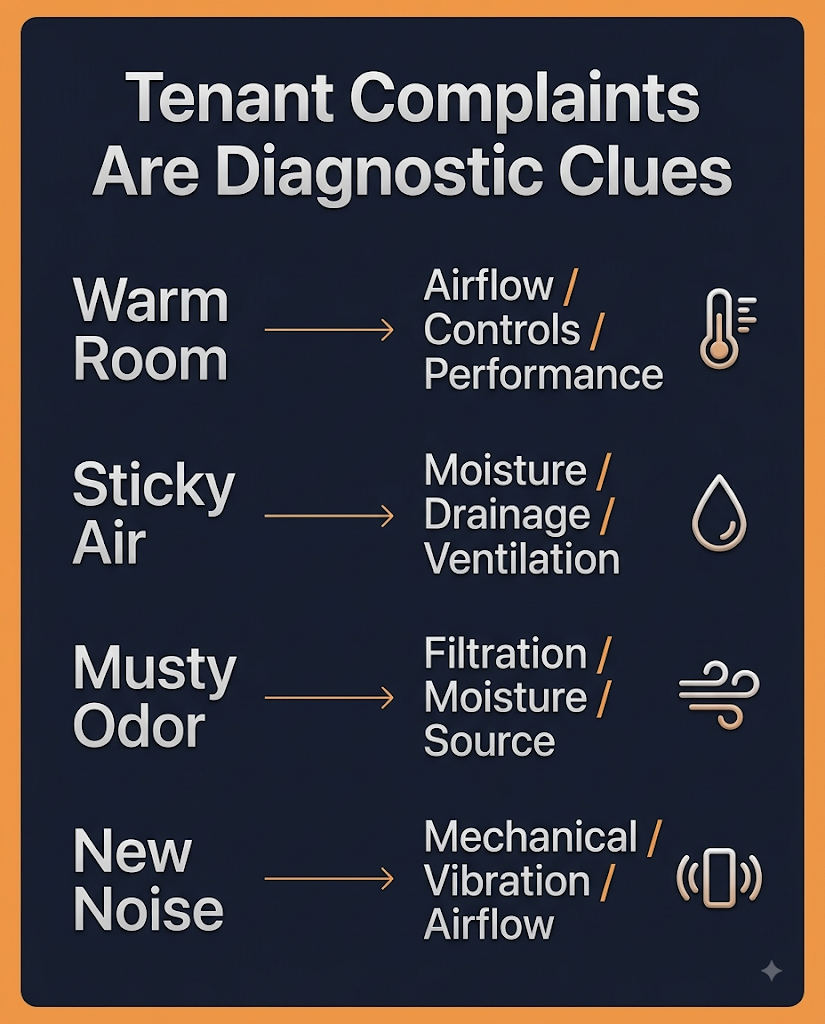
Complaints Are the Signal. Failure Comes Later.
Property teams sometimes separate tenant relations from mechanical maintenance. In practice, the two overlap.
A room that will not cool may point toward airflow, controls, load, or equipment performance. Musty odors can justify checking moisture, drainage, filtration, and ventilation. New noise can point toward vibration or a developing mechanical issue.
The U.S. Department of Energy notes that HVAC system and control faults are estimated to account for an average of 29% of commercial building energy use. That does not mean every tenant complaint represents a major fault, but it shows why a system can still operate while performing poorly.
A smart property team treats complaints as operating data. The question is not simply, “Did the technician get the unit running?” It is, “What changed, why did it change, and has this happened before?”
What Can Tenant Complaints Reveal Before Failure?
The strongest clues are often patterns.
A single warm-room complaint may be situational. The same complaint returning under similar conditions deserves a deeper look.
Temperature complaints can involve airflow, filters, controls, or equipment performance. Humidity may involve drainage, runtime, ventilation, or infiltration. Odors can involve filtration or moisture. Noise may come from moving components, vibration, or duct pressure.
EPA guidance for commercial buildings explains that comfort and indoor-air concerns can be influenced by temperature, humidity, air movement, ventilation-system operation, filtration, moisture, and HVAC maintenance. A diagnosis should therefore look at the full system rather than attaching one favorite fix to every complaint.
For property managers reviewing hvac charleston sc service options, this is an important dividing line: a strong service process should explain the likely cause and the evidence behind it, not simply recommend the most expensive next step.
A Commercial HVAC Maintenance Checklist That Follows the Clues
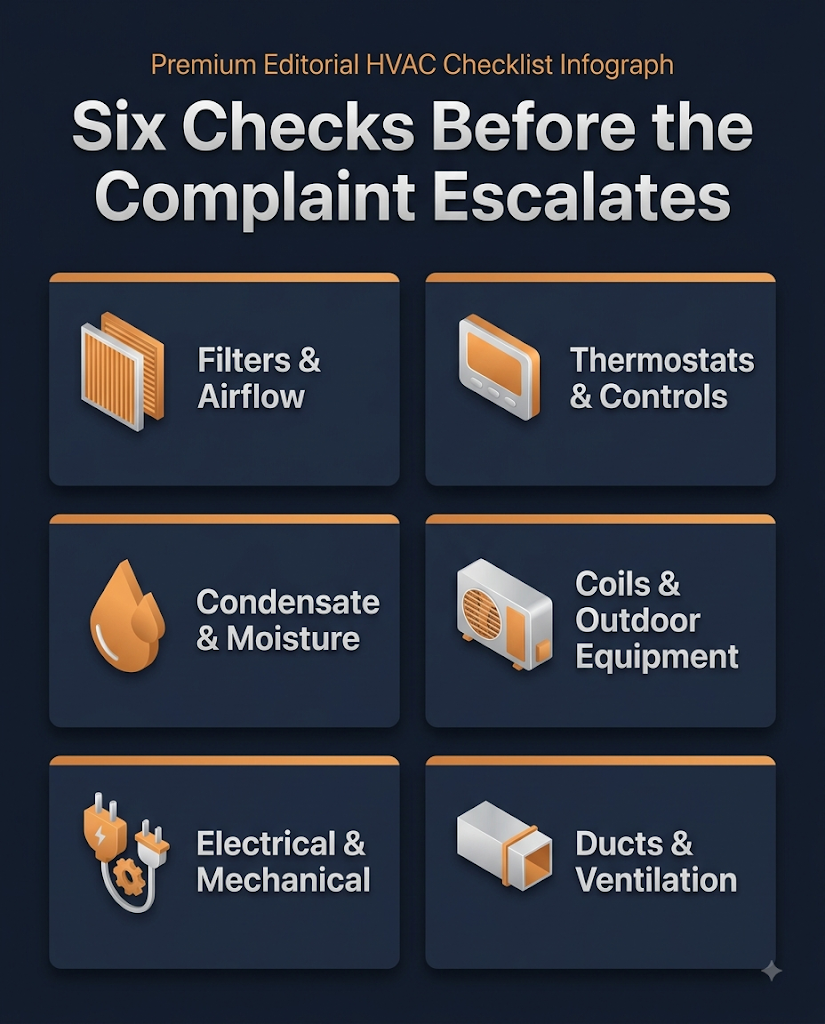
A checklist should be repeatable enough for a portfolio but flexible enough to respond to the actual complaint. At minimum, the maintenance process should connect occupant feedback with these system checks.
Filters and Airflow
Inspect filters for loading, fit, and replacement needs, then compare supply and return airflow in complaint areas with normal areas.
Poor airflow is not automatically a duct-cleaning problem. Before turning the conversation into a commercial air duct cleaning cost question, the service process should confirm whether the restriction is coming from the filter, blower performance, dampers, registers, duct condition, or another cause.
Thermostats and Controls
Check thermostat operation, placement, schedules, sensors, setpoints, and whether control signals match actual equipment behavior.
Condensate and Moisture Control
Check drain pans, condensate lines, pumps where present, and visible moisture. In humid conditions, moisture problems can appear as sticky rooms, odors, or staining before a major failure.
Coils, Outdoor Equipment, and Heat Transfer
Inspect coils and outdoor equipment for dirt, debris, and airflow restrictions that can weaken performance.
Electrical and Mechanical Condition
Document unusual sounds, vibration, repeated resets, intermittent starts, and changing cycles. Qualified service should evaluate electrical and mechanical components according to equipment requirements.
Ducts, Ventilation, and Indoor Air Quality
Duct condition, supply and return distribution, ventilation, humidity, filtration, and room use all matter. Airflow complaints should be diagnosed in context, particularly when only part of a building is affected.
This is where a commercial hvac maintenance checklist becomes useful: it creates a common baseline without pretending every complaint has the same cause. DOE guidance likewise emphasizes planned maintenance, performance monitoring, safety, and regular O&M for commercial HVAC equipment.
Read the Complaint Pattern. Find the Root Cause.
| Tenant reports | What may deserve attention | What to verify | Escalate when |
|---|---|---|---|
| One area stays warm | Airflow, thermostat, zoning, load, performance | Airflow, controls, space changes | Complaint repeats |
| Space feels humid | Runtime, drainage, ventilation, infiltration | Condensate path and moisture conditions | Moisture persists |
| Musty odor | Filtration, moisture, drainage, ventilation | Filter, drain, visible moisture, source | Odor returns |
| Rattling or vibration | Fan, motor, mounting, duct pressure | Location, timing, operating stage | Noise worsens |
| Repeated resets | Controls, electrical issue, safety trip | Error history and operating conditions | Shutdown repeats |
| Several units complain | Shared systems, controls, schedule, ventilation | Building-level pattern | Multiple zones are affected |
The table is not a remote-diagnosis tool. Its purpose is to keep teams from closing a complaint before the underlying pattern has been considered.
One Ticket Is a Repair. A Pattern Is a Management Problem.
The costly mistake is not necessarily missing one unusual complaint. It is resolving the same complaint again and again without changing the diagnosis.
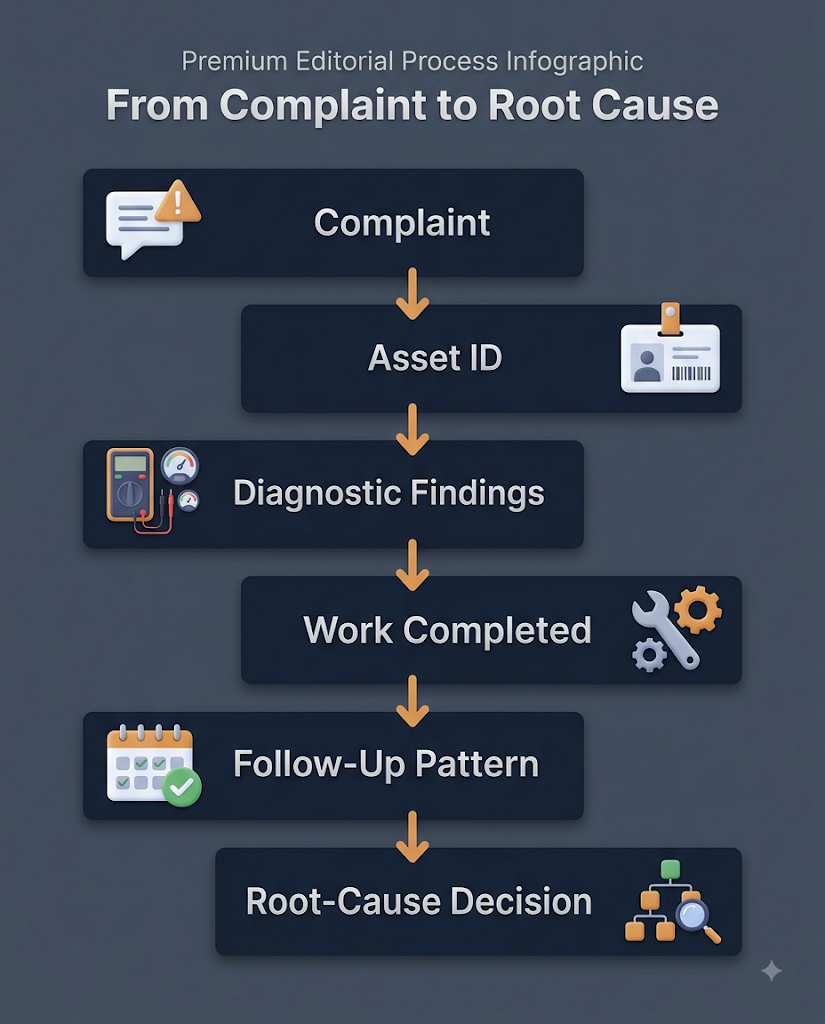
If one rooftop unit receives repeated comfort calls, its history should travel with it: findings, work completed, temporary improvements, and the conditions under which the complaint returned.
Across a portfolio, isolated work orders force each visit to start from zero. Linked history helps distinguish one-off repair from maintenance gaps, control problems, airflow issues, or equipment moving toward replacement territory.
James Clear puts the systems idea neatly:
“You do not rise to the level of your goals. You fall to the level of your systems.”
For maintenance teams, the “system” is the repeatable process that keeps every complaint, diagnosis, repair, and follow-up connected.
Standardize the Service Process Across Every Property
Vendor notes can vary in style, but the information should stay consistent.
A useful closeout should capture:
- Asset and location: which unit, building, zone, or suite was involved.
- Complaint condition: what occupants reported and when it happened.
- Diagnostic findings: what was inspected, measured, or observed.
- Work completed: what was cleaned, adjusted, repaired, or replaced.
- Next recommendation: monitor, maintain, repair further, improve airflow, or evaluate replacement.
This is where a practical hvac maintenance checklist becomes more than a seasonal reminder. It becomes the language that property staff and vendors share.
When evaluating hvac charleston sc providers, property teams should look for clear communication, diagnosis before recommendations, and documentation that makes the next service visit smarter than the last one.
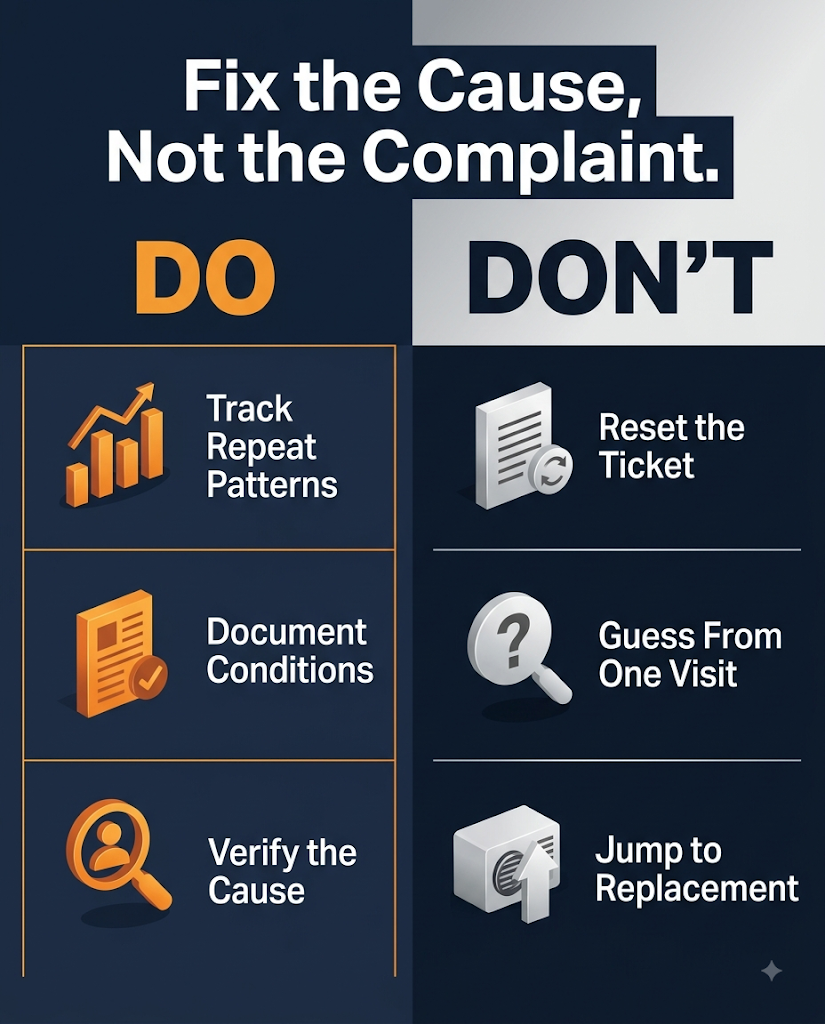
Fix the Cause, Not the Complaint: Do This, Not That
Do this: ask whether the complaint has happened before.
Not that: treat every ticket as a first-time event.
Do this: document the conditions when the problem appears.
Not that: close the work order because the room feels fine when the technician arrives.
Do this: verify airflow, controls, drainage, and equipment condition before choosing a major remedy.
Not that: jump from weak comfort straight to replacement.
Do this: compare the repair history of the same asset over time.
Not that: evaluate each invoice in isolation.
Do this: standardize what vendors report across buildings.
Not that: accept “checked unit, working now” as a complete diagnosis.
Do this: escalate persistent comfort, humidity, electrical, or mechanical issues to qualified HVAC professionals.
Not that: ask property staff to troubleshoot beyond their training.
A diagnosis-first process protects the budget in both directions. It avoids paying repeatedly for symptom-level work, and it also avoids replacing equipment before the evidence supports that decision.
When Is Fixing the System Smarter Than Replacing It?
Not every repeat complaint means a system is finished.
Repair may still make sense when the underlying fault is identifiable, the rest of the equipment is in reasonable condition, the repair addresses the real cause, and performance can be verified afterward. Airflow corrections, thermostat problems, drainage issues, worn components, and maintenance-related performance losses may be repairable without a full system replacement.
Replacement becomes a more serious conversation when failures are recurring, major components are deteriorating, comfort remains unstable despite appropriate repairs, parts or refrigerant considerations complicate continued service, or repair spending is no longer producing dependable performance.
The key is evidence. A diagnosis-first provider should explain why repair, maintenance, replacement, airflow improvement, or indoor air quality work is being recommended rather than defaulting to replacement. Repair-versus-replacement guidance, preventive maintenance, diagnostics, thermostat work, airflow improvements, indoor-air solutions, and commercial troubleshooting all align with the service scope supplied for this website.
Airflow, Humidity, and Ducts Deserve Their Own Questions
A cooling complaint is not always a cooling-equipment complaint.
A room may feel hot because air movement is weak, or feel poorly cooled because humidity is high. Room use, registers, duct condition, ventilation, filters, and thermostat placement can all affect comfort.
EPA guidance for office and commercial buildings specifically notes that comfort can be affected by temperature, humidity, air movement, ventilation, filtration, moisture, and how spaces are used. It also emphasizes diligent HVAC maintenance as part of good indoor-air management.
That is why duct cleaning should never be used as a catch-all answer. If a manager is comparing commercial air duct cleaning cost, the better first question is whether inspection has actually identified contamination, airflow restriction, moisture, or another duct-related condition that the service would address.
For Charleston properties, humidity and airflow deserve special attention because comfort can deteriorate before a thermostat reading looks dramatic.
One Complaint. Multiple Clues. A Smarter Portfolio Response.
Consider a manager overseeing several light-commercial buildings. One zone draws occasional afternoon comfort complaints. A filter change appears to solve it.
Later, the complaint returns and a thermostat adjustment again seems to solve it.
The shift happens when the manager reviews both visits together and gives the next technician the complaint pattern, prior work, operating conditions, and unit history.
Now the service call starts with a better question: What keeps creating the same symptom?
The answer may be airflow, controls, equipment condition, space load, or something else. The value is the process: reaction has become evidence-based troubleshooting.
That discipline scales because a repeatable process makes diagnosis clearer, recommendations easier to evaluate, and service history useful.

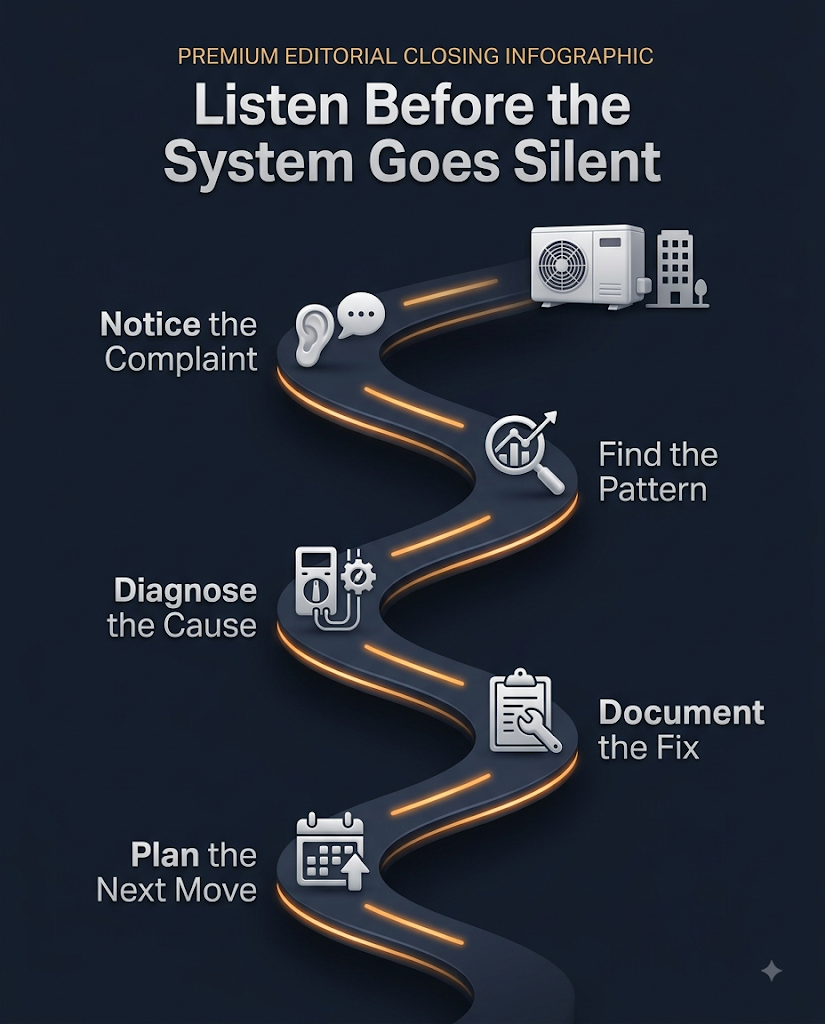
Final Thoughts: Listen Before the System Goes Silent
Tenant complaints do not have to be treated as noise around the edges of property management. When comfort, airflow, humidity, odor, or noise complaints keep pointing back to the same equipment or zone, they can become an early-warning layer for maintenance.
A strong commercial hvac maintenance checklist gives property managers a way to turn those warnings into action. It connects the tenant experience with filters, airflow, controls, drainage, coils, electrical condition, ventilation, system history, and qualified diagnostics. Just as important, it creates a repeatable vendor process across the portfolio.
The goal is not to replace equipment at the first complaint or keep repairing it forever. The goal is to understand what is actually happening and make the next decision with better evidence. That diagnosis-first philosophy is central to the HVAC repair, maintenance, airflow, indoor air quality, and commercial troubleshooting approach described for Charleston’s hot, humid climate.
For property managers and business owners who want a clearer answer before approving the next repair or replacement, Charleston Air Pros offers diagnosis-first HVAC support for local residential and commercial properties. Email info@charlestonairpros.com or visit charlestonairpros.com to discuss the property, the complaint pattern, and the practical next step.
Frequently Asked Questions
What makes a good commercial HVAC maintenance checklist?
A good checklist connects tenant complaints with filters, airflow, thermostats, controls, drainage, coils, electrical and mechanical condition, ventilation, and documented service history.
What are the best practices for handling repeat HVAC complaints?
Track the affected asset, complaint conditions, previous repairs, diagnostic findings, and whether the same symptom returns. Repeat issues should trigger root-cause review rather than another identical ticket.
How can property managers tell whether an HVAC issue is airflow-related?
Look for complaints limited to specific rooms or zones, blocked supply or return paths, uneven air movement, thermostat-location issues, and differences between affected and unaffected areas. Qualified testing can confirm the cause.
When should a property manager hire professional HVAC service?
Professional diagnosis is appropriate when complaints persist, electrical or mechanical faults are suspected, moisture problems recur, equipment repeatedly shuts down, or routine maintenance does not restore stable comfort.
Is duct cleaning always the answer to odor or airflow complaints?
No. Odors and airflow problems can come from several sources. The duct system should be inspected and the cause identified before cleaning or other corrective work is recommended.
What HVAC maintenance trends should property managers watch?
The biggest shift is toward more preventive, data-informed maintenance: tracking repeat complaints, keeping better service histories, and using performance patterns to guide repair decisions before equipment fails.
What HVAC services are most useful for commercial properties?
Useful services can include preventive maintenance, diagnostics, airflow testing, thermostat and controls work, duct inspection, indoor air quality support, repair, and replacement planning when system condition justifies it.
How can property managers reduce repeat HVAC complaints?
Standardize the service process. Record the complaint, asset, conditions, diagnosis, repair, and follow-up result so recurring patterns become easier to spot across one property or an entire portfolio.
What factors affect commercial air duct cleaning cost?
Cost can vary based on building size, duct layout, accessibility, system condition, contamination level, and the scope of work. The system should be inspected first so cleaning is recommended for a clear reason rather than as a default response.