
How Often Should HVAC Be Serviced in Charleston? A Practical Coastal Guide
August 14, 2026

A new homeowner in Charleston can learn a lot during the first full summer in the Lowcountry. The air conditioner may seem to run longer than expected. Humidity can make an otherwise comfortable room feel sticky. Then fall arrives, the heating system comes back into use, and another question appears: when was any of this equipment last professionally checked?
That is usually when how often should HVAC be serviced stops feeling like a routine maintenance question and starts feeling like a decision about comfort, reliability, and protecting a major home system.
For most Charleston properties, a practical schedule is two professional maintenance visits each year: one before the main cooling season and another before the heating season. Spring service prepares the cooling side for Charleston’s long, humid warm season, while fall service gives the heating equipment its own inspection before cooler weather arrives.
The important part, however, is not simply putting two appointments on a calendar. Coastal conditions, system type, runtime, airflow, humidity, equipment condition, and manufacturer requirements can all influence what a property actually needs.
Key Takeaways
- A spring-and-fall service rhythm is a practical baseline for Charleston HVAC systems.
- Coastal humidity, extended cooling demand, debris, and salt exposure can justify closer observation between professional visits.
- Filter checks and basic homeowner care should continue between tune-ups.
- Maintenance should identify developing problems, not automatically become a reason to recommend replacement.
Why Charleston Changes the Maintenance Conversation
General HVAC advice often sounds simple: service the equipment periodically and change the filter.
That is useful, but it does not fully answer the question for a coastal property.
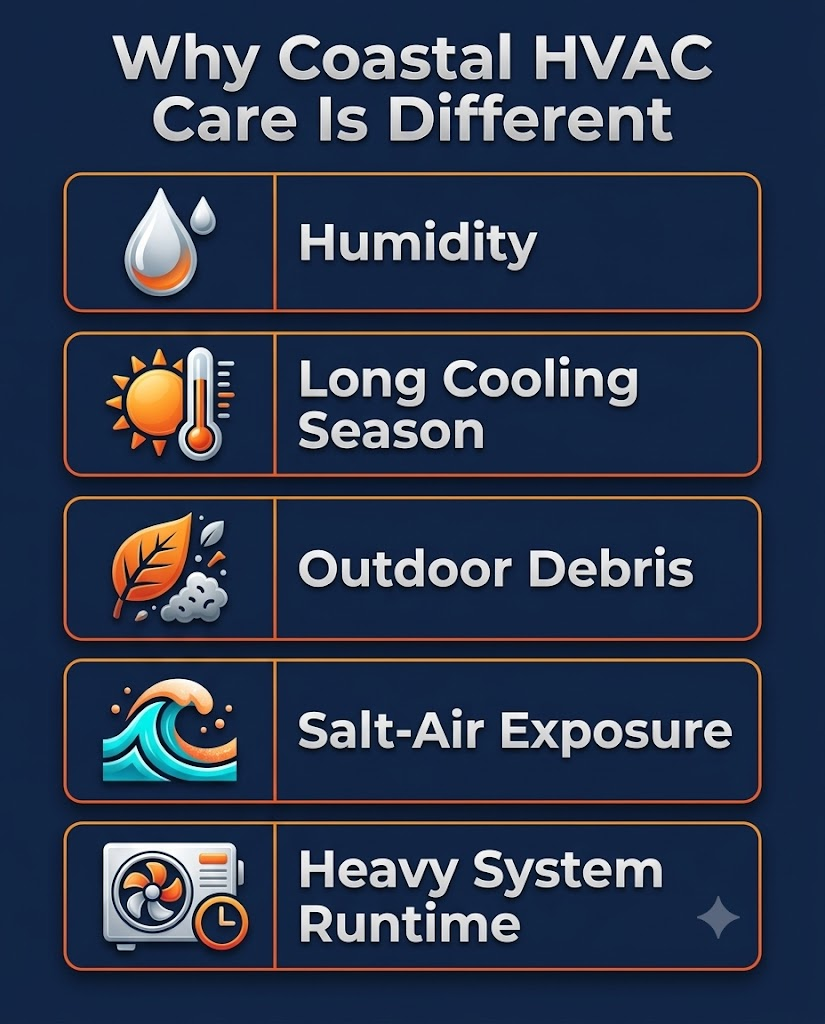
Charleston’s HVAC systems are expected to manage more than indoor temperature. During humid weather, the cooling system also removes moisture from indoor air. Outdoor equipment is exposed to heat, rain, vegetation, airborne debris, and, depending on location and conditions, coastal salt exposure.
A system can therefore appear to be “working” while gradually becoming less comfortable or less dependable.
A homeowner might notice that the thermostat reaches its setting but the rooms still feel humid. Another property might have one bedroom that never seems to cool as well as the rest. An outdoor unit may collect vegetation or surface deterioration long before the equipment stops operating.
Those situations are why a useful hvac maintenance checklist should go beyond asking whether cold air is coming through a vent.
Maintenance is ultimately about condition and performance.
How Often Should HVAC Be Serviced in Charleston?
A sensible starting point is twice yearly.
One professional visit should focus on preparing the cooling system before the period of heaviest air-conditioning demand. A second visit should prepare and evaluate the heating side before regular winter use.
A simple schedule looks like this:
- Spring: Inspect and prepare cooling equipment before sustained summer demand.
- During the cooling season: Watch airflow, drainage, filtration, humidity, unusual noises, and outdoor-unit condition.
- Fall: Inspect heating operation, controls, airflow, electrical components, and applicable safety components.
- Between visits: Keep the equipment area clear and follow the filter and maintenance instructions appropriate to the specific system.
This schedule matches the source material’s recurring recommendation of spring and fall maintenance for Charleston properties.
It also leaves room for professional judgment. A heavily used heat pump, older equipment, a commercial property with long operating hours, or a system already showing performance problems may deserve closer attention.
That is why maintenance frequency should be treated as a baseline rather than a substitute for diagnosis.
Is Once-a-Year HVAC Maintenance Enough?
Sometimes a property owner may be told that one annual appointment is enough.
Whether that is appropriate depends on the equipment and the manufacturer’s requirements, but Charleston’s long cooling season makes a two-season approach particularly practical. It creates an opportunity to inspect the cooling system before heavy summer use and the heating system before its seasonal workload.
A single appointment should not be stretched into a false promise that nothing can go wrong for another twelve months.
The condition of the equipment still matters.
Anyone comparing service options may also want to review hvac tune up cost alongside what the visit actually includes. A lower price means little if the appointment consists of little more than a quick visual check.
What Should a Professional HVAC Service Actually Check?
A useful maintenance visit should answer a basic question:
Is the system operating the way it is supposed to, and is anything developing that deserves attention?
The source material describes service as involving inspection, cleaning, testing, thermostat checks, electrical connections, filters, coils, condensate drainage, refrigerant-related checks where applicable, airflow, and heating-system components.
Not every system will require the same procedure, but the service should generally examine four areas.
1. Airflow
Restricted airflow can affect comfort throughout the home.
The technician may inspect the filter, blower operation, visible duct or return-air issues, registers, and other components related to air movement. Uneven rooms should not automatically be dismissed as “just how the house is.”
2. Heat Transfer and Cooling Performance
Coils and related cooling components need appropriate inspection because the system depends on efficient heat transfer.
A professional can look for conditions that may interfere with normal cooling operation rather than simply checking whether the supply air feels cold.
3. Electrical and Mechanical Condition
Connections, controls, motors, and other operating components can develop wear.
Maintenance provides an opportunity to identify concerning conditions before the homeowner encounters a complete loss of heating or cooling.
4. Drainage and Moisture Management
Charleston’s humidity makes condensate management particularly relevant.
The system removes moisture as it cools the home. Drainage problems, airflow problems, equipment issues, or other conditions can interfere with how comfortably the property handles humid weather.
A well-built hvac charleston sc maintenance approach therefore considers more than the thermostat number. Temperature, humidity, airflow, equipment condition, and property characteristics all matter.
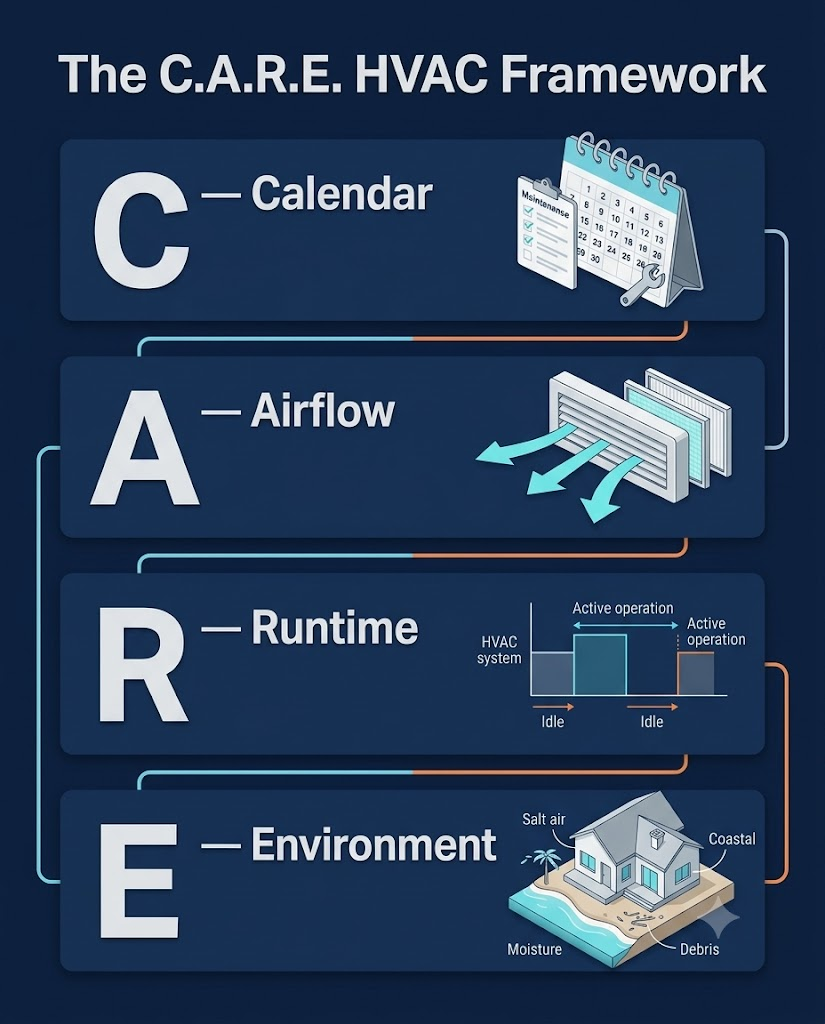
The C.A.R.E. Framework for Smarter HVAC Maintenance
Homeowners do not need to become technicians to make better maintenance decisions.
They simply need a consistent way to think about the system.
C — Calendar
Schedule professional service before the periods when heating and cooling equipment will be relied upon most.
A — Airflow
Pay attention to weak vents, changing airflow, unusually warm rooms, or filters that become dirty faster than expected.
R — Runtime
Notice meaningful changes in how the equipment behaves. Longer cycles, repeated starts and stops, unusual sounds, or difficulty maintaining comfort are worth investigating.
E — Environment
Consider Charleston-specific conditions around the equipment, including humidity, vegetation, debris, drainage, and coastal exposure.
Benjamin Franklin’s familiar line fits preventive maintenance surprisingly well:
“An ounce of prevention is worth a pound of cure.”
The wording is documented in Benjamin Franklin’s 1735 writing on fire prevention.
HVAC maintenance is not a guarantee against failure, but the principle remains useful: finding a developing issue during a planned visit is usually preferable to discovering it when the property urgently needs cooling or heat.
Why Efficiency Is Part of the Maintenance Conversation
Comfort is usually what gets a homeowner’s attention first, but HVAC performance also matters because heating and cooling represent a major energy demand.
The U.S. Department of Energy reports that heating and cooling buildings account for around 35% of total energy consumption, making them the largest building energy end use it identifies.
Department of Energy HVAC source
That does not mean every maintenance appointment will dramatically change an energy bill.
It means a system responsible for a significant share of building energy use deserves attention when airflow, controls, coils, equipment condition, or operating behavior appear abnormal.
This is also why an hvac maintenance checklist is most useful when it tracks observable changes instead of becoming a box-checking exercise.
A Practical Between-Visit Checklist
Professional maintenance does not replace basic property care.
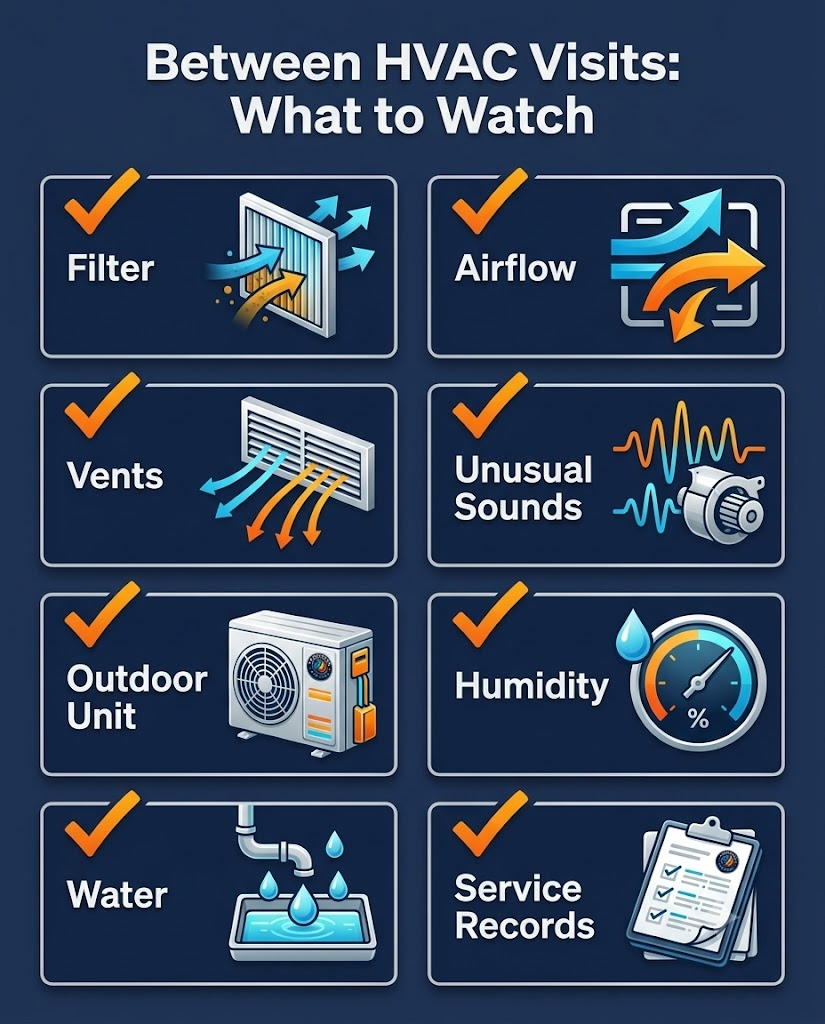
Between scheduled appointments, a homeowner or property manager can keep an eye on several simple things without opening equipment or attempting technical repairs.
- Check the filter according to the filter and equipment manufacturer’s guidance.
- Keep supply and return-air openings unobstructed.
- Keep vegetation and loose debris away from outdoor equipment.
- Look for unexpected water around indoor HVAC components.
- Notice changes in airflow from room to room.
- Listen for new rattling, buzzing, grinding, or repeated cycling.
- Pay attention when humidity feels noticeably different indoors.
- Keep service records and invoices in one place.
- Review the equipment manufacturer’s maintenance and warranty terms.
What Most Homeowners Get Wrong About HVAC Maintenance
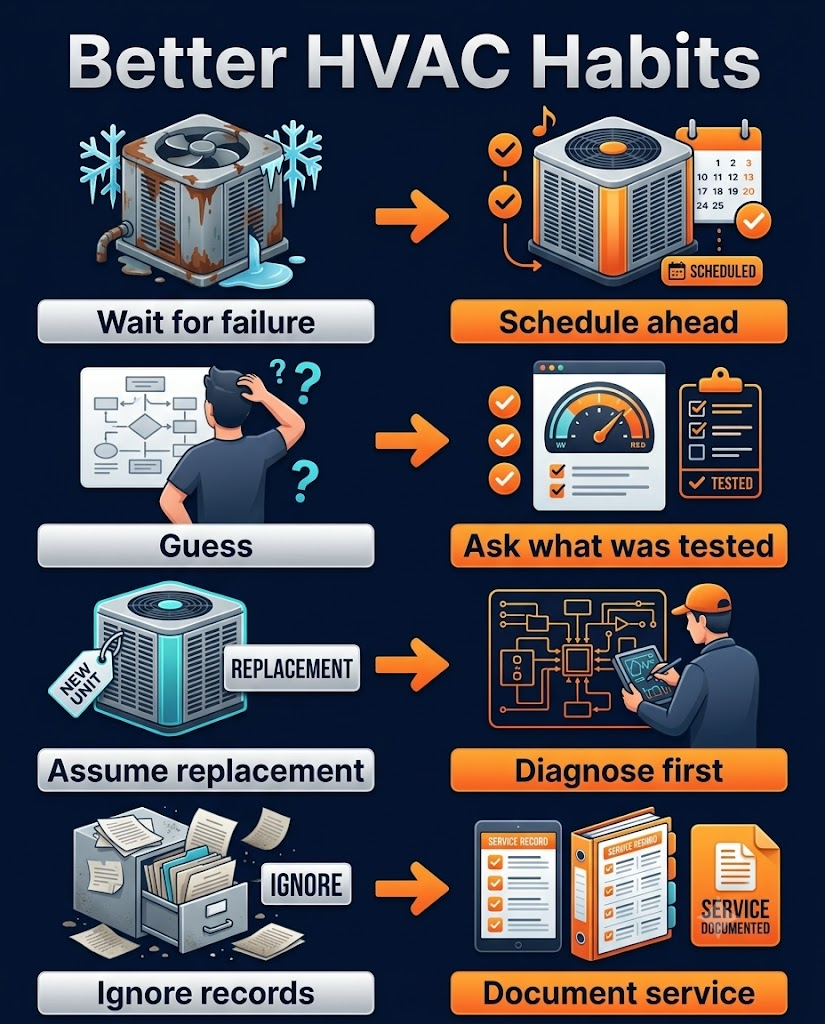
One common mistake is waiting for failure before arranging service.
Another is assuming every maintenance recommendation means equipment must be replaced.
Neither approach is particularly useful.
Good maintenance should produce information. A technician should be able to explain what was inspected, what appears normal, what needs attention now, and what can reasonably be monitored.
Do This, Not That
| Do This | Avoid This |
| Schedule service before peak heating and cooling demand | Wait until the system stops working |
| Ask what was inspected and tested | Accept vague statements without explanation |
| Track changes in comfort and airflow | Judge the entire system only by thermostat temperature |
| Review manufacturer maintenance requirements | Assume every HVAC warranty has identical terms |
| Ask whether repair is reasonable | Assume replacement is automatically necessary |
| Keep maintenance records | Depend on memory when documenting previous service |
This distinction becomes particularly important when homeowners compare hvac tune up cost. The better question is not simply, “What is the cheapest tune-up?” It is, “What inspection and testing are actually included?”
Does HVAC Maintenance Protect a Warranty?
This is an area where homeowners should be careful with sweeping online claims.
Maintenance requirements are not identical across every manufacturer, model, installation, or warranty.
Some equipment warranties may include maintenance or documentation requirements. The safest approach is to read the warranty terms for the specific equipment and preserve invoices and service records.
If the system is relatively new, the owner should ask the technician to document the visit clearly.
That is more reliable than assuming a generic rule found online applies to every product.
For first-time homeowners, this is also a good reason to identify the installed equipment early rather than waiting for a repair. A service history, model information, warranty documentation, and a sensible hvac charleston sc maintenance schedule can remove considerable uncertainty later.
When Should a Homeowner Schedule Service Earlier?
Calendar maintenance should never become a reason to ignore a developing problem.
An earlier diagnostic visit can make sense when:
- the system stops maintaining a normal indoor temperature;
- airflow becomes noticeably weaker or uneven;
- the equipment starts making unfamiliar sounds;
- the system repeatedly starts and stops;
- water appears where it normally should not;
- the indoor space suddenly feels much more humid;
- unusual odors appear while the equipment operates;
- electrical breakers repeatedly trip;
- one part of the property becomes consistently uncomfortable.
Those signs do not diagnose the problem by themselves.
They simply indicate that the system deserves professional assessment rather than waiting for the next seasonal tune-up.
Maintenance, Repair, or Replacement: Which Comes Next?
One of the most valuable things an HVAC professional can provide is not a piece of equipment. It is a clear diagnosis.
Consider a familiar Charleston scenario.
A homeowner notices that the upstairs rooms feel warmer during humid afternoons. Because the equipment is older, the homeowner starts assuming replacement is inevitable.
A diagnosis-first approach would not begin with the equipment catalog.
It would begin with questions.
Is airflow reaching the upstairs rooms properly? Is the filter restricting air movement? Is the thermostat reading representative of the occupied space? Are the coils and equipment operating correctly? Is there a duct or balancing issue? Is the system actually failing to meet its expected performance?
Only after those questions are investigated does the repair-versus-replacement conversation become useful.
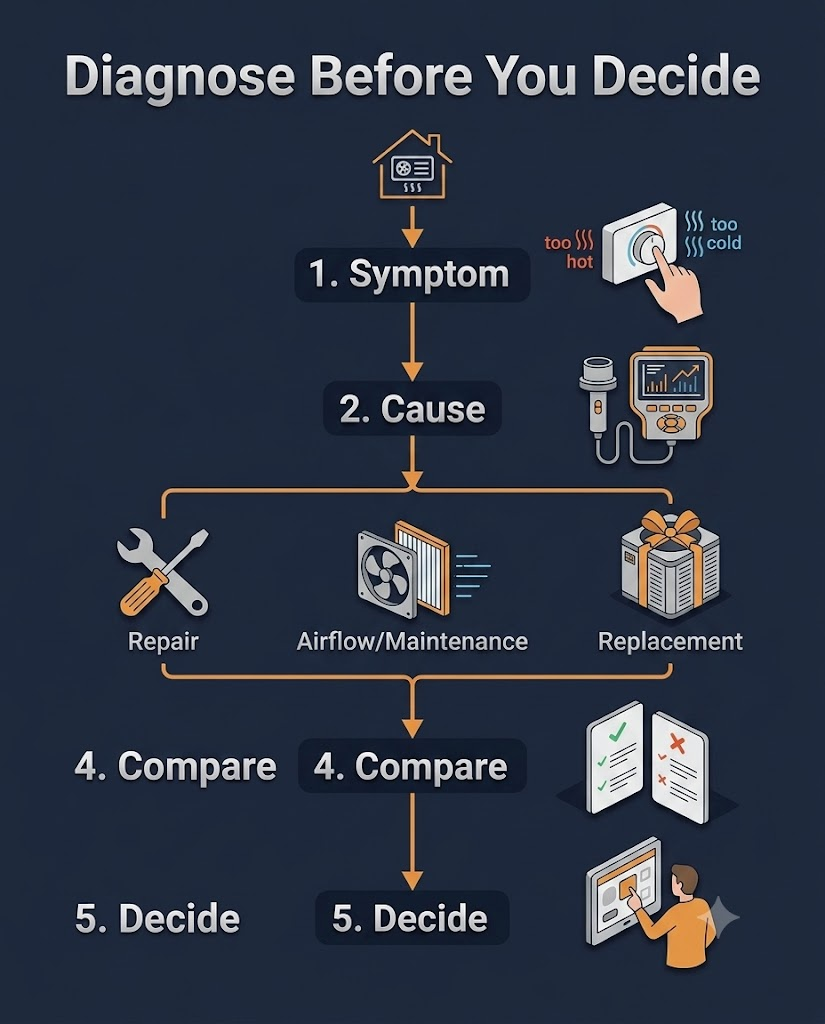
A practical decision sequence is:
- Confirm the symptom.
- Identify the cause.
- Separate necessary work from optional improvements.
- Compare repair, maintenance, airflow, control, and replacement options.
- Choose based on equipment condition, comfort needs, property goals, and budget.
What About Commercial HVAC Maintenance?
Commercial properties deserve a slightly different conversation because operating schedules, occupancy, equipment configuration, comfort expectations, and downtime risks can vary significantly.
A small professional office may not need the same maintenance structure as a restaurant, retail environment, or building with several HVAC systems.
The right frequency should therefore reflect equipment type and actual operating conditions.
Property managers and business owners should ask for a maintenance plan that explains what will be inspected, how often, what records will be provided, and when a performance problem should trigger a separate diagnostic visit.
That approach turns maintenance into an operating process rather than a recurring invoice.
So, How Often Should HVAC Be Serviced?
For a Charleston homeowner looking for a clear answer, spring and fall professional service is a strong practical baseline.
The spring visit prepares the cooling equipment before Charleston’s demanding warm season. The fall visit gives the heating system its own inspection before regular use.
Between those appointments, homeowners should observe filters, airflow, drainage, outdoor-unit condition, humidity, unusual noises, and changes in system behavior.
Most importantly, maintenance should not be confused with automatic repair or replacement.
Its real value lies in giving property owners better information about what the equipment is doing and what, if anything, should happen next.
For homeowners who want a local, diagnosis-first approach, Charleston Air Pros supports HVAC and AC repair, installation and replacement, preventive maintenance, diagnostics, thermostat upgrades, airflow and ventilation improvements, indoor humidity and air quality solutions, heating support, and commercial HVAC troubleshooting. The service scope in the supplied brief emphasizes practical recommendations and identifying the underlying cause before recommending work.
Need help evaluating an HVAC system or planning seasonal maintenance?
Website: charlestonairpros.com
Email: info@charlestonairpros.com
The supplied material does not include a verified phone number, so a placeholder is retained rather than publishing an unconfirmed number.

Frequently Asked Questions
1. What makes a good HVAC maintenance visit?
A good visit includes meaningful inspection, testing, cleaning where appropriate, and a clear explanation of the system’s condition rather than a rushed visual check.
2. What are the best practices for HVAC maintenance in Charleston?
Schedule seasonal professional service, monitor filters and airflow, keep outdoor equipment clear, watch humidity and drainage, and keep maintenance documentation.
3. How to know whether an HVAC system needs service before its scheduled tune-up?
Changes in temperature control, airflow, noise, moisture, cycling, odors, or system behavior are reasonable reasons to request an earlier diagnostic visit.
4. When should a homeowner hire an HVAC professional instead of troubleshooting alone?
Professional help is appropriate when the issue involves electrical components, refrigerant, heating safety, persistent drainage problems, equipment failure, or a symptom that basic filter and thermostat checks do not resolve.
5. What services can a diagnosis-first HVAC provider offer?
Depending on the problem, support may include maintenance, repair, diagnostics, airflow improvement, thermostat work, installation, replacement, heating service, humidity solutions, or commercial troubleshooting.
6. Are custom HVAC maintenance schedules useful?
They can be. Equipment type, operating hours, property conditions, system age, manufacturer guidance, and coastal exposure can all influence the right maintenance approach.
7. What should homeowners expect from a professional HVAC company?
Clear findings, understandable recommendations, documented work, and an explanation of why a repair, adjustment, maintenance task, or replacement is being recommended.
8. What is the best time of year for HVAC maintenance in Charleston?
Spring is a practical time to prepare cooling equipment, while fall provides a natural opportunity to inspect the heating system before regular use.
9. How does HVAC maintenance cost compare with choosing the cheapest service?
Price alone does not show value. Homeowners should compare what is inspected, tested, cleaned, documented, and explained during the appointment.
10. What should a homeowner ask a local HVAC provider before approving work?
Ask what caused the problem, what work is necessary now, what can be monitored, what alternatives exist, and why the recommended solution fits the system’s condition.