
It Starts. It Stops. It Starts Again. The System Is Wearing Out.
August 30, 2026
A Charleston homeowner hears the outdoor unit start while making dinner. Cold air begins moving through the house, so nothing seems unusual.
Then the system stops.
The rooms are not quite comfortable yet, but a few minutes later the equipment starts again. Then it stops again. By bedtime, the homeowner is no longer listening for the AC to come on. They are waiting to hear how quickly it shuts back off.
That repeated pattern is hvac short cycling. The equipment begins a heating or cooling cycle, quits before the cycle seems complete, and then starts again sooner than expected. It is easy to dismiss because the system technically still works. It starts. Air moves. Sometimes it even cools for a while.
But the rhythm has changed.
That change can be the real warning. Short cycling may point toward restricted airflow, thermostat or control trouble, refrigerant or electrical problems, protective shutdowns, or equipment that does not match the home properly. The cause matters because repeatedly replacing the “usual suspect” is not the same as diagnosing why the cycle keeps ending.
The right question is not simply, “Why does my HVAC keep turning on?”
It is:
“What is forcing this cycle to end before the house is ready?”
Key Takeaways
- Short cycling describes a pattern, not a specific failed part.
- The reason the system stops matters more than the restart itself.
- Repeated starts can affect comfort, humidity control, efficiency, and equipment stress.
- A lasting repair begins by tracing what happens before every shutdown.
What Does HVAC Short Cycling Actually Mean?
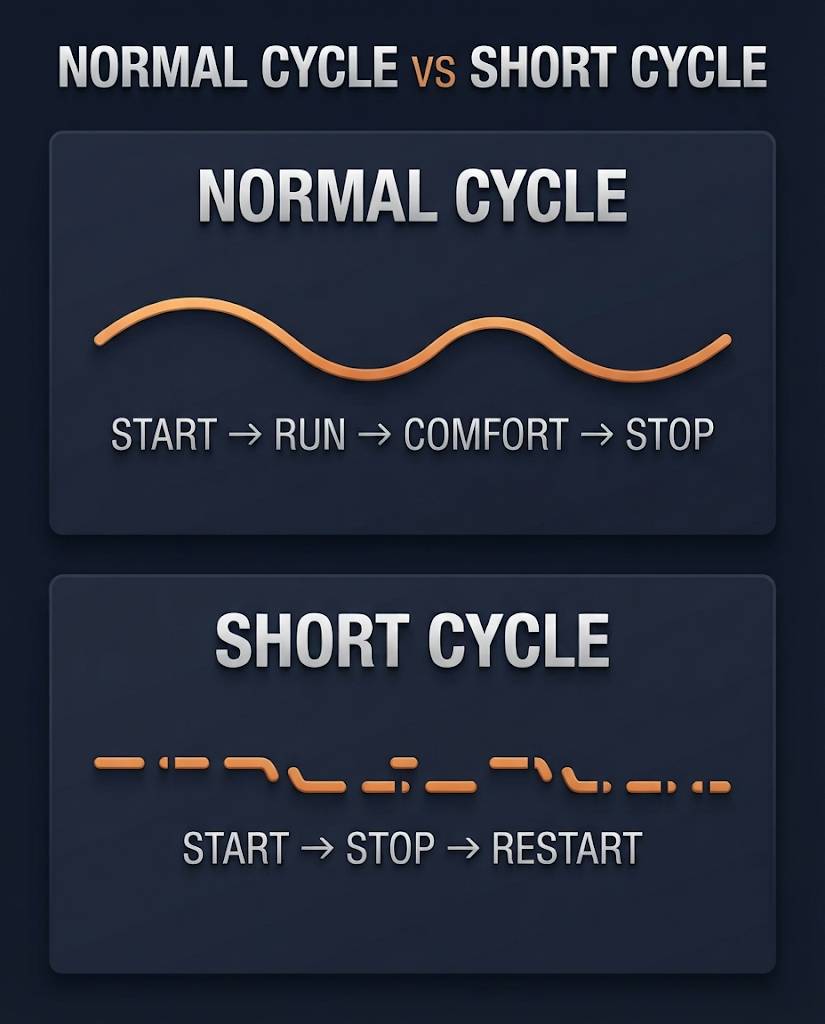
A normal HVAC system is supposed to turn on and off. Reaching the thermostat setting and shutting down is not a malfunction.
The concern begins when the operating pattern becomes unusually brief or repetitive. The system starts, runs only long enough to make limited progress, shuts down, and soon receives another call to run.
That distinction matters.
A homeowner who simply counts every startup may worry about normal operation. A homeowner who notices the system repeatedly quitting while the house remains uncomfortable has found a much more useful clue.
Short cycling can also look different depending on the equipment. During cooling, a homeowner might hear the condenser repeatedly starting outside. With a combined heating and cooling system, the indoor blower may appear to start and stop unusually. Sometimes the change is first noticed through temperature swings rather than sound.
The key is behavior compared with the system’s normal behavior.
If the home used to settle comfortably and the equipment now seems unable to finish a cycle, the question becomes why the cycle is being interrupted.
Why Should Repeated Starting and Stopping Matter?
The most obvious problem is comfort. A system that continually interrupts itself may struggle to create stable indoor conditions.
One room may feel acceptable while another never catches up. The house may cool briefly, warm again, and repeat the process. During cooling season, short operating periods can also work against moisture removal, particularly when an oversized system satisfies temperature demand too quickly. ENERGY STAR guidance notes that oversized air conditioners can short-cycle and provide poorer humidity control.
That connection becomes important when a homeowner notices high humidity in house at the same time the equipment begins cycling differently. The thermostat may show an acceptable temperature while the rooms still feel sticky.
There is also the repeated startup itself. Starting major HVAC components over and over creates a different operating pattern from a stable cycle.
And energy use deserves attention. According to ENERGY STAR, nearly half of the energy used in a typical home goes to heating and cooling. When the home’s largest comfort systems begin behaving abnormally, unexplained changes in utility costs become worth investigating rather than normalizing.
Short cycling therefore deserves attention even before the system stops working completely.
Why Does the System Keep Ending the Cycle?
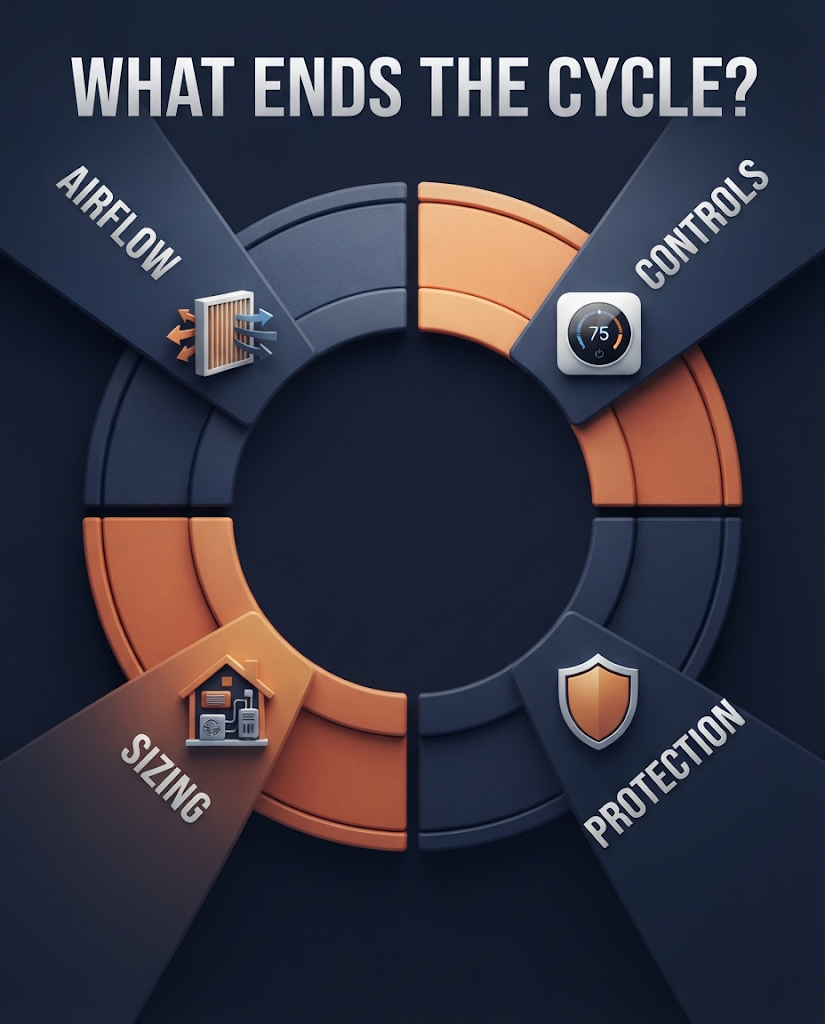
Several faults can create the same start-stop pattern.
Restricted Airflow Can Trigger Trouble
Heating and cooling equipment depends on air moving properly through the system.
A clogged filter is one of the easiest restrictions to check. DOE consumer guidance explains that a clogged filter restricts airflow and reduces an air conditioner’s ability to cool effectively.
But the filter is not the entire airflow system.
Blocked returns, dirty coils, blower problems, crushed or poorly designed ducts, or other restrictions can change how equipment operates. That is why replacing a dirty filter is useful, but automatically declaring the problem solved can be premature if the unusual cycling continues.
An hvac maintenance checklist becomes especially valuable here because it helps homeowners compare current conditions with normal ones instead of waiting for a breakdown.
The Thermostat May Be Ending the Call Too Soon
A thermostat reacts to the conditions around it, not magically to every room in the house.
If its location exposes it to unusual heat, direct sunlight, a supply register, or another unrepresentative condition, the signal it sends may not reflect how the rest of the property feels.
Controls can also malfunction or become incorrectly configured.
A useful clue is the relationship between the thermostat and the rooms. If the equipment stops while major living areas remain uncomfortable, that mismatch belongs in the diagnostic conversation.
The Equipment May Be Protecting Itself
Some shutdowns happen because the system encounters an operating problem.
In cooling mode, freezing, refrigerant-related trouble, electrical faults, or other abnormal conditions can interrupt operation. Heating equipment has its own safety controls and limits.
Visible ice, repeated electrical trips, burning odors, unusual startup noises, or water appearing where it normally does not belong should not be treated as invitations to repeatedly reset the system.
They are reasons to stop guessing.
The System May Be Oversized
This is where the common search what size ac do i need becomes relevant.
Oversized cooling equipment can change the room temperature quickly and shut off before running long enough to manage the home evenly. ENERGY STAR and EPA guidance both identify short cycling and reduced moisture control as consequences of substantially oversized air-conditioning equipment.
But there is an important distinction:
A system that has short-cycled since installation creates a different sizing question from a system that suddenly begins doing it after years of normal operation.
The second situation deserves fault diagnosis before anyone blames equipment size.
Five Moments Reveal Why the Cycle Keeps Breaking
Rather than beginning with a list of replacement parts, it helps to watch one complete start-stop-start sequence.
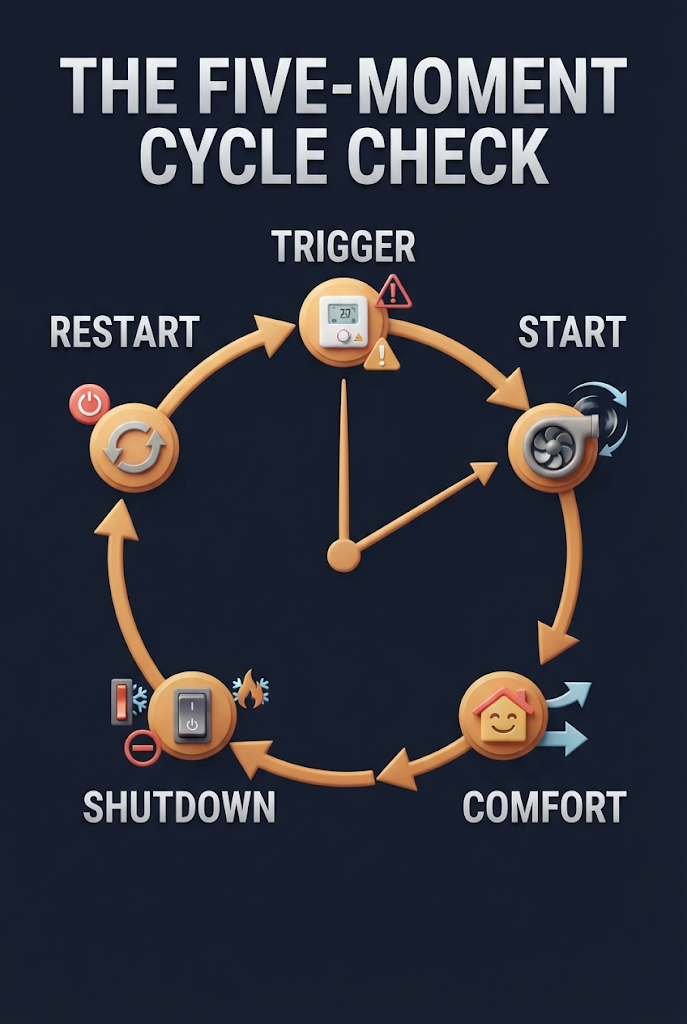
Think of it as the Five-Moment Cycle Check.
1. What Triggered the Start?
Was the thermostat clearly asking for heating or cooling? Did the call make sense based on the room temperature?
2. What Happened at Startup?
Did the indoor blower begin normally? During cooling, did the outdoor equipment start as expected? Was there an unusual hum, click, delay, or vibration?
3. Did Comfort Actually Begin to Change?
Was the air appropriately heated or cooled? Did airflow remain strong? Did the rooms begin moving toward the thermostat setting?
4. What Happened Right Before Shutdown?
This is often the most valuable moment.
Did airflow weaken? Did ice become visible? Was there an electrical trip? Did everything simply stop even though the house remained uncomfortable?
5. How Quickly Did It Return?
A restart becomes more meaningful when connected to what happened immediately before it.
That sequence turns hvac short cycling from an irritating sound into a timeline a technician can investigate.
As Plato is quoted as saying, “The beginning is the most important part of the work.” In this situation, the beginning is careful observation before assumptions take over.
What Should You Check Before Calling an HVAC Technician?
The safest first steps are observational.
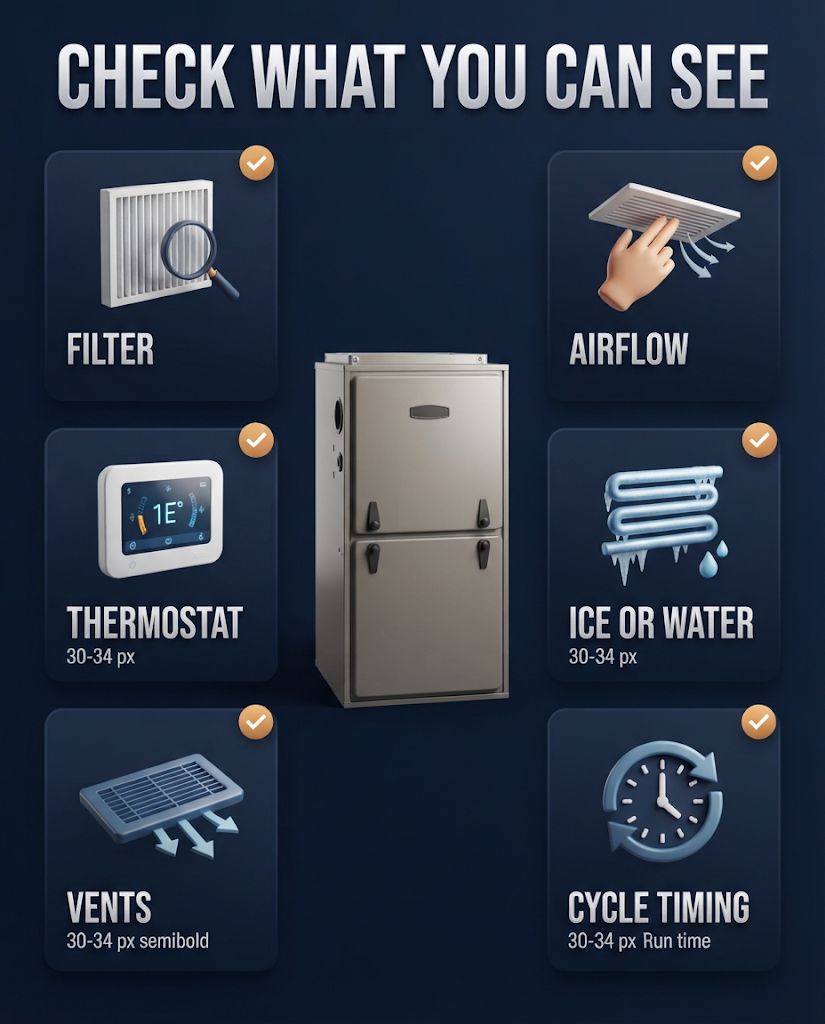
Start with the filter. If it is visibly loaded with debris, replace it with the correct type for the system.
Make sure accessible supply registers and returns have not been blocked by furniture, rugs, storage, or closed coverings.
Check thermostat mode and settings. If the cycling began after a schedule change, thermostat replacement, or power interruption, make note of that.
Then listen.
Does the indoor blower stop at the same moment as the outdoor equipment? Does the outdoor unit shut down while the fan indoors continues? Does airflow gradually weaken before the cycle ends?
Look only at what is safely visible. Ice, unusual water, or abnormal equipment behavior should be reported.
This is where a simple hvac maintenance checklist is useful. It creates a baseline for filters, vents, thermostat behavior, airflow, drainage, outdoor-unit condition, and unusual sounds.
What it should not become is a DIY electrical or refrigerant inspection. Capacitors, contactors, energized wiring, compressors, refrigerant pressures, and internal safety controls belong in professional diagnostics.
What Is Your HVAC’s Start-Stop Pattern Telling You?
A homeowner does not need to diagnose the component to organize the evidence.
| What Happens | What It May Point Toward | What to Notice Next |
| Cycle ends with weak airflow | Airflow restriction | Filter, vents, return airflow |
| System stops but rooms remain uncomfortable | Control or equipment problem | Thermostat behavior at shutdown |
| Ice appears during cooling | Airflow or refrigeration issue | When freezing begins |
| Cycling has happened since installation | Possible sizing/design issue | Load, ducts, original setup |
| Cycling appeared suddenly | New fault more likely | What changed before it began |
| Rooms cool but stay sticky | Short runtime/moisture issue | high humidity in house pattern |
| Electrical protection repeatedly trips | Electrical/equipment fault | Stop repeated resets |
The table is intentionally a map, not a diagnosis.
Two homes can display almost identical start-stop timing while requiring completely different repairs.
That is why searching for hvac repair charleston sc should lead to a diagnostic conversation rather than a preselected part.
When Repeated Restarts Become a Real Comfort Problem
Consider a homeowner who first notices the pattern during a humid Charleston evening.
The AC starts and delivers noticeably cool air. Nothing about the first minute feels wrong.
Then it shuts off.
The temperature has not settled, and an upstairs bedroom still feels warmer than the downstairs living area. Soon the outdoor unit starts again.
The homeowner initially assumes the weather is forcing the system to work harder. But over the next several cycles, another clue appears: airflow from the upstairs registers becomes weaker before each shutdown.
A filter check reveals substantial buildup.
Replacing the filter is a sensible first action, but the story should not automatically end there. The homeowner watches the system afterward.
If airflow returns and the equipment resumes a more stable pattern, that observation matters.
If it continues to start and stop repeatedly, then the dirty filter may have been only one condition rather than the entire cause. Coil condition, blower performance, thermostat behavior, controls, or another operating issue may still need testing.
Now imagine a second property with strong airflow and the same repeated cycling. That system has behaved this way since a recent replacement.
Suddenly what size ac do i need becomes a more relevant question.
Same symptom. Different story.
That is exactly why the cycle has to be read before the repair is chosen.

Diagnose the Pattern, Don’t Chase the Symptom
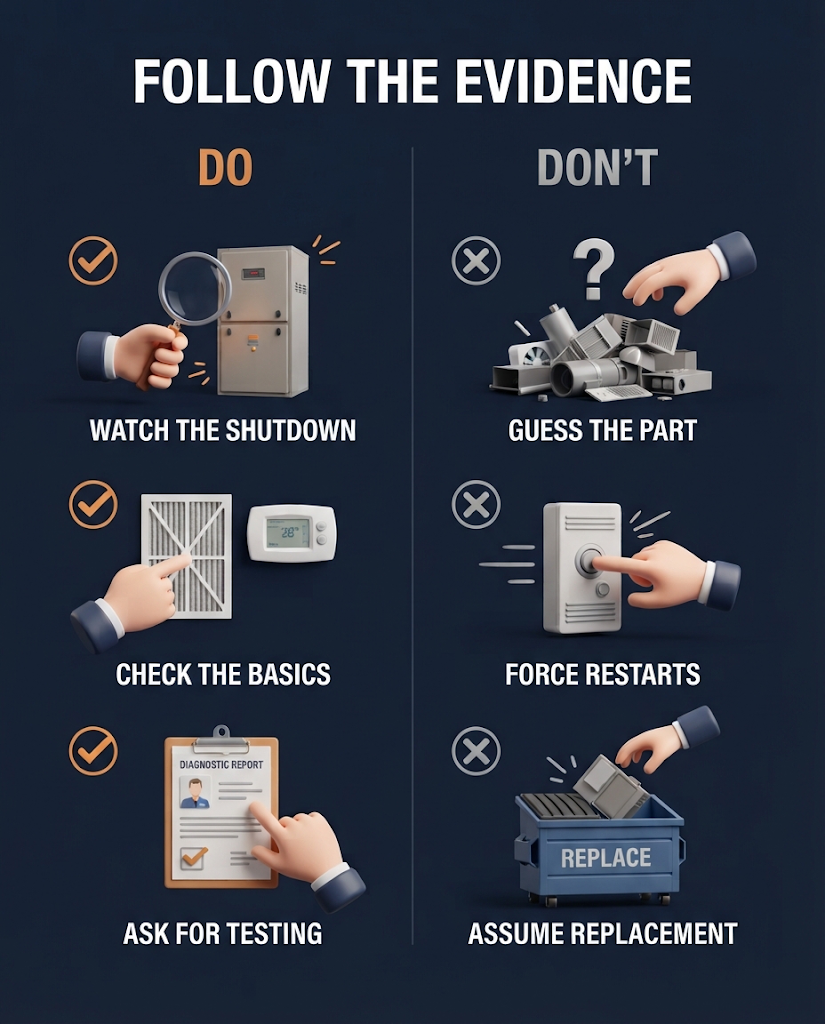
Do this: Watch what happens immediately before shutdown.
Not that: Assume the restart itself identifies the failed part.
Do this: Check the filter, accessible vents, thermostat settings, and visible warning signs.
Not that: Open electrical compartments or troubleshoot refrigerant equipment.
Do this: Mention if the behavior appeared suddenly.
Not that: Blame equipment sizing when the system operated normally for years.
Do this: Ask what measurement or test supports the recommended repair.
Not that: Replace a thermostat, capacitor, blower, or major component simply because it commonly causes cycling problems.
Do this: Discuss what size ac do i need when installation history and testing make sizing relevant.
Not that: assume a bigger system will solve a comfort problem.
The difference is simple: observation narrows the problem; guessing multiplies possibilities.
Is It Safe to Keep Running a Short-Cycling System?
This is where urgency matters.
A single unusual cycle does not automatically mean a major failure. A persistent pattern is different.
If the equipment repeatedly starts and stops and the cause remains unknown, continued operation can hide a developing problem behind the fact that the system “still works.”
More concerning signs include repeated electrical trips, burning or electrical odors, visible icing, abnormal water, harsh startup noises, or rapidly worsening heating or cooling performance.
Those are not signs to keep resetting the equipment.
If basic accessible checks do not explain the pattern, professional testing becomes the safer next step.
The technician can evaluate the thermostat and control sequence, airflow, electrical operation, equipment condition, temperature performance, refrigerant circuit where relevant, and system sizing instead of working backward from assumptions.
That diagnosis is especially important when a homeowner is comparing hvac repair charleston sc options. Short cycling can come from a relatively contained maintenance problem or a more significant system fault, and those should not be treated as the same repair conversation.
Repair, Maintenance, or Replacement?
Short cycling does not automatically mean the HVAC system is wearing out beyond repair.
Sometimes maintenance restores the missing airflow or corrects a condition before it becomes larger.
Sometimes a thermostat, electrical component, blower issue, refrigerant-system problem, or another fault requires targeted repair.
Replacement enters the conversation differently.
If the equipment has recurring major repairs, declining performance, chronic comfort problems, or evidence that it has never been properly matched to the property, replacement may deserve consideration. ENERGY STAR advises professional evaluation when heating and cooling equipment requires frequent repairs while energy bills are rising.
But the order matters:
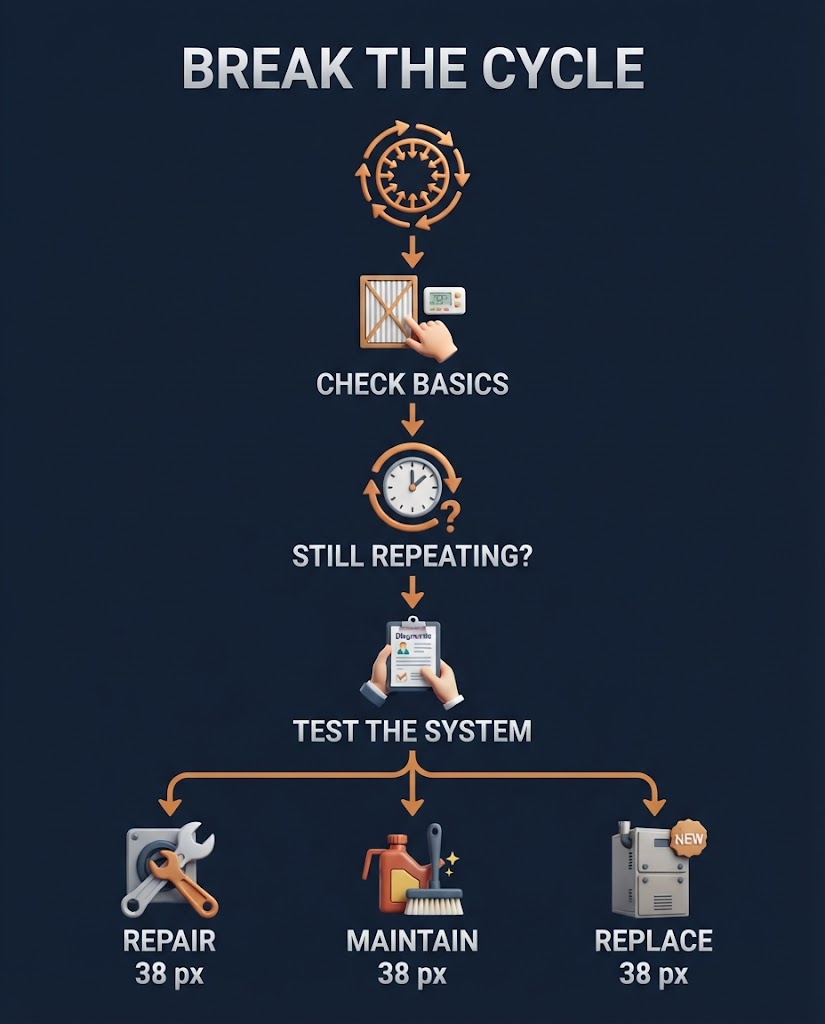
Diagnose first. Decide second.
A new system should solve a known problem, not become an expensive experiment.
Conclusion: Stop the Cycle Before It Becomes a Breakdown
A system that starts, stops, and starts again is doing more than making noise. Persistent hvac short cycling is a change in operating behavior, and that change can point toward airflow restrictions, thermostat or control trouble, protective shutdowns, equipment faults, or a system that was never properly matched to the property.
The smartest response is not to predict the most expensive failure. It is to watch one complete cycle carefully: what triggers the start, whether comfort begins to change, what happens immediately before shutdown, and how the system behaves when it restarts. Those details create a far better path toward maintenance, repair, or replacement than guesswork.
For Charleston homeowners and property operators who want that pattern properly diagnosed before major work is recommended, Charleston Air Pros can evaluate cycling behavior, airflow, thermostats, equipment performance, maintenance needs, and repair-versus-replacement options. Visit charlestonairpros.com or email info@charlestonairpros.com to address the repeated starts while the system is still giving clues about what is wrong.
Audio Summary (Separate Voice Version)
HVAC short cycling is the repeated pattern of a system starting, shutting down before the comfort job seems complete, and restarting again soon afterward. The cause may involve airflow, controls, protective shutdowns, equipment condition, or improper sizing. Homeowners can safely observe the filter, thermostat, vents, airflow, warning signs, and cycle timing, but persistent cycling deserves professional testing. The goal is to understand why the cycle keeps ending before deciding whether the answer is maintenance, repair, or replacement.
Frequently Asked Questions
What makes a good HVAC short-cycling diagnosis?
A good diagnosis looks at the entire operating sequence: what triggers startup, how airflow and comfort change, what happens before shutdown, and why the system restarts.
What are the best practices when HVAC keeps starting and stopping?
Check accessible basics, record the pattern, note warning signs, and avoid repeatedly resetting equipment when the cause is unknown.
How can a homeowner reduce the chance of short cycling?
Regular filter checks, keeping vents unobstructed, appropriate thermostat settings, and professional maintenance can help address avoidable operating problems.
When should a professional be hired?
Professional testing makes sense when cycling keeps returning after basic checks or appears with ice, electrical trips, unusual odors, water, abnormal noises, or poor comfort.
Which HVAC services may address short cycling?
Depending on the cause, service can involve maintenance, thermostat work, airflow correction, electrical repair, refrigerant-system diagnostics, duct improvements, or replacement.
Can a custom HVAC evaluation determine whether sizing is wrong?
Yes. Equipment sizing should be considered alongside the building load, ductwork, system history, installation quality, and actual operating behavior.
Is professional testing better than replacing parts one by one?
Yes. Testing helps establish why the equipment is stopping instead of relying on whichever component happens to be a common suspect.
What affects the cost of repairing short cycling?
Cost depends on the underlying cause and scope. An airflow or control correction is a very different project from major electrical, refrigeration, or equipment work.
What are the top warning signs that should not be ignored?
Repeated breaker trips, burning odors, visible freezing, unusual water, worsening comfort, and increasingly aggressive start-stop behavior deserve prompt attention.
Does short cycling always mean the HVAC system needs replacement?
No. Short cycling is a symptom. Maintenance or targeted repair may solve it, while replacement should follow evidence that the existing equipment or system design makes replacement the more practical option.