
The Fan Spins, the House Bakes, and the Clock Works Against You
August 16, 2026
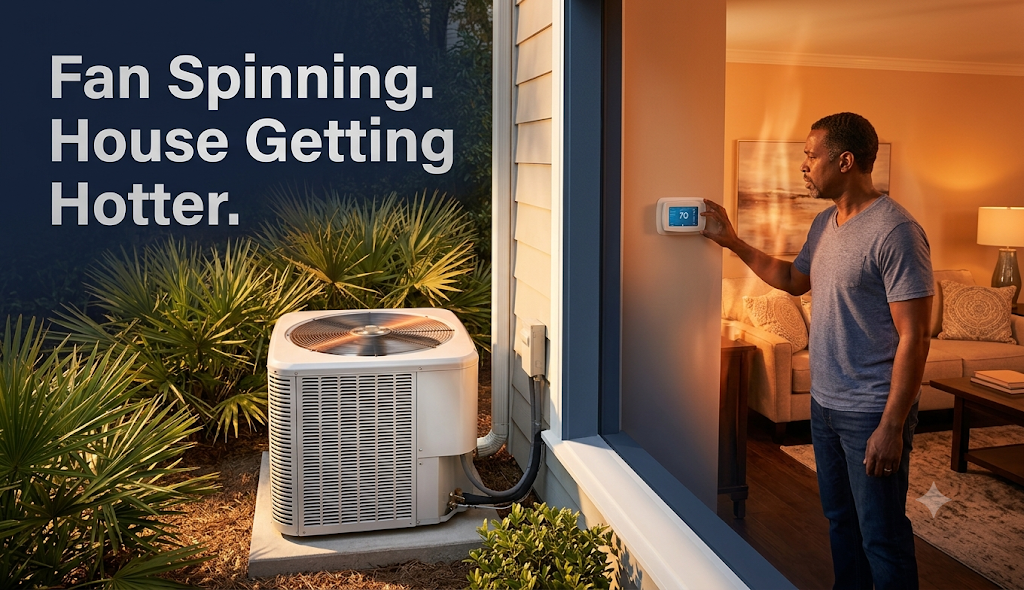
The thermostat has already been checked. It is set to cool. The indoor temperature is still climbing. Then a Charleston homeowner steps outside, looks at the condenser, and sees something reassuring: the fan on top is spinning.
That sight can create false confidence. If the outdoor unit looks alive and sounds busy, it is easy to assume the air conditioner simply needs more time.
But an ac not cooling but running problem can hide behind a perfectly normal-looking fan. Movement does not prove that the compressor, refrigerant circuit, indoor coil, or airflow path is doing its job.
That matters when the house is already uncomfortable. Continuing to wait can mean a hotter home and more strain on equipment that may already be struggling.
The useful question is not, “Is something spinning?” It is, “Is the system actually moving heat out of the house?”
For homeowners who have already checked the thermostat, the next clues come from vent temperature, airflow, unusual sounds, visible ice, the filter, and what the outdoor unit is doing beyond the fan blades.
Key Takeaways
- A spinning outdoor fan does not prove the compressor is operating.
- Warm vent air, ice, humming, or weak airflow can narrow the possible cause.
- Safe homeowner observations can help, but electrical and refrigerant work belong to trained professionals.
- When hvac not blowing cold air becomes the symptom, diagnosis matters more than waiting.
What Does a Spinning Outdoor Fan Actually Prove?
A spinning condenser fan proves that the fan is able to turn at that moment. It does not prove that the compressor is running, refrigerant is circulating correctly, the indoor coil is absorbing heat, or cold air is reaching the rooms.
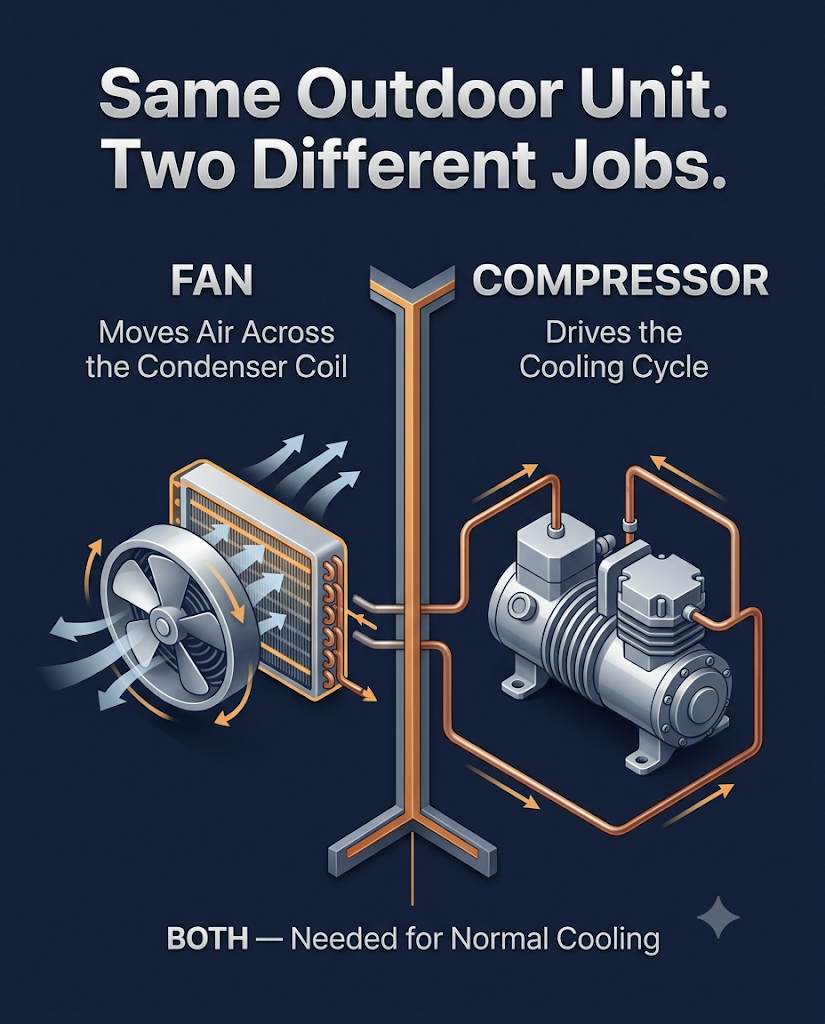
The outdoor cabinet contains components with different jobs. The condenser fan moves outdoor air across the coil so heat can be released. The compressor drives the refrigerant cycle that makes moving indoor heat outdoors possible.
That distinction explains why outside AC fan spinning but not cooling is so confusing. From the patio, the unit looks active. Inside, the vents may be moving room-temperature air while the thermostat continues losing ground.
A homeowner does not need to identify a failed component by sight. The goal is simpler: stop treating fan movement as proof that the entire cooling cycle is healthy.
If ac not cooling remains the problem while the outdoor fan spins, the next clues should come from what the system is delivering inside.
One Outdoor AC Unit, Two Critical Cooling Jobs
Think of the outdoor unit as two workers sharing one cabinet. One moves air across the condenser coil. The other drives the refrigerant cycle that transports heat.
Seeing the first worker active does not guarantee the second is working.
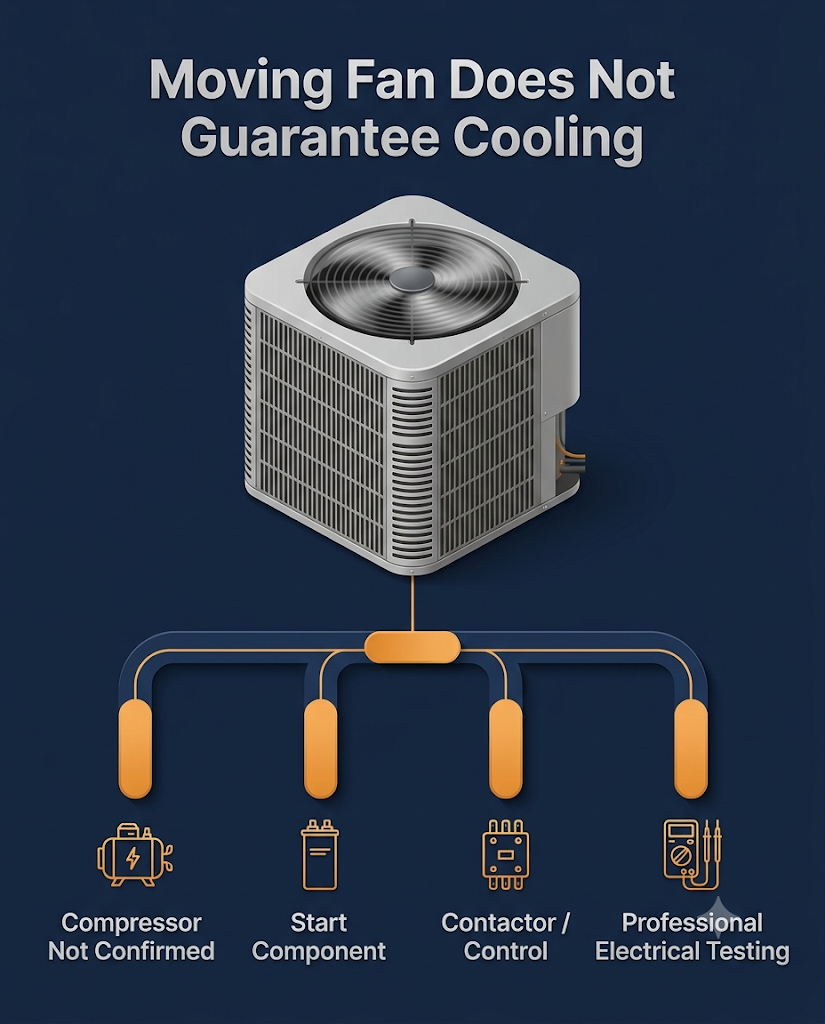
The fan may continue spinning while the compressor fails to start, while an electrical component prevents normal compressor operation, or while another refrigeration problem stops the system from producing useful cooling.
The indoor side can complicate matters further. A frozen evaporator coil or severe airflow restriction may interfere with heat transfer even when the condenser fan looks perfectly normal.
For someone dealing with AC fan running but no cold air, the distinction changes the question. Instead of asking why the outdoor fan is working, the homeowner can ask which part of the cooling process is missing.
Fan movement is evidence of activity. Cold supply air and a home that actually cools are evidence of successful operation.
Could the Compressor Be Off While the Fan Keeps Spinning?
Yes. The condenser fan and compressor are separate components, so one can operate while the other does not.
A compressor that fails to start can leave the outdoor fan turning while indoor temperatures rise. The homeowner may notice that the unit sounds different than usual, perhaps with humming or clicking instead of its familiar operating sound.
Those sounds are clues, not proof of compressor failure.
The compressor itself may not be the failed component. A capacitor, contactor, electrical connection, control problem, or protective device may prevent it from starting normally. Different faults can therefore produce the same visible symptom.
That is why ac repair cost cannot be predicted accurately from “the fan spins but the house is hot.” A relatively contained electrical repair and a serious compressor problem can look surprisingly similar from outside the cabinet.
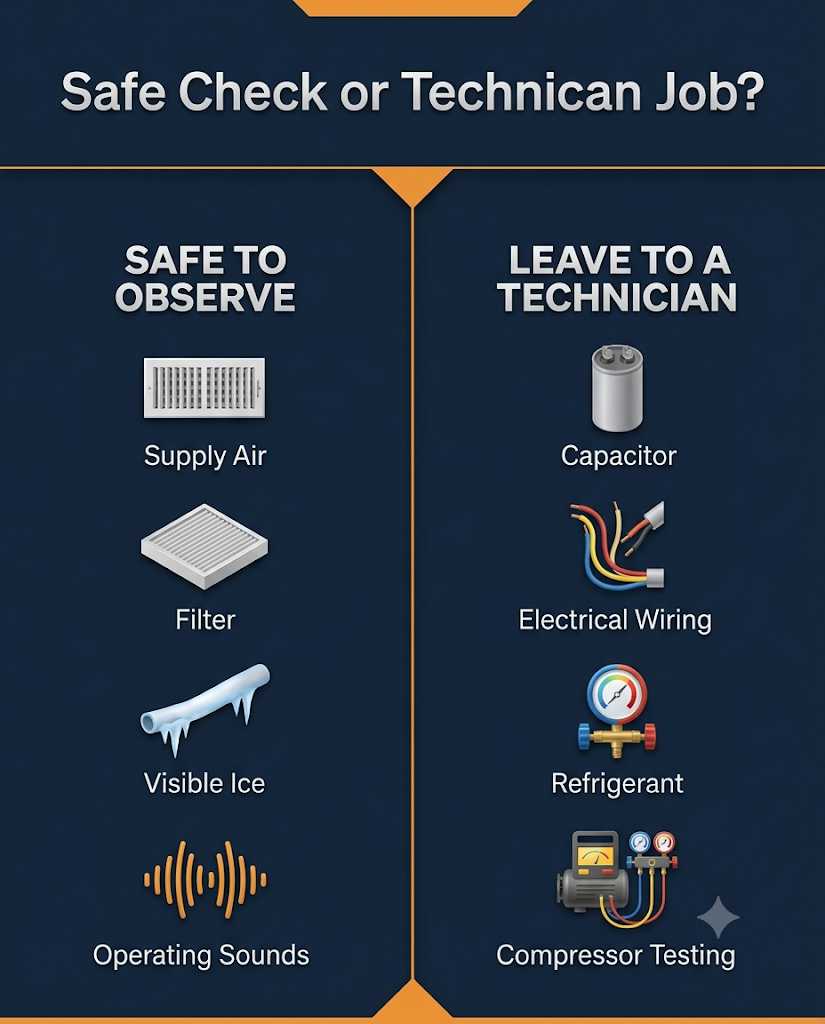
Homeowners should not open service panels, handle wiring, or attempt to force equipment to start. Outdoor units contain high-voltage electrical components.
The useful observations are straightforward: whether the fan turns, whether the normal operating sound has changed, whether cold air comes from the vents, and whether the indoor temperature is still rising.
Professional testing can then determine whether the compressor has failed or whether something else is preventing it from operating.
Why Can a Weak Capacitor Make the AC Look Normal?
A run capacitor helps certain HVAC motors start and operate. When part of a dual run capacitor weakens or fails, the condenser fan may continue to turn while the compressor does not start normally.
That can create a convincing version of ac not cooling but running. The homeowner sees moving blades and hears an outdoor unit making noise. Yet the refrigeration cycle may not be removing heat from the house.
Humming or clicking may appear with a start problem, but neither sound identifies a bad AC capacitor by itself. Other electrical and mechanical conditions can create similar symptoms.
A capacitor is also not a safe DIY component. It can retain electrical energy after power is disconnected. Internet shortcuts that involve opening the cabinet, touching terminals, or trying to push-start equipment create unnecessary risk.
A better diagnostic process tests the capacitor against its specifications, checks whether the contactor is supplying power correctly, and evaluates how the compressor responds.
The key is not finding the fastest part to blame. It is finding the component that actually failed.
Dirty Coils and Restricted Airflow Hide in Plain Sight
Not every spinning-fan cooling failure starts with an electrical component. The system still needs clean heat-transfer surfaces and adequate airflow.
The outdoor dirty condenser coil can become coated with pollen, dust, grass clippings, or debris. The fan may continue moving air while the dirty surface makes releasing heat more difficult.
Inside, a clogged filter creates another bottleneck. Restricted airflow across the evaporator coil reduces the amount of warm household air available for heat transfer and can contribute to coil icing.
ENERGY STAR notes that airflow problems can reduce HVAC system efficiency by up to 15%, which is why filters, blower performance, and airflow deserve attention when the fan runs but the home is not cooling properly.
A homeowner can safely inspect the filter and look around the outdoor cabinet for obvious obstructions. Heavy coil cleaning, disassembly, and electrical work are different matters.
If a clean filter does not restore cold air, it has still served a useful diagnostic purpose: one simple restriction has been ruled out.
Can Low Refrigerant or a Frozen Coil Leave the Fan Running?
Yes. A condenser fan can continue spinning while cooling deteriorates because of low refrigerant or a frozen evaporator coil.
Refrigerant carries heat through the system. If refrigerant has escaped, the system may run for long periods without moving enough heat. Ice or frost can sometimes appear on accessible refrigerant lines or around the indoor equipment.
A frozen coil can also begin with low airflow. When too little warm indoor air crosses the evaporator, moisture can freeze on the coil. As ice builds, airflow and heat transfer become even worse.
That can create a frustrating loop: the outdoor fan spins, the thermostat keeps calling for cooling, and AC blowing warm air continues indoors.
Refrigerants should not be treated as a routine consumable that simply needs topping off. If the system is low, the cause matters.
Visible ice also should not be chipped away as a “repair.” It is evidence that something in the system needs attention.
For a homeowner already worried about ac repair cost, ice narrows the problem but does not identify the exact repair. Airflow and refrigeration faults can overlap, which is why measurements matter.
The SPIN Check Before the Clock Works Against You
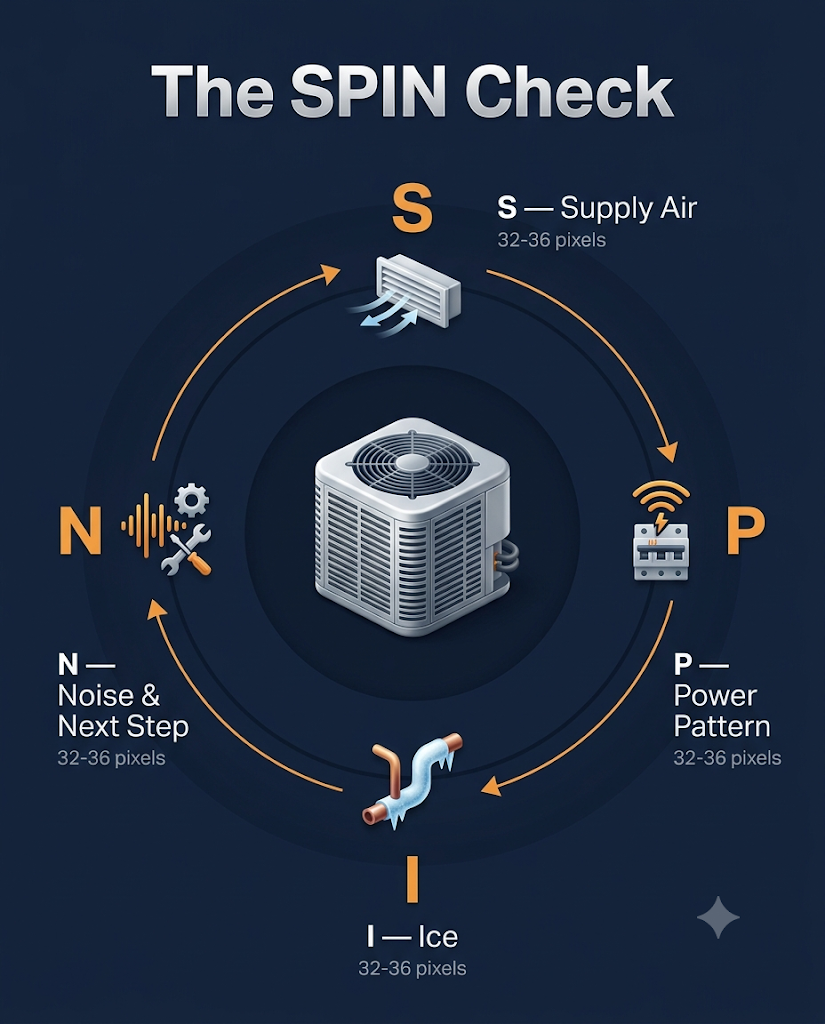
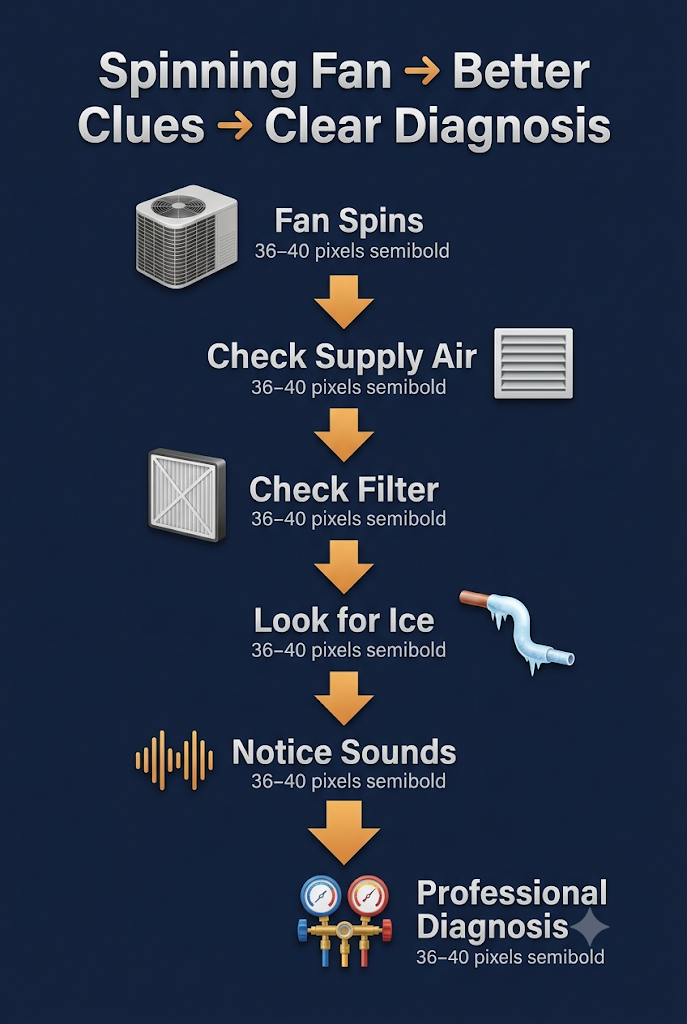
Once the thermostat has already been checked, the SPIN check organizes the next observations without turning a homeowner into an HVAC technician.
S — Supply air: Feel the air from a nearby supply vent. Is it clearly cool, close to room temperature, or warm?
P — Power pattern: Observe the outdoor unit from a safe distance. Is the fan spinning normally? Does the unit sound different from usual? Has electrical protection tripped?
I — Ice: Look for visible frost or ice on accessible refrigerant lines or around indoor equipment. Do not open panels or chip the ice away.
N — Noise and next step: Humming, clicking, repeated start attempts, or a noticeably changed operating sound should be reported. If the safe checks do not restore cooling, move from observation to professional diagnosis.
The SPIN check is not designed to identify a part to buy. Its purpose is to create a useful description.
“The outdoor fan spins, the vent air is warm, there is no visible ice, and the unit has developed a strange hum” gives a technician far more useful information than “the AC sounds like it is running.”
| What the homeowner notices | What may need investigation | Safe observation | What not to assume |
| Fan spins, air stays warm | Compressor side or refrigeration | Listen for changed sounds | Spinning means cooling works |
| Fan spins, airflow feels weak | Filter, coil, blower, airflow | Inspect the filter | Outdoor unit is definitely at fault |
| Visible ice | Airflow or refrigeration | Note where it appears | Removing ice fixes the cause |
| Humming or clicking | Starting or electrical issue | Report the sound | One specific part has failed |
| Cooling fades again | Intermittent system problem | Note the pattern | The problem fixed itself |
Should You Keep Running an AC That Is Not Cooling?
A system running for a long time is not automatically broken. During demanding weather, a healthy air conditioner may operate for extended periods while still maintaining the home.
The concern is different when the unit runs but indoor temperature continues to climb or the vents stop delivering cold air.
When hvac not blowing cold air is combined with visible ice, repeated electrical trips, burning or electrical odors, or abnormal mechanical sounds, continuing normal cooling operation is not a useful experiment. Professional help is appropriate.
Even without dramatic warning signs, there is little benefit in letting an obviously ineffective system run indefinitely simply because the condenser fan still turns.
An indoor ceiling fan can provide temporary comfort while service is being arranged. During summer, a standard ceiling fan is commonly set to create a downward breeze. Moving air can help people feel cooler, but it does not repair the air conditioner or prove that the HVAC cooling cycle is working.
Spinning Fan, No Cooling: What to Do and Avoid
Do this: Compare supply-air feel with the room temperature and report whether the air feels cold, neutral, or warm.
Not that: Assume the system only needs more time because the outdoor fan is turning.
Do this: Check the filter and look for visible ice from a safe position.
Not that: Open the condenser cabinet or touch capacitors, wiring, or refrigerant components.
Do this: Arrange diagnosis when cold air does not return.
Not that: Let an obvious ac not cooling problem run endlessly while indoor comfort keeps getting worse.
One Quiet Fan Can Hide a Serious Cooling Failure
Consider a familiar Charleston breakdown pattern, not a claimed customer case.
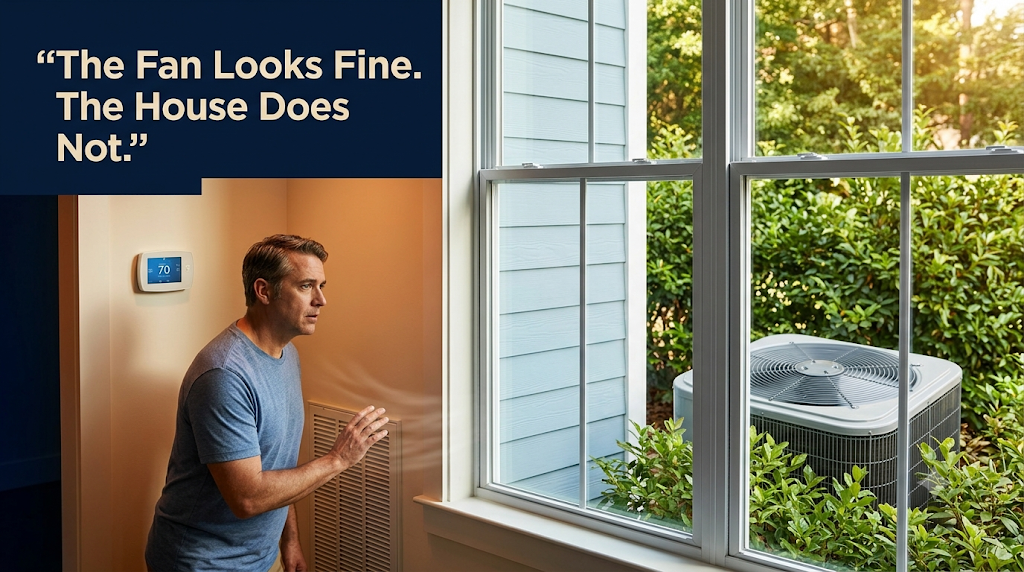
A homeowner has already checked the thermostat. Cooling mode is correct, but the house feels warmer every time they pass the hallway.
Outside, the condenser fan is spinning. At first glance, nothing looks dramatically broken.
Back inside, air is moving from the vents, but it is not cold. The filter appears reasonably clean. There is no obvious ice on the accessible line. The outdoor unit, however, has developed an intermittent hum that the homeowner does not remember hearing before.
The temptation is to keep waiting because the fan is still moving.
Instead, the homeowner uses the pattern as the decision point. Fan motion plus warm supply air plus a changed operating sound means the system needs diagnosis. The cabinet stays closed. No capacitor is touched. No wiring is tested.
The eventual fault could involve a start component, compressor circuit, refrigerant condition, or another problem that requires measurements. The homeowner does not need to know which one before calling.
That is the value of recognizing the gap between motion and cooling. It identifies the moment when waiting has stopped being a useful plan.
When Is It Time for Professional AC Repair in Charleston?
Professional service makes sense when the outdoor fan spins but cold air does not return after safe checks, particularly when the system sounds abnormal, shows ice, trips electrical protection, or keeps running while the indoor temperature rises.
Diagnosis should look beyond the visible fan. Depending on the symptoms, a technician may need to evaluate starting components, electrical controls, compressor operation, refrigerant conditions, condenser performance, evaporator-coil condition, and indoor airflow.
That is why an ac repair charleston sc search should lead to testing before parts are recommended.
A clear diagnosis also makes the ac repair cost conversation useful. The homeowner should understand what was found, what the proposed repair is expected to restore, and whether another condition contributed to the failure.
Sometimes the answer is a focused repair. Sometimes airflow or maintenance is part of the solution. Sometimes the system’s condition makes replacement worth discussing.
None of those answers should be predetermined because one outdoor fan happened to be spinning.
John F. Kennedy once said,
“The time to repair the roof is when the sun is shining.”
Preventive attention is easier before a warning becomes an active cooling failure.
Conclusion: A Spinning Fan Doesn’t Mean Your AC Is Fine
For a Charleston homeowner staring at a turning outdoor fan while the house keeps heating up, the most important shift is simple: movement is not proof of cooling.
An ac not cooling but running problem can involve a starting component, compressor operation, refrigerant condition, frozen coil, restricted airflow, dirty heat-transfer surfaces, or another fault that cannot be identified by fan motion alone.
Safe observations can narrow the story, but they should not become electrical or refrigerant DIY work. When ac not cooling has become an active breakdown, the right next step is an accurate diagnosis that explains what failed before repair or replacement is discussed.
For Charleston homeowners, landlords, property managers, and businesses ready to find the actual cause of a cooling failure, Charleston Air Pros offers AC repair, HVAC diagnostics, maintenance, airflow support, thermostat service, and repair-versus-replacement guidance built around clear explanations and practical next steps. Contact info@charlestonairpros.com or visit charlestonairpros.com to request service.
FAQ
What Makes a Good Diagnosis When the Outside AC Fan Is Spinning?
A good diagnosis looks beyond fan movement and checks the electrical starting system, compressor operation, refrigeration performance, heat transfer, and indoor airflow according to the symptoms.
What Are the Best Practices When the AC Fan Runs but No Cold Air Comes Out?
Check the filter, confirm vents are open, notice how supply air feels, look for visible ice, and listen for unusual sounds. Avoid opening electrical panels or touching refrigerant components.
How Can a Homeowner Tell if the Compressor Is Not Running?
A spinning fan combined with warm vent air or a changed outdoor-unit sound can raise suspicion, but those clues cannot confirm compressor failure. Electrical and system testing are needed.
When Should Someone Hire a Professional for a Spinning Fan and Hot House?
Call for diagnosis when cold air does not return after basic checks, the house keeps warming, ice appears, unusual sounds develop, or electrical protection repeatedly trips.
What Services May Fix an HVAC System That Is Not Blowing Cold Air?
Depending on the diagnosis, work may involve electrical repair, capacitor or contactor service, airflow correction, coil service, refrigerant-related repair, compressor evaluation, maintenance, or replacement planning.
How Does a Professional Check a Suspected Bad AC Capacitor?
A technician safely isolates the electrical system and tests the component against its required specifications while checking the equipment it supports. Homeowners should not handle capacitors themselves.
What Should Homeowners Know About AC Repair Cost in This Situation?
Cost depends on the diagnosed failure. A starting-component problem, airflow restriction, refrigerant issue, or compressor fault can produce similar symptoms while requiring very different repairs.
What Is the Best Next Step if the AC Keeps Running but the House Gets Hotter?
If thermostat and basic airflow checks are already complete, document what the system is doing and arrange professional diagnosis. A spinning fan alone is not a reason to keep waiting.