
The Air Is Cold and the House Still Feels Wet. Here Is the Reason.
August 22, 2026

A Mount Pleasant vacation rental has been empty since checkout. The air conditioner has been running. The rooms are cool. Nothing looks obviously wrong.
Then the property manager opens the linen closet.
The towels feel faintly damp. The room carries that hard-to-place musty smell that disappears after a few minutes but returns whenever the door stays shut. A nearby bedroom feels cool enough, yet the sheets seem heavy and the air feels almost slick against the skin.
That is what makes high humidity in house problems so deceptive. Cold air convinces people the cooling system must be doing its job. Moisture tells a different story.
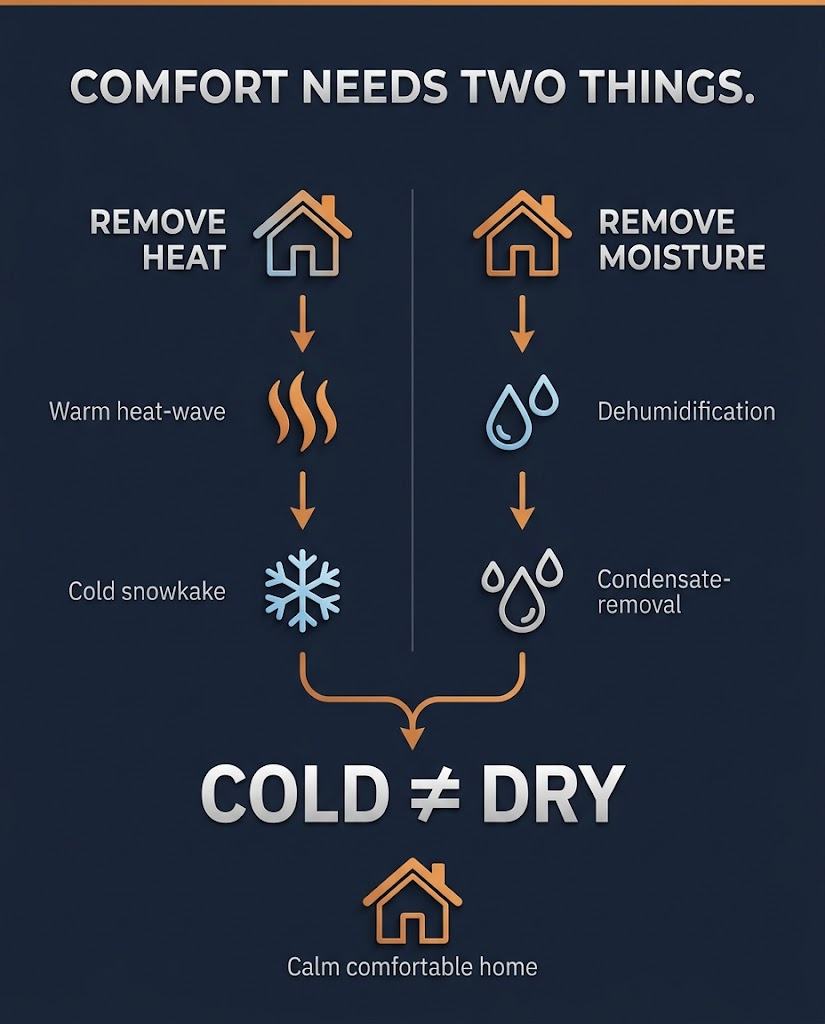
In Charleston and Mount Pleasant, a home does not become comfortable simply because heat has been removed. Moisture has to leave too.
An air conditioner can produce cold supply air while the house continues collecting humidity from outdoor air, daily activity, weak ventilation, leaky ducts, damp materials, or cooling cycles that end before enough moisture is removed. The result can be a home that feels refrigerated rather than refreshed.
This is also a different problem from hvac not blowing cold air. When the air is genuinely cold but the house remains sticky, the investigation has to move beyond temperature.
Key Takeaways
- Cold supply air does not prove moisture control is working.
- Humidity can enter, form indoors, or linger inside materials.
- Short cooling cycles may satisfy temperature before drying the air.
- A lasting fix starts by finding the moisture pathway.
The House Is Cool. Why Does It Still Feel Damp?
Air conditioning has two comfort jobs. It lowers temperature, and as indoor air passes across a cold evaporator coil, moisture can condense and drain away. Federal energy guidance describes dehumidification as part of the cooling process, especially where hot, humid conditions make moisture control essential.
But those two jobs do not always finish at the same time.
A system may satisfy the temperature demand before the moisture problem has been handled. This is especially important when equipment cools the space rapidly and stops.
The U.S. Environmental Protection Agency specifically notes that in hot regions, air conditioners that cool too quickly may not operate long enough to remove excess moisture.
That creates a strange indoor experience. Tile may feel cool underfoot. Air from a register may feel properly chilled. Yet upholstery feels heavy, a closet smells stale, or a bedroom becomes uncomfortable after the door stays closed.
A homeowner may interpret the situation as weak cooling and start researching hvac repair cost. But temperature production is only one part of the evidence. Moisture removal, cycle length, drainage, airflow, ventilation, and building leakage all deserve attention before the problem is labeled.
Moisture Has More Than One Way In
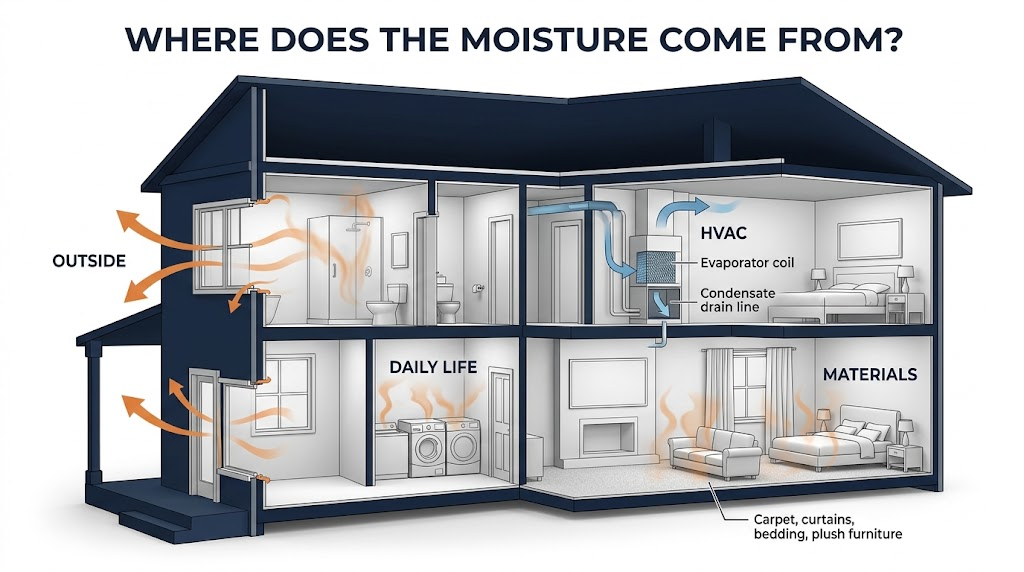
A humid home is often treated like an equipment problem because the air conditioner is the most visible machine involved. But moisture can enter the building without asking the HVAC system for permission.
Outdoor air can move through cracks, joints, doors, windows, penetrations, and other openings. EPA guidance describes infiltration as air moving into a building through openings and cracks, while weather, ventilation, and occupant behavior can all influence indoor air quality and moisture conditions.
Then there is moisture created indoors. Showers, cooking, laundry, and other ordinary activities release water vapor. EPA also identifies indoor clothes drying, plants, cooking, and long showers among potential moisture sources.
Materials can complicate the picture further. Carpet, rugs, upholstered furniture, bedding, and other porous materials can absorb moisture and release it later. EPA specifically warns that carpet can absorb moisture, particularly where it sits over moisture-prone surfaces.
That is why early action matters when dampness starts showing up in a home.
As John F. Kennedy said,
“The time to repair the roof is when the sun is shining.”
The same principle applies here: finding where moisture is entering, collecting, or being trapped before the problem spreads can prevent recurring odors, damp furnishings, comfort complaints, and unnecessary equipment changes.
Is the AC Cooling Faster Than It Can Dry?
One of the most important clues is not simply whether the AC turns on. It is how it runs.
A rapidly cycling system can lower temperature and shut down before the indoor coil has had enough operating time to remove as much moisture as the home needs.
That does not automatically prove the unit is oversized, but improper sizing belongs on the list of possibilities when the pattern repeats. EPA guidance supports the underlying principle: cooling too rapidly in hot climates can reduce the time available for moisture removal.
This is where hvac short cycling becomes more than a wear-and-tear concern. Short cycles can also be a comfort clue. A house may swing between “cold enough” and “sticky again” because sensible cooling has been achieved while latent moisture remains.
The opposite pattern deserves attention too. A system that runs for long stretches but still leaves the house damp may be dealing with dirty components, poor airflow, drainage trouble, duct leakage, control problems, excessive moisture entry, or another performance issue.
Replacing equipment based on runtime alone can therefore miss the actual problem. A cooling system has to be evaluated as part of a house, not as an isolated box.
What Causes High Humidity in House With Cold AC?
Instead of asking only whether the AC works, it helps to ask where the moisture is winning.
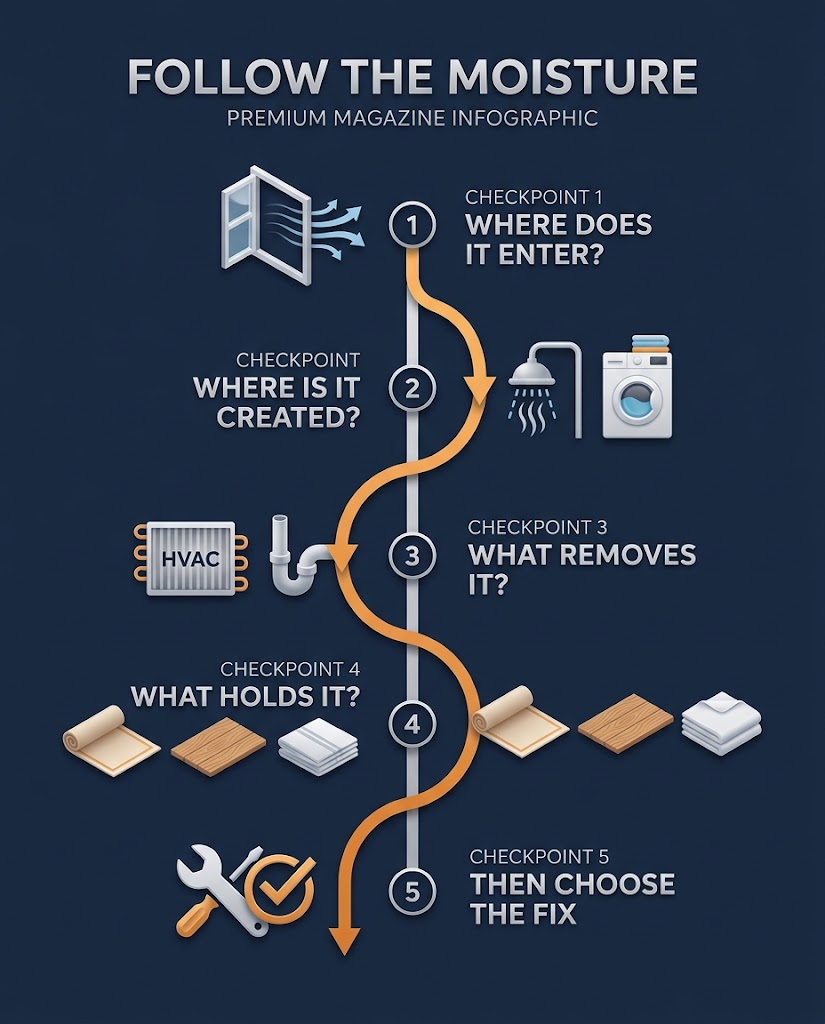
There are four main paths to investigate.
- Moisture entering from outside. Humid outdoor air can move through building leaks or be pulled into ductwork from unconditioned spaces.
- Moisture being created indoors. Bathrooms, kitchens, laundry areas, frequent door traffic, damp crawlspaces, and occupant routines can add moisture faster than it leaves.
- Moisture not being removed effectively. Cooling cycles, airflow, coil performance, condensate drainage, control settings, and equipment sizing all influence how effectively an HVAC system dries air.
- Moisture being stored and released. Fabrics, carpet, wood, closets, and other surfaces can act like reservoirs after humid periods or previous wetting.
That last category is easy to underestimate. A weather change or HVAC adjustment may improve the air before the contents of a room fully dry. The home can therefore continue to smell or feel damp even while the system appears to be performing better.
For anyone searching “hvac repair charleston sc“, this distinction matters because the correct service may involve the cooling equipment, ductwork, ventilation, moisture control, or a combination rather than a single repair.
The Moisture Ledger Changes the Diagnosis
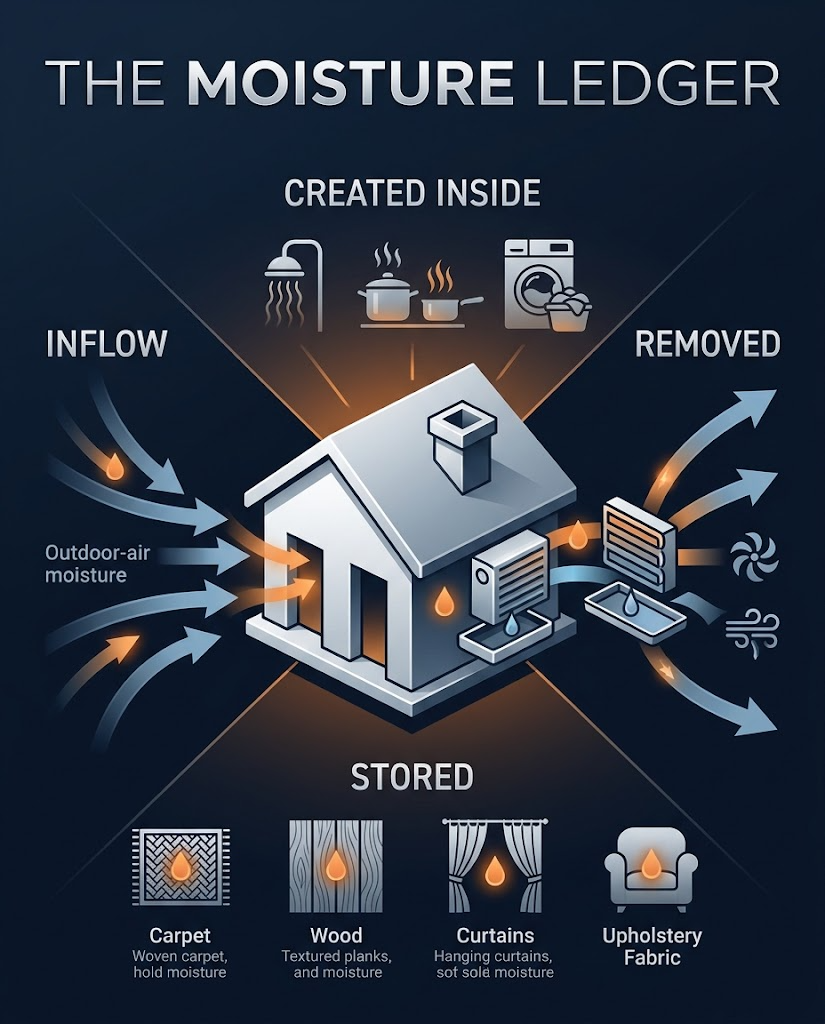
A useful way to think about indoor humidity is as a moisture ledger.
The home has inflows, such as humid outdoor air. It has indoor deposits, such as shower steam and laundry moisture.
It has withdrawals, mainly drainage, ventilation, and dehumidification. And it has reservoirs, such as fabrics and building materials that can hold moisture and release it later.
If more moisture enters and accumulates than the home removes, the balance stays uncomfortable.
That simple framework prevents tunnel vision. A technician may find the cooling equipment operating normally while an air leak continually adds humid outdoor air.
Another property may be well sealed but have weak bathroom exhaust. A third may have good ventilation yet struggle because the cooling equipment stops too quickly.
The clue is the balance, not one isolated symptom.
| What the Home Is Doing | What It May Point Toward | What to Check Next |
| Cool rooms, damp fabrics | Moisture remains after cooling | Cycle pattern, fabrics, indoor sources |
| Musty closed spaces | Weak circulation or trapped moisture | Closets, returns, ventilation |
| Dampness after rainy weather | Outdoor moisture entry | Gaps, ducts, crawlspace, doors |
| Sticky air after short cooling cycles | Limited moisture-removal time | Controls, sizing, airflow |
| One room stays damp | Local airflow or moisture source | Room use, return path, exhaust |
| Whole house stays muggy | Broader moisture imbalance | HVAC performance and building envelope |
What Can a Homeowner Check Without Guessing?
Before opening equipment or assuming a major repair, several safe observations can reveal the pattern.
- Start with the rooms, not the machine. Identify whether the damp feeling affects the entire home or concentrates in bedrooms, closets, bathrooms, laundry spaces, or areas near the crawlspace.
- Notice when the problem gets worse. Dampness that appears after rain, showers, guest turnover, laundry, or long periods with doors closed can reveal where moisture is being added or trapped.
- Check accessible ventilation. Bathroom and kitchen exhaust should actually move moist air away from the space. EPA recommends giving homes a way to expel excess moisture and increasing circulation where stagnant areas are a problem.
- Inspect the filter and visible vents. A dirty filter or blocked return can interfere with airflow. Heavy furniture, rugs, or storage should not smother air pathways.
- Look for condensation or persistent dampness. Moisture collecting on surfaces is not something to normalize. EPA recommends addressing visible moisture and its source rather than allowing it to linger.
- Write down the cycle pattern. If cooling starts and stops repeatedly, hvac short cycling belongs in the service conversation. If cooling runs for long periods but humidity remains, that pattern matters too.
None of these checks requires opening refrigerant lines, electrical panels, or sealed HVAC
Could the Ducts Be Feeding the Problem?
Ductwork is easy to overlook because most of it stays hidden.
But hidden air pathways matter. If duct connections or return-side gaps communicate with an attic, crawlspace, garage-adjacent cavity, or another humid area, the system can move unwanted moisture along with air. EPA guidance for HVAC systems emphasizes keeping moisture out of ductwork and identifies excess outdoor moisture, improper drainage, and poorly sealed ducts among potential contributors.
A property may therefore have cold supply air and still struggle because humid air is being introduced somewhere else in the distribution system.
Room-to-room differences make this possibility more interesting. If the primary bedroom smells stale but the living room does not, or one section of a vacation rental repeatedly earns “muggy” guest comments while another feels normal, distribution deserves attention.
This is also why hvac repair cost should not be judged before the scope is understood. A duct correction, drainage problem, control adjustment, maintenance issue, or humidity solution represents a very different project from major equipment replacement.
Stop Treating Every Damp Room Like an AC Failure
A damp room is a symptom. It is not a verdict.
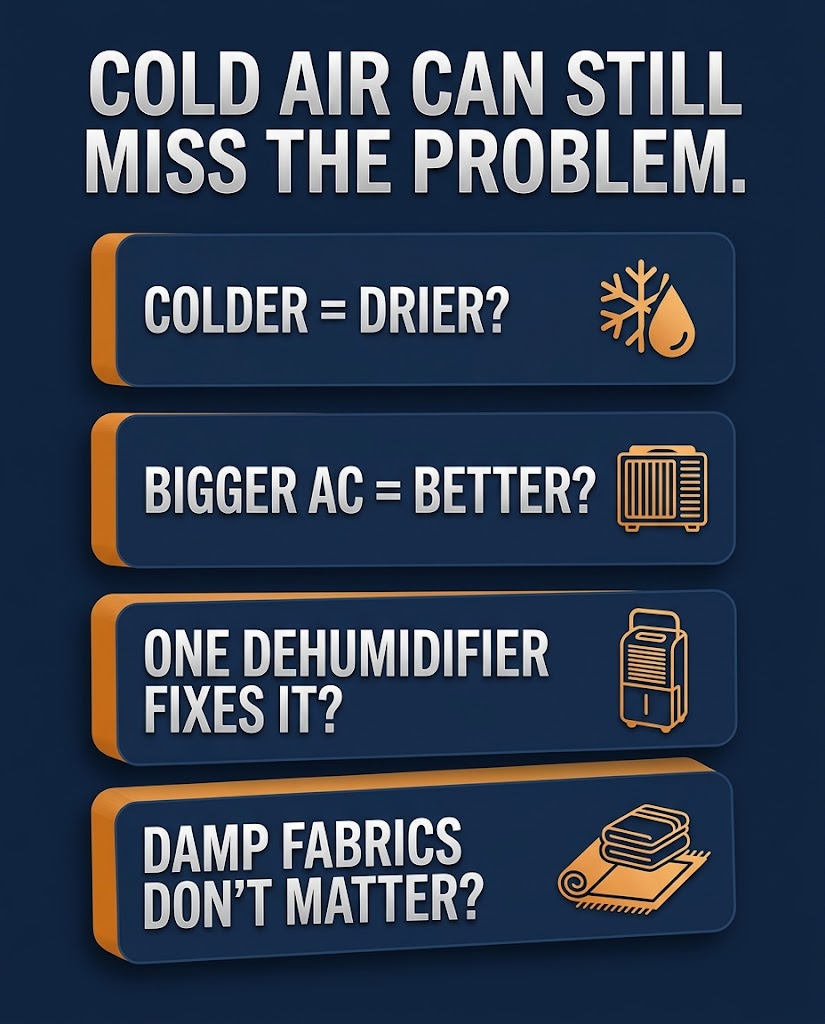
One common mistake is lowering the cooling setting further and assuming colder air must eventually solve the moisture problem. Sometimes that simply creates a room that is colder and still unpleasant.
Another mistake is immediately blaming the equipment size. Oversizing can contribute to inadequate moisture removal, but so can building leakage, ventilation, drainage, airflow, controls, and indoor moisture generation.
A third mistake is buying a portable dehumidifier for every uncomfortable room without asking why the moisture keeps returning. A dehumidifier can be useful, but it should not become camouflage for an active leak, poorly vented bathroom, damp crawlspace, or HVAC performance problem.
And a fourth mistake is ignoring fabrics and storage areas because the air itself seems better. Moisture held in rugs, furnishings, bedding, or closets may continue affecting how a space smells and feels after the immediate air condition changes.
The better mindset is simple: trace moisture before prescribing equipment.
When Does a Dehumidifier Actually Make Sense?
A dedicated dehumidifier makes the most sense when testing shows that moisture control remains a recurring need even after obvious sources, airflow issues, ventilation problems, and HVAC faults have been considered.
That distinction matters.
A whole-home humidity solution is not meant to excuse a leaking building envelope or malfunctioning cooling system. It is another tool for properties where moisture loads and cooling demand do not always line up neatly.
This can be particularly relevant during periods when outdoor air remains humid but the home does not need much sensible cooling. The cooling system may have less reason to run even though moisture still needs to be managed.
The decision should therefore answer several questions: Is the moisture problem whole-home or local? Is the AC functioning correctly? Are ducts introducing outside air? Are exhaust systems doing their job? Are there damp crawlspace or building-envelope conditions? Is the property occupied consistently, or does it sit empty between rental stays?
A custom recommendation should follow those answers rather than precede them.
For a homeowner comparing hvac repair charleston sc options, that kind of evaluation helps separate “add another device” from “solve the actual moisture load.”
Why Do Rentals Get Humidity Complaints Faster?
Vacation rentals add another layer because comfort is judged by people who did not watch the house gradually become damp.
A homeowner may stop noticing a faint musty odor. A guest who walks in with luggage notices it immediately.
A familiar hypothetical pattern might look like this: a Mount Pleasant rental is empty for several days, doors remain closed, the cooling system maintains temperature, and cleaning staff later wash towels, mop floors, and reset the property. Guests arrive that evening and say the bedrooms feel sticky even though the air is cold.
That does not prove an HVAC failure.
The property could be dealing with limited air movement behind closed doors, moisture from cleaning and laundry, stored moisture in fabrics, outdoor-air infiltration, or a cooling cycle that manages temperature more effectively than humidity.
For landlords and rental operators, the practical lesson is to document recurring patterns. Which rooms receive complaints? Do odors appear after rainy periods? Does the problem show up after cleaning days or long vacancies? Does one floor behave differently? Does opening an interior door improve the room?
Those observations are useful because humidity complaints are often environmental stories rather than single-component failures.
The importance of indoor conditions is easy to underestimate. The U.S. Environmental Protection Agency reports that Americans spend approximately 90% of their time indoors. For homes and rentals, indoor comfort is therefore not a minor detail tucked behind the thermostat; it shapes how people experience the property itself.

When Is Professional Testing Worth It?
Professional testing becomes valuable when the pattern continues after simple causes have been ruled out, when multiple rooms behave differently, or when the building and HVAC system seem to be interacting in ways that are difficult to separate.
A strong evaluation may look at temperature and moisture conditions, equipment cycling, airflow, filter and coil condition, drainage, thermostat operation, duct behavior, ventilation, and building leakage as appropriate.
The purpose is not to turn every damp room into a major project.
A maintenance issue may be enough. A thermostat or airflow adjustment may change the pattern. Ductwork may require attention.
A recurring whole-home humidity load may justify dedicated moisture control. Older or poorly matched equipment may eventually make replacement the sensible choice.
Those options should come after evidence.
This is especially important when property owners are worried about musty odors, material damage, tenant dissatisfaction, or a recurring high humidity in house problem.
EPA advises controlling moisture sources and acting on condensation or visible dampness rather than simply allowing moisture to persist.
The most useful HVAC conversation is therefore not “Which product should be installed?” It is “Where is the moisture coming from, why is it staying, and what is the least complicated solution that addresses that cause?”
Conclusion: Dry Comfort Starts With the Cause
A cold house that still feels damp is giving useful information. It is showing that temperature and moisture are no longer moving together. Repeatedly lowering the cooling setting may hide that distinction, but it does not explain whether humid air is entering through leaks, being produced indoors, lingering in fabrics, moving through ductwork, or simply not being removed effectively enough.
That is why persistent high humidity in house conditions deserve a whole-property view. The right answer could be maintenance, repair, better airflow, ventilation work, duct correction, thermostat improvements, dedicated humidity control, or eventually equipment replacement. What matters is that the recommendation follows the moisture path instead of beginning with an assumption.
For homeowners, landlords, property managers, and vacation-rental operators who want the cause understood before work is recommended,
Charleston Air Pros can evaluate cooling performance, airflow, ductwork, controls, indoor humidity, and longer-term repair-versus-replacement options. A property owner can visit Charleston Air Pros or email info@charlestonairpros.com to begin with a clear assessment and work toward a home that feels genuinely dry and comfortable, not merely cold.
FAQ
What makes a good indoor humidity diagnosis?
A good diagnosis looks at the entire pattern: where moisture appears, when it gets worse, how the HVAC system runs, and how air moves through the property.
What are the best practices for a damp home?
Address visible moisture, keep exhaust and airflow paths working, check accessible filters and vents, and investigate recurring dampness rather than masking it with colder settings.
How can a homeowner reduce sticky indoor air?
Start by limiting avoidable indoor moisture, using appropriate exhaust, keeping airflow paths open, and having recurring HVAC or building issues evaluated.
When should a professional be hired for humidity issues?
Professional help makes sense when dampness keeps returning, affects multiple rooms, produces persistent odors, or continues despite basic maintenance and ventilation checks.
Which HVAC services can address indoor humidity?
Depending on the cause, useful services may include maintenance, AC repair, airflow testing, duct corrections, thermostat work, ventilation improvements, or dedicated moisture control.
Can a custom humidity solution help a vacation rental?
Yes, when the solution is based on the property’s actual occupancy, moisture sources, airflow, equipment performance, and periods of vacancy rather than a one-size-fits-all approach.
Is professional HVAC testing better than replacing the AC?
Testing should usually come first because it can show whether the problem involves the equipment, ductwork, airflow, controls, moisture entry, or another part of the building.
What affects HVAC repair cost for humidity problems?
Cost depends on the actual cause and scope. A maintenance or control issue is fundamentally different from duct repair, humidity-control equipment, or full system replacement.
What are the top clues that moisture is being trapped?
Musty closed spaces, damp-feeling fabrics, recurring condensation, room-to-room differences, and humidity complaints despite cold supply air all deserve investigation.
What should property owners ask during an evaluation?
They should ask where the moisture is coming from, what evidence supports that conclusion, what options address the cause, and why the recommended work is appropriate.