
Cool Air Turned Room Temperature and the System Never Warned You
August 26, 2026
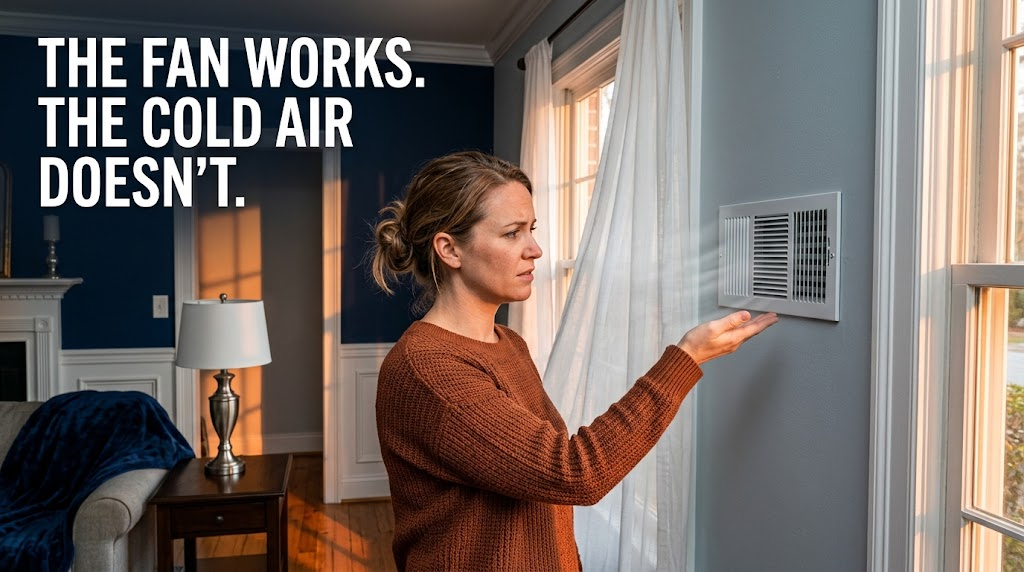
There is an HVAC failure that can be unusually confusing because the system does not appear dead.
The thermostat is lit. Air is moving from the registers. The familiar blower noise is there. Nothing necessarily flashes an error. Yet the air that used to arrive distinctly cold now feels almost identical to the room around it.
When hvac not blowing cold air becomes the complaint, the important clue is not simply that the system is “running.” A combined heating and cooling system contains several parts that can operate independently. The indoor blower can move air even when the outdoor unit, refrigerant circuit, compressor, or cooling command is no longer doing its part.
That difference gives a homeowner somewhere useful to start. Instead of saying, “The AC stopped working,” the better question becomes: Which part of the cooling chain stopped?
That matters when an ac not cooling problem appears suddenly. It can separate a basic control or airflow issue from a fault that requires electrical, refrigerant, or mechanical testing.
Key Takeaways
- Moving air does not prove the cooling cycle is operating.
- The thermostat, indoor blower, outdoor unit, and refrigerant loop perform different jobs.
- Room-temperature airflow can leave clues about where cooling stopped.
- Safe observation comes first; electrical and refrigerant work belongs to trained technicians.
The Fan Runs. So Where Did the Cold Air Go?
A central HVAC system is a team, not a single appliance.
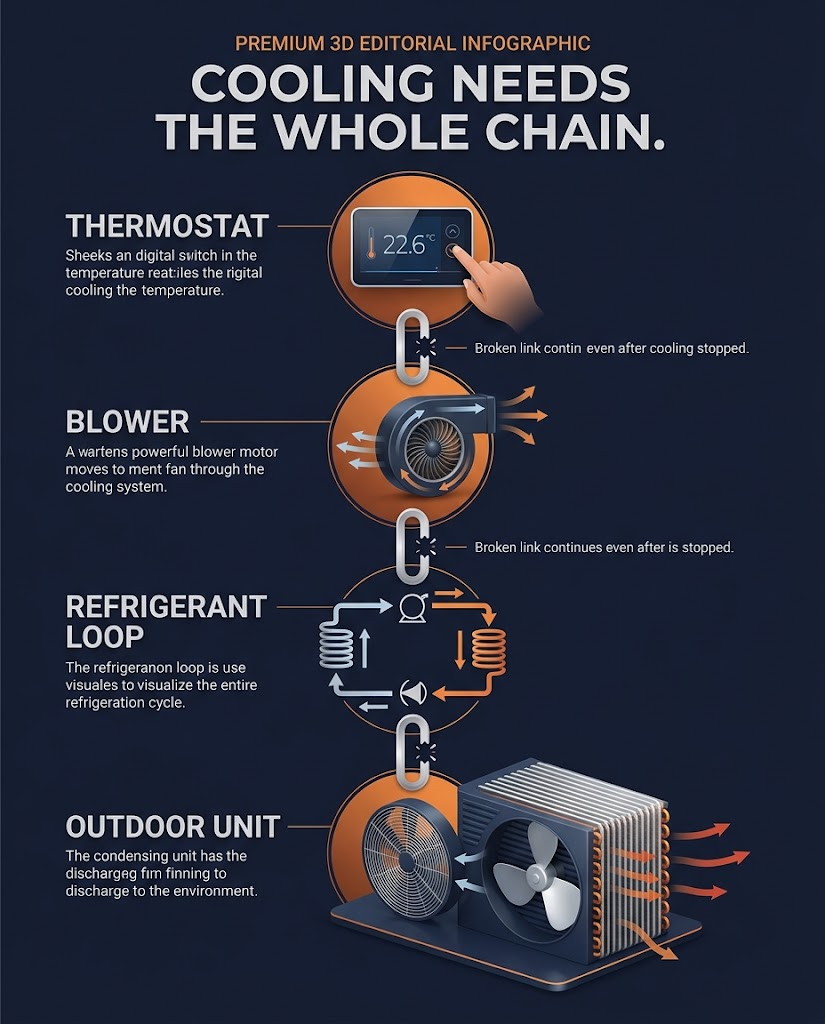
During cooling, the thermostat requests a cooling cycle. The indoor side moves household air across the evaporator coil. Refrigerant allows heat to be absorbed indoors and carried through the system. The outdoor unit then releases that heat outside.
If the indoor blower continues running while another part of that chain drops out, the vents can keep delivering air. It simply will not be properly cooled.
That explains why hvac not blowing cold air can feel so mysterious. Noise and airflow create the impression that the AC is operating, while the actual heat-transfer process may have stopped.
The U.S. Department of Energy’s HVAC diagnostic guidance identifies airflow, refrigerant charge, coils, expansion devices, contactors, capacitors, and compressors among areas technicians may evaluate when cooling performance is compromised.
This is also different from a high humidity in house complaint where the supply air is cold but the property still feels damp. Here, the first question is more fundamental: is the system actually producing cooled air?
Is the Thermostat Actually Calling for Cooling?
The thermostat is the first link because it tells the system what should happen.
A homeowner can confirm that the control is in cooling mode and that the requested temperature is below the current indoor temperature. Scheduled settings or an accidental mode change can also create confusion.
The fan setting deserves attention too. If the blower is commanded to run independently, air may continue circulating when the cooling components are not active. That can make a failed cooling cycle look like an AC system that is “sort of working.”
A thermostat can also display normally while failing to communicate correctly with the equipment. That cannot always be diagnosed from the screen alone.
The useful distinction is simple:
If the thermostat is asking for cooling and only the blower responds, the next clue is outside.
Did the Outdoor Unit Quietly Drop Out?
An indoor fan humming along can mask the absence of another familiar sound: the outdoor condenser operating.
If the indoor system is moving air while the outside equipment remains inactive during a cooling call, the investigation changes immediately. Power, controls, a contactor, capacitor, compressor, wiring, or another electrical problem may be involved.
This is not a reason to open an electrical panel or begin testing capacitors at home. It is simply an observation worth giving the technician.
A useful service description would be: “The thermostat is calling for cooling, the indoor blower runs, but the outside unit does not appear to start.”
That is much more diagnostic than “the AC is broken.”
It can also help prevent premature assumptions about hvac repair cost. A control failure and a compressor failure can create similar room-temperature airflow from the homeowner’s perspective while representing very different repairs.
Four Places Your Cooling Can Suddenly Stop
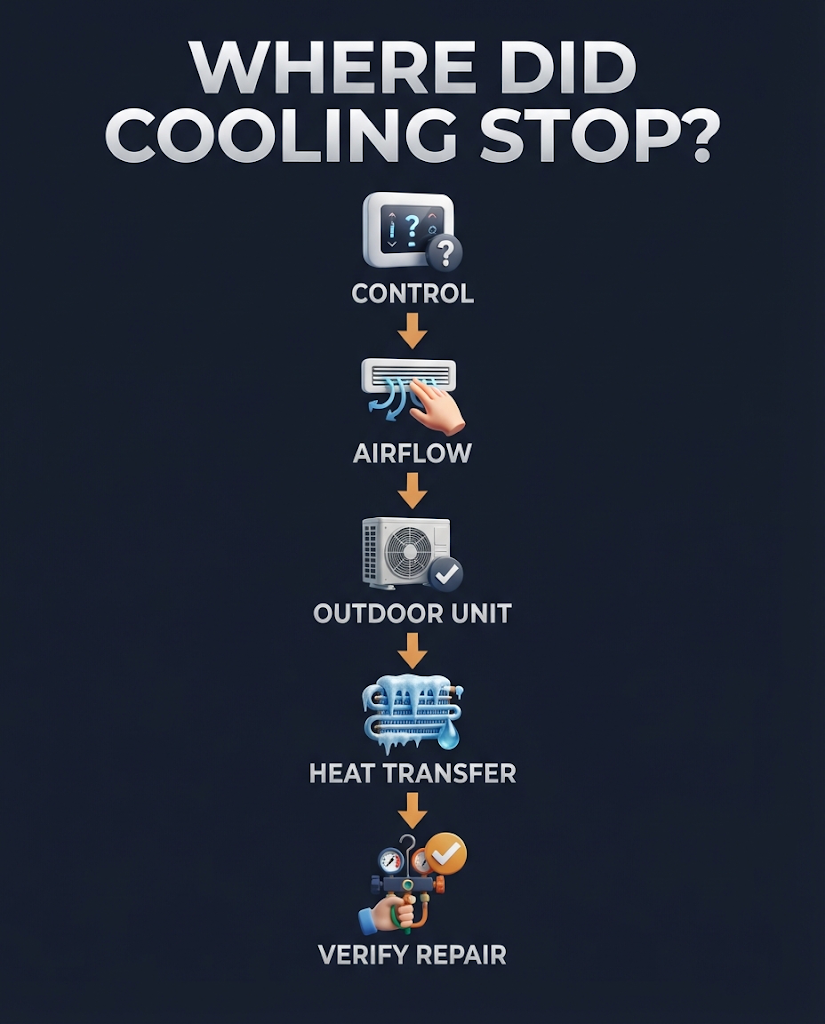
A simple way to organize the problem is to follow four links:
1. Call. Did the thermostat actually request cooling?
2. Move. Is the indoor blower moving enough air through the system?
3. Transfer. Is the evaporator coil and refrigerant circuit absorbing indoor heat?
4. Reject. Is the outdoor system successfully releasing that heat?
A failure at any link changes what reaches the registers.
That framework also prevents the common mistake of treating ac not cooling as one diagnosis. It is a symptom with several possible causes.
As Arthur Conan Doyle wrote,
“It is a capital mistake to theorize before one has data.”
That principle suits HVAC troubleshooting surprisingly well. A quiet condenser, frozen line, weak airflow, dirty filter, or incorrect thermostat mode is evidence. “It must need a new system” is a theory.

What Can Break the Heat-Transfer Process?
Suppose the thermostat is calling correctly and the outdoor unit appears to operate. Room-temperature air can still point toward a failure deeper in the cooling process.
A dirty filter can reduce airflow through the indoor equipment. A heavily restricted or frozen evaporator coil can interfere with heat absorption. Condenser contamination can make outdoor heat rejection less effective. Refrigerant faults can reduce cooling capacity. Compressor or expansion-device problems can interrupt the refrigeration cycle itself.
DOE diagnostic guidance specifically recommends verifying airflow and examining refrigerant charge, evaporator coils, condensers, and equipment components rather than diagnosing from one symptom alone.
Refrigerant deserves extra caution. EPA advises homeowners with leaking air conditioners to have the leak located and repaired rather than simply adding refrigerant repeatedly.
That work is not ordinary homeowner maintenance.
The practical clue remains what the air is doing. If airflow is strong but no longer cold, the likely direction differs from a system with barely any airflow at all.
Room-Temperature Air Can Help Trace the Breakdown
The pattern can narrow the conversation before a technician arrives.
| What the Homeowner Notices | Useful Diagnostic Direction |
| Strong airflow, no cold air | Cooling cycle or heat-transfer problem |
| Indoor blower runs, outdoor unit silent | Controls, power, or outdoor equipment |
| Airflow becomes progressively weaker | Filter, blower, coil, or duct restriction |
| Ice appears on accessible refrigerant piping | Airflow or refrigeration problem |
| Some rooms stay warm while others cool | Duct or air-distribution issue |
| Air was cold earlier, then suddenly changed | Intermittent control, electrical, or system fault |
This table is not meant to diagnose the equipment from across the room. It helps a homeowner describe the failure accurately.
That matters when comparing hvac repair charleston sc service options. A technician has a much stronger starting point when the customer can explain which equipment is operating and how the symptoms changed.
What Can a Homeowner Check Safely?
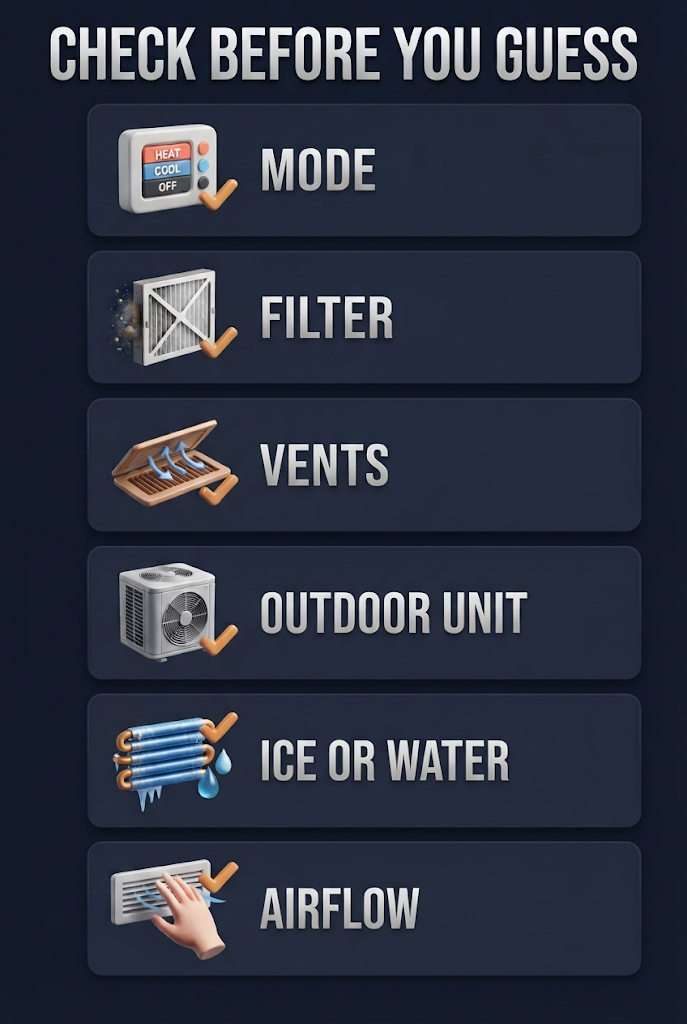
Before arranging service, several observations are reasonable:
- Confirm cooling mode and the thermostat setting.
- Inspect the accessible air filter.
- Make sure visible supply and return vents are not blocked.
- Listen for whether the outdoor equipment starts.
- Look for obvious ice, water, or unusual equipment behavior.
- Note whether airflow is strong, weak, or different by room.
If a breaker has tripped, repeatedly resetting it without knowing why is not a repair strategy. Electrical panels, capacitors, compressors, sealed refrigeration systems, and refrigerant lines should be left to qualified professionals.
Heating and cooling problems also matter financially because these systems represent a major part of building energy use. The U.S. Department of Energy says energy devoted to heating and cooling buildings accounts for around 35% of all energy consumption.
That makes accurate repair and performance testing more useful than letting a poorly operating system run indefinitely.
What Should You Tell the HVAC Technician?
When cold air suddenly disappears, a clear symptom report can help a technician understand where to begin before arriving. Instead of saying only that the AC is not working, the homeowner should describe what each part of the system is doing.
Useful details include:
- Whether the thermostat is set to Cool and calling for cooling
- Whether the indoor blower is running
- Whether the outdoor unit starts or stays silent
- Whether airflow feels strong, weak, or normal
- Whether the vent air is warm, room temperature, or briefly cold
- Whether there is visible ice, water, unusual noise, or a burning smell
- Whether the problem happened suddenly or became worse gradually
Even the timing matters. If the system cooled normally in the morning and stopped producing cold air later that afternoon, that pattern gives the technician another clue.
A precise description will not replace professional testing, but it can make the diagnostic conversation much clearer and reduce unnecessary guesswork.
Do This Before Blaming the Compressor
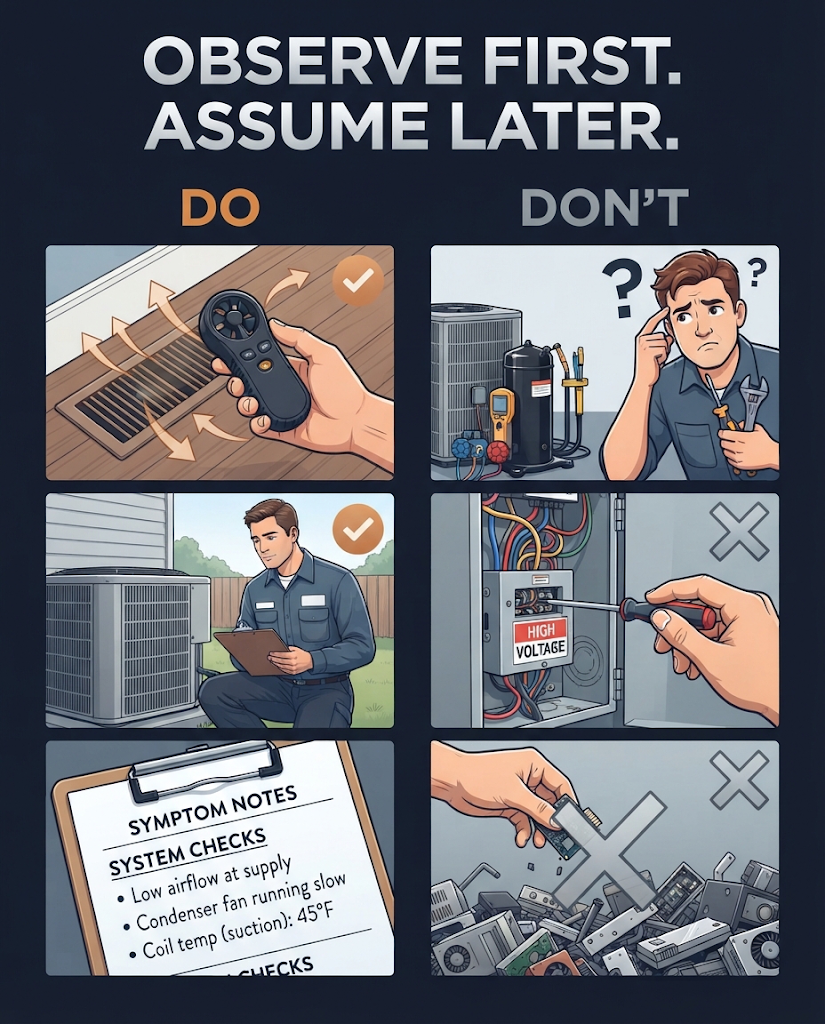
Do this: Say whether air is moving and whether it is actually cold.
Not that: Describe every no-cooling problem as “the fan is broken.”
Do this: Check whether the outside equipment appears to operate.
Not that: Open electrical panels or test energized components.
Do this: Report ice, water, strange sounds, and when the problem began.
Not that: Keep running equipment that is visibly freezing and hope it clears itself.
Do this: Ask what testing supports the diagnosis.
Not that: Assume room-temperature air automatically means a failed compressor.
Do this: Understand the cause before comparing hvac repair cost with replacement.
Not that: make the biggest financial decision from one symptom.
A Typical Cooling Breakdown and What It Tells You
Consider a familiar Charleston afternoon.
A combined heating and cooling system had been operating normally that morning. Later, a homeowner notices the house becoming warmer. Air still comes from the registers, so the first assumption is that the system simply cannot keep up.
The thermostat is checked. Cooling is selected.
The filter does not appear obviously blocked.
Then comes the useful observation: the indoor blower is unmistakably running, but the outdoor equipment is quiet.
That one detail transforms the service conversation. Rather than reporting only hvac not blowing cold air, the homeowner can explain that the cooling call appears active, indoor airflow continues, and the outdoor portion does not seem to start.
It does not prove a capacitor, contactor, wiring, power, or compressor failure. It simply narrows the territory.
A different house might produce the opposite pattern: both sections appear to run, but the supply air is no longer cold. That could send the evaluation toward airflow, coil condition, refrigeration performance, or another heat-transfer problem.
The familiar scenario matters because several faults can feel identical from the couch.
The job of testing is to make them stop looking identical.
Could High Humidity Be Part of the Problem?
Yes, but it should not blur two different complaints.
A high humidity in house problem often means the system is cooling but the property still feels sticky or damp. An air conditioner blowing truly room-temperature air suggests a more direct loss of cooling performance.
The two can overlap. A system with weak cooling may also remove moisture poorly, making the home feel warmer and heavier as the failure continues.
But if the supply air changed from noticeably cold to room temperature, that change deserves attention on its own. It should not be dismissed as “just humidity.”
Similarly, an ac not cooling complaint should not immediately become an equipment-sizing discussion. Sudden loss of cold air is more likely to call for fault diagnosis before long-term design questions are considered.
When Does Repair Become the Right Call?
Professional service is appropriate when basic controls and accessible airflow checks do not restore cooling, particularly when the outdoor unit will not operate, freezing is visible, electrical behavior seems abnormal, or the system continues blowing uncooled air.
The technician can then separate the indoor, outdoor, control, electrical, airflow, and refrigerant sides of the system through measurements rather than assumptions.
DOE guidance describes a comprehensive diagnostic approach that includes system inspection, airflow and temperature measurements, refrigerant-related checks, compressor electrical measurements, comparison with target values, repair, and verification afterward.
That last step matters: the job is not finished merely because a component was changed. Cooling performance should make sense after the repair.
For homeowners searching “hvac repair charleston sc“, the most useful question is therefore not, “What part usually causes this?” It is, “What test shows which part failed on this system?”
Conclusion: When the Fan Works but Cooling Does Not
An HVAC system can sound alive while the part that actually produces cooling has stopped doing its job. That is why hvac not blowing cold air should be described in pieces:
- what the thermostat is requesting
- whether the indoor blower runs
- whether the outdoor equipment starts
- how strong the airflow feels
- whether the air itself is cold.
Those details turn a vague comfort complaint into useful diagnostic information.
The answer may be straightforward maintenance, a thermostat or airflow correction, an electrical repair, a refrigerant-system issue, or a larger mechanical problem. The point is not to guess which one from the vent. It is to test the chain, identify where cooling stopped, and then decide whether repair or replacement makes practical sense.
For homeowners and property operators who want that cause explained before major work is recommended, Charleston Air Pros provides HVAC diagnostics, AC repair, airflow testing, thermostat service, maintenance, and repair-versus-replacement guidance. Visit Charleston Air Pros or email info@charlestonairpros.com to have a room-temperature-air problem evaluated from the control signal through the final cooling output.
What Are Homeowners Asking?
What makes a good diagnosis for room-temperature air?
A good diagnosis separates thermostat control, airflow, outdoor-unit operation, electrical performance, and heat transfer instead of guessing from one symptom.
What are the best practices when AC stops cooling?
Confirm the thermostat, inspect the accessible filter and vents, observe the outdoor unit, document symptoms, and avoid opening electrical or refrigerant components.
How can someone tell if the outdoor AC unit failed?
If the thermostat calls for cooling and the indoor blower runs while the outside equipment remains inactive, tell the technician exactly that.
When should an HVAC professional be hired?
Call when basic checks do not restore cooling or when there is ice, water, abnormal electrical behavior, unusual noise, or persistent room-temperature airflow.
Which services may fix an AC blowing warm air?
Depending on testing, the solution could involve controls, airflow, electrical components, coils, refrigerant-system work, maintenance, ductwork, or equipment repair.
Can a custom HVAC diagnosis lower unnecessary repair work?
It can help ensure the recommendation is based on the actual failure rather than automatically replacing whichever component seems most likely.
What should professional HVAC testing include?
Testing may include airflow, temperature performance, equipment operation, electrical behavior, coil condition, and refrigeration-system measurements as appropriate.
What affects HVAC repair cost when cooling suddenly stops?
The cost depends on the failed component and scope of work, which is why the cause should be established before repair and replacement options are compared.
What is the best first clue to give an HVAC technician?
Explain whether the thermostat calls for cooling, whether the blower and outdoor unit run, and whether airflow is strong but room temperature.
What are the top signs this is more than a filter issue?
Persistent no-cooling after a clean filter check, an inactive outdoor unit, visible freezing, abnormal sounds, or ongoing room-temperature supply air warrant deeper testing.