
Set to Seventy-Two, Stuck at Seventy-Eight: When Humidity Wins
August 20, 2026
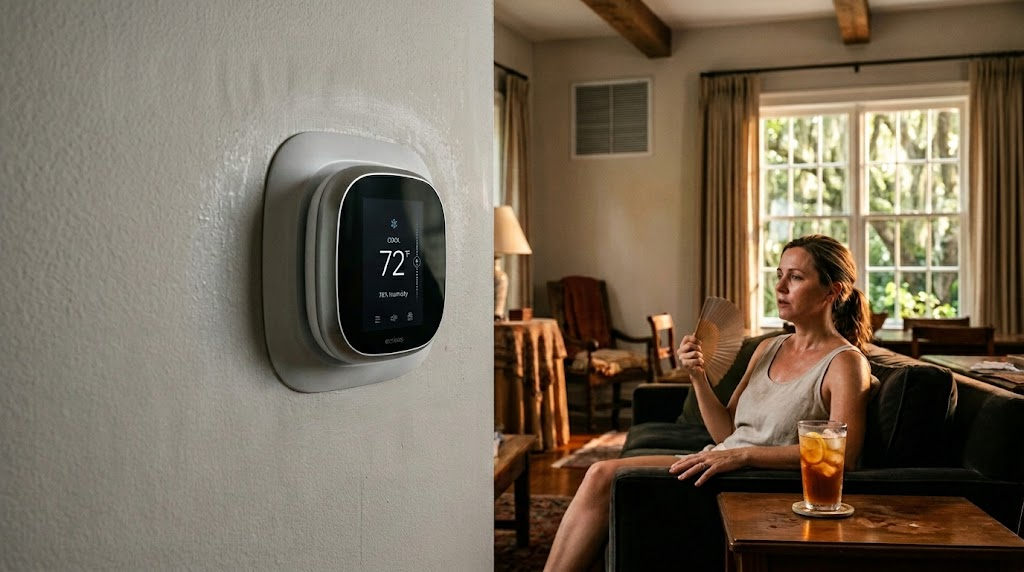
A Charleston homeowner lowers the thermostat before dinner. The display accepts the setting. The air conditioner starts. Hours later, the system is still running and the room still feels warm and heavy.
That is the maddening part of an ac not cooling below 75 complaints. The thermostat may say one thing, a room thermometer another, and the body may report something warmer still.
In peak Lowcountry summer, that mismatch can push a homeowner toward a quick conclusion: the unit is undersized, the thermostat is broken, or replacement is inevitable.
The better first move is to separate temperature from moisture, airflow from capacity, and a real mechanical failure from a comfort problem that only resembles one.
The National Weather Service notes that relative humidity can be misleading because it changes with temperature, while dew point more directly reflects moisture in the air.
As Mark Twain put it,
“Climate is what we expect, weather is what we get.”
Charleston homes often make that difference feel very real.
Key Takeaways:
- A low thermostat setting does not prove the house is actually reaching that temperature.
- High indoor moisture can make a reasonably cool room feel warmer and can expose dehumidification problems.
- Weak airflow, dirty components, duct leakage, control issues, refrigerant problems, and incorrect sizing can produce similar symptoms.
- Replacement should follow diagnosis, not replace it.
Thermostat Says 72°F. Why Does Your Home Feel Like 78°F?
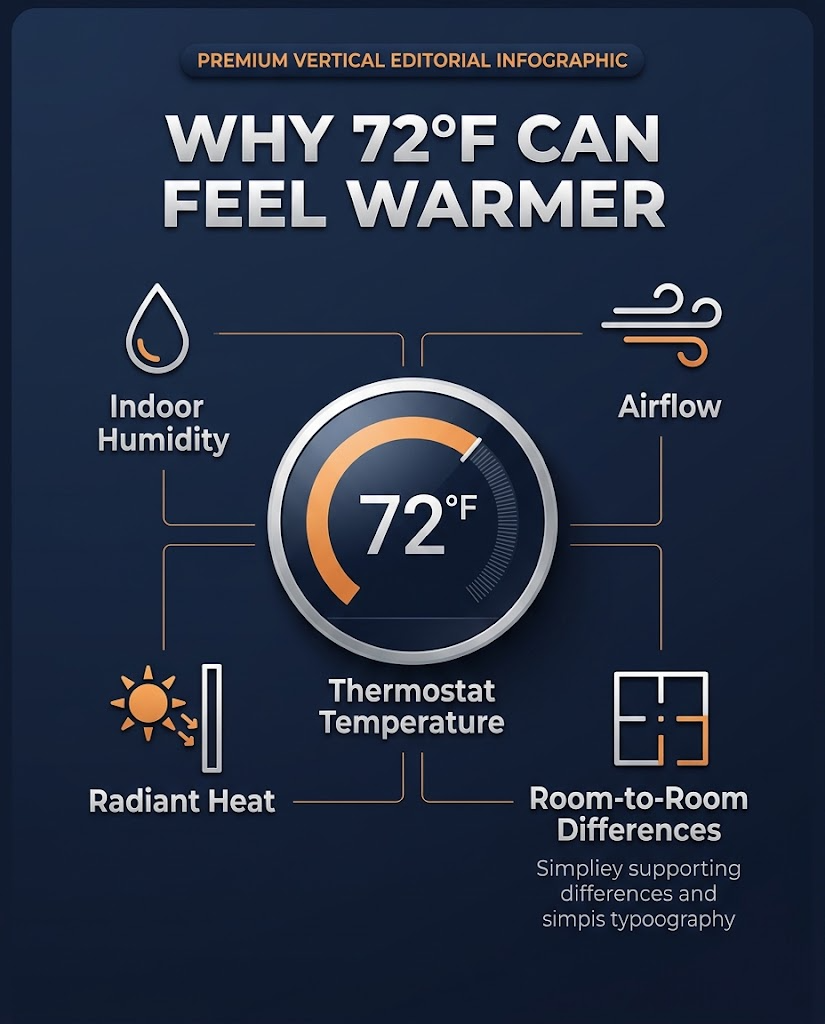
A thermostat is a sensor, not a comfort meter. It reads temperature where it is installed. It does not directly measure how warm sunlit walls feel, how much moisture is sitting in the indoor air, whether a bedroom at the end of a duct run is starved for airflow, or whether the upstairs ceiling is radiating heat from a hot attic.
That distinction matters when a homeowner says the AC is set to 72 but the house feels like 78. There are actually three different questions hiding inside that sentence.
First, is the thermostat reading accurate? Second, is the rest of the home actually at the same temperature as the thermostat location? Third, even if the air temperature is correct, is high humidity in house conditions making the space feel clammy and warmer than expected?
A separate room thermometer and a basic humidity meter can begin sorting those questions without touching the HVAC equipment.
If the thermostat says the target has been reached but another thermometer in the occupied space reads warmer, sensor location or air distribution deserves attention. If the temperatures are close but the home still feels muggy, moisture control moves higher on the list.
This is also why the question ac not cooling needs more detail than a setpoint alone can provide. Cooling is not simply a number on a wall. It is a system moving heat and moisture out of a building while distributing conditioned air back through the rooms people actually use.
Humidity Changes the Whole Equation
Air conditioning lowers air temperature and also removes moisture as warm indoor air passes over a cold evaporator coil. If that moisture-removal process is weak, a home can feel uncomfortable even when the thermostat looks respectable.
Short cycling, restricted airflow, coil trouble, refrigerant problems, air leakage, or control settings can all interfere with dehumidification.
The U.S. Environmental Protection Agency advises keeping indoor humidity low and notes that excess moisture can contribute to condensation and mold concerns. In Charleston, humidity is therefore a diagnostic clue, not a footnote.
One nuance matters: formal outdoor heat index uses air temperature and relative humidity, while dew point is often more intuitive for understanding how much moisture is actually in the air. Indoors, the practical lesson is simpler: comfort cannot be judged by thermostat temperature alone.
The System Is On. The Comfort Is Not.
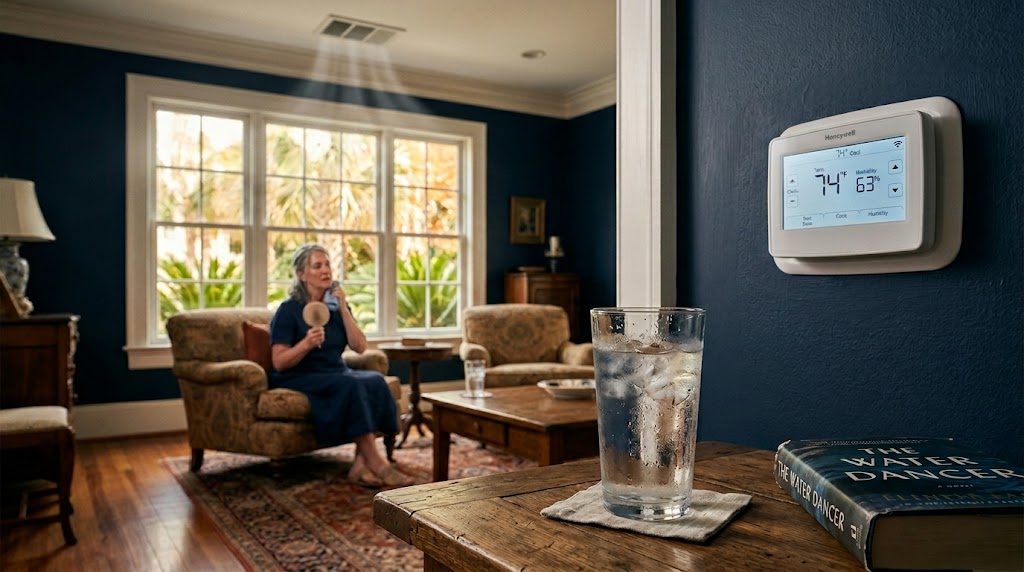
Long run time is a symptom, not a diagnosis. On a harsh summer afternoon, a healthy system may run longer because sunlight, attic heat, outdoor air leakage, cooking, occupancy, and duct losses are adding load.
The concern grows when the pattern is persistent: long cycles, little temperature progress, warm rooms, and sticky air even after conditions ease.
According to the U.S. Energy Information Administration, air conditioning accounted for about 19% of electricity consumption in U.S. homes in 2020. That makes poor cooling performance worth investigating before extra runtime becomes the household’s normal.
A homeowner searching what size ac do i need may assume a larger unit is the answer. Capacity matters, but so do moisture, ducts, airflow, the building envelope, and actual cooling demand. The better question is what is preventing the home from reaching and holding comfortable conditions.
What’s Really Stopping Your Home From Cooling Down?
Several different faults can create the same stuck-temperature complaint.
A dirty filter can restrict airflow. Dirty coils can reduce heat transfer. A frozen evaporator coil can choke cooling. A refrigerant problem can weaken cooling and moisture removal. Leaky or poorly balanced ducts can send conditioned air somewhere other than the room that needs it.
Thermostat location matters too. A sensor in a cool hallway may be satisfied while a sun-exposed living room stays warm.
There is also a separate control problem that sounds similar: the thermostat itself will not accept a lower setting. That is different from a system that accepts the setpoint but cannot reach it. If two similar thermostats behave differently, or one refuses to move below a set value, control settings, scheduling, sensor behavior, and thermostat operation deserve attention before the cooling system is blamed.
So an ac not cooling below 75 diagnosis should begin by confirming whether the equipment cannot reach the target or the control will not allow it.
| Symptom | Likely Direction | Homeowner Clue | Best Next Move |
|---|---|---|---|
| Thermostat reached, room feels sticky | Moisture control | Clammy air, condensation | Check indoor humidity and system cycles |
| Temperature will not fall | Heat removal problem | Long runtime, weak progress | Check filter, airflow, coils, equipment |
| One area stays warm | Distribution problem | Room-to-room difference | Inspect vents, ducts, balancing |
| Thermostat will not accept lower setting | Control problem | Setpoint itself is limited | Review thermostat settings and controls |
| Fast cooling, muggy house | Possible oversizing | Short cycles, poor moisture removal | Evaluate sizing and runtime pattern |
| Cold vent air, warm room | Load or airflow mismatch | Cool supply, poor room comfort | Check airflow, duct delivery, heat gain |
The Five Checks That Reveal What’s Really Wrong
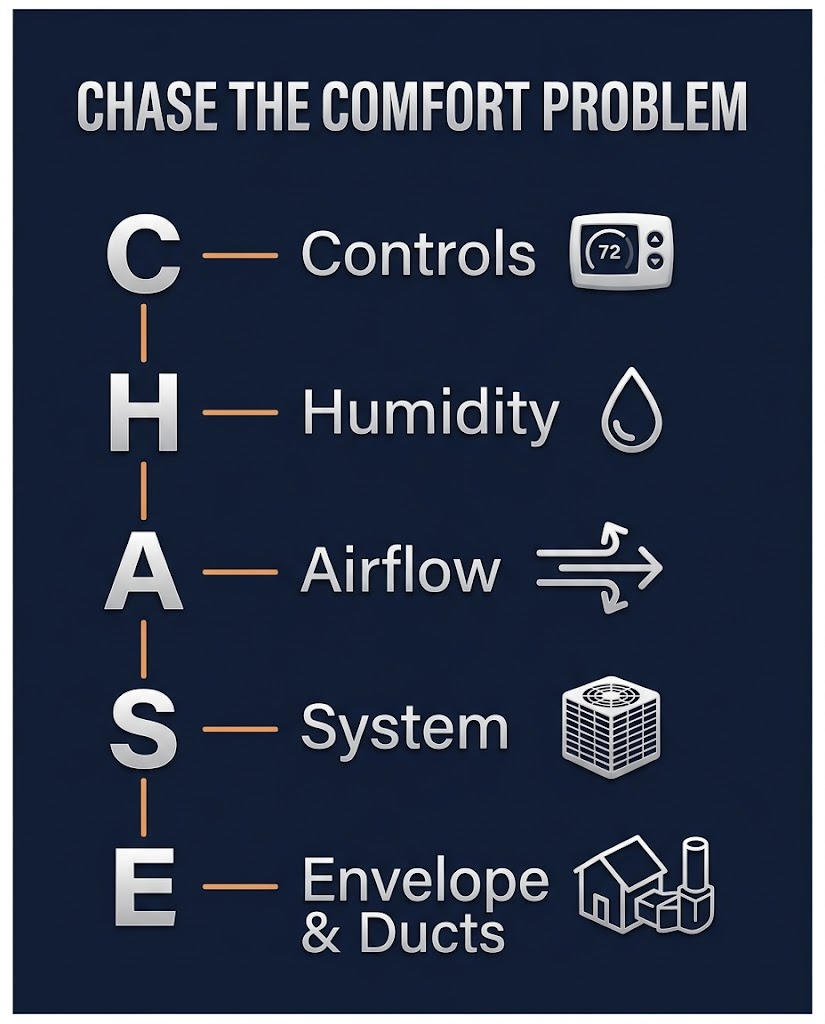
A useful way to avoid guesswork is to CHASE the problem instead of chasing the thermostat.
C — Controls. Confirm cooling mode, setpoint behavior, schedules, and whether the sensor agrees reasonably with a separate thermometer.
H — Humidity. Notice damp air, condensation, and whether cooling cycles are actually drying the home. A high humidity in house complaint can point toward short cycling, moisture infiltration, or weak dehumidification.
A — Airflow. Check the filter, open supply and return paths, and compare airflow between rooms.
S — System. Icing, unusual sounds, weak cooling, suspected refrigerant trouble, dirty coils, or electrical problems call for professional diagnosis.
E — Envelope and ducts. Leaky ducts, air leakage, insulation gaps, solar gain, and attic heat can add load that becomes obvious in peak summer.
The order matters: simple controls and airflow come before expensive conclusions, while moisture stays near the top because Charleston comfort depends on it.
What Should a Homeowner Check First?
A safe first pass can reveal a lot without turning the homeowner into a technician.
- Confirm thermostat behavior. Make sure it accepts the setting and calls for cooling.
- Compare temperatures. Check the main living area with a separate thermometer.
- Inspect the filter. Replace a visibly dirty filter with the correct type and size.
- Check vents and returns. Remove obvious obstructions and note weak rooms.
- Look and listen. Ice, water, strange noises, weak airflow, or air that no longer feels cool justify service.
- Notice the pattern. Is the problem limited to one room, peak afternoon, or the entire day?
Patterns matter. One west-facing room overheating late in the day suggests a different direction than a whole house that never recovers. The goal is not DIY repair; it is better evidence for the next decision.
Smart HVAC Moves vs Costly Assumptions
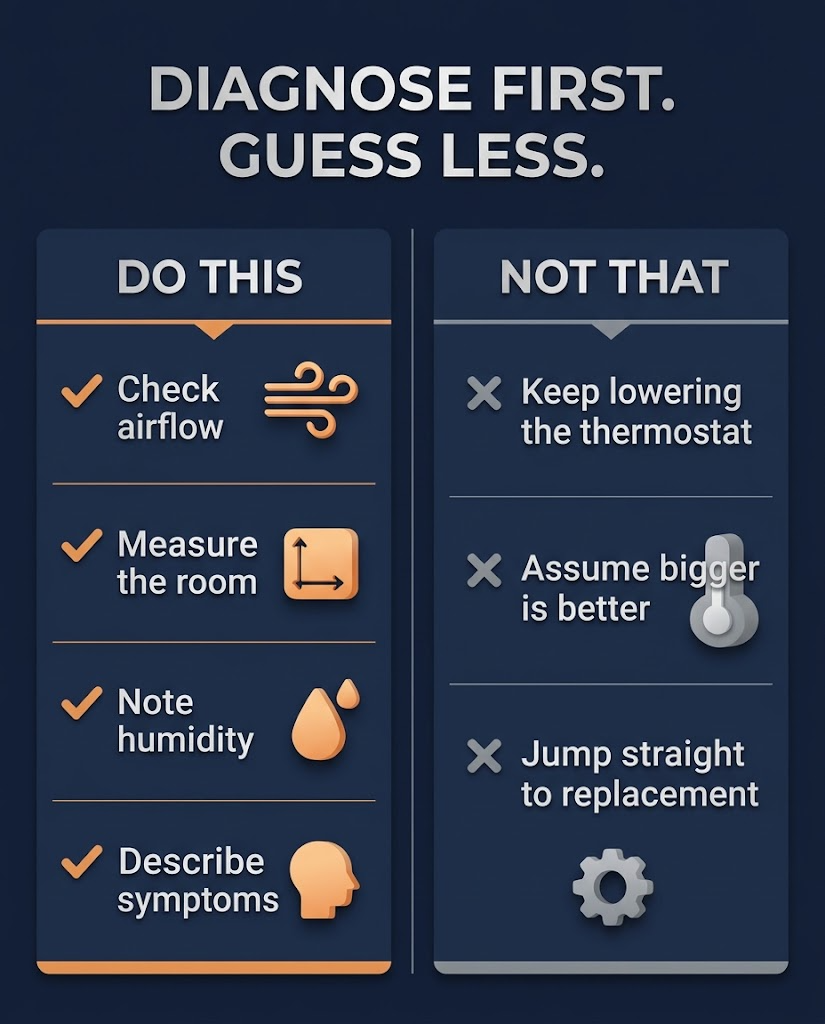
Do this: describe what the system is doing.
Not that: diagnose it from the thermostat number alone.
Do this: note run time, airflow, room differences, moisture, noises, and whether the setpoint is actually accepted.
Not that: keep lowering the thermostat and assume a lower number forces the equipment to cool faster.
Do this: replace a clearly dirty filter and remove obvious vent obstructions.
Not that: open refrigerant lines, electrical panels, or frozen equipment in an attempt to force a repair.
Do this: ask for the cause to be explained before approving major work.
Not that: assume the answer to what size ac do i need is automatically one size larger than what is already installed.
This is where a diagnosis-first approach protects the customer. The expensive option can be the right option, but it should earn its place through evidence.
Is the AC Size Wrong, or Is the Problem Somewhere Else?
Sizing gets blamed quickly because it sounds intuitive: a warm house must need more cooling power.
An undersized system can struggle when the load exceeds its capacity. An oversized system can create a different problem by satisfying the thermostat quickly and shutting off before moisture removal catches up.
The right size is not determined by square footage alone. Insulation, windows, orientation, air leakage, ducts, occupancy, internal heat, and local climate all affect load. That makes what size ac do i need a calculation question, not a guess.
It also explains why replacement should not open every ac not cooling conversation. A duct leak, poor return airflow, control issue, dirty coil, or moisture problem can survive the installation of new equipment.
On extreme afternoons, even sound equipment may run hard; persistent underperformance deserves deeper testing.
What Does a Real Diagnosis Look Like?
A strong HVAC diagnosis moves from symptom to evidence.
It starts with the pattern: when the problem began, which rooms are affected, whether nights are better, whether the home feels damp, and whether anything recently changed.
Then the technician verifies temperature, airflow, equipment operation, coil condition, refrigerant performance, duct behavior, drainage, and electrical operation as needed.
Sequence matters. Airflow should be checked before undersizing is assumed. Refrigerant trouble should be verified, not guessed. Replacement should connect to condition, performance, repairability, comfort goals, and the building’s needs.
For anyone searching AC repair Charleston SC, that standard matters. The useful service call explains the cause and why the recommended level of work is justified.
The Charleston Summer Pattern That Points to HVAC Trouble
Consider a familiar, hypothetical Lowcountry scenario.
A two-story home feels acceptable in the morning. By midafternoon, the thermostat has stopped making progress. The upstairs rooms are warmer, the air feels heavy, and the system seems to run without a break. The owner assumes the AC is too small.
The CHASE check changes the conversation.
The thermostat is responding normally. The filter is not badly restricted. The downstairs supply airflow feels stronger than the upstairs airflow. The home feels especially muggy after long cycles, and the worst rooms sit below the attic and at the end of longer duct runs.
None of that proves a single cause. It does, however, point away from blind replacement and toward a proper airflow, duct, moisture, and equipment-performance evaluation.
Perhaps the final answer is repair. Perhaps maintenance restores capacity. Perhaps duct improvements solve the room imbalance. Perhaps the existing equipment is genuinely mismatched to the load and replacement becomes the sensible long-term choice. The point is that each option should emerge from the evidence.
That is what dependable comfort looks like in a humid climate: not one magic fix, but the right fix for the actual failure.
When Should You Stop Guessing and Call an HVAC Pro?
Homeowners can handle basic observation, filter replacement, thermostat checks, and removing obvious airflow obstructions. Professional help is appropriate when the system still cannot maintain reasonable comfort after those basics are addressed, or when the symptoms suggest something deeper.
Service should move up the list when there is ice, leaking water, unusual electrical behavior, unfamiliar noises, weak airflow throughout the home, a thermostat that behaves inconsistently, repeated short cycling, suspected refrigerant trouble, or a persistent gap between the setpoint and actual room temperature.
A professional evaluation is also useful when comfort varies dramatically from room to room or when the house cools but never feels dry. Those patterns can require airflow testing, duct inspection, system-performance testing, thermostat evaluation, or a broader indoor air quality and humidity strategy.
Commercial properties, rentals, and managed homes deserve the same logic. Occupancy, operating schedules, doors opening frequently, zoning, tenant complaints, and maintenance history can all affect what looks like a simple cooling complaint.
The best service recommendation should therefore answer two questions: What is failing now, and what will prevent the same problem from returning?
Conclusion: Fix the Cause, Not Just the Temperature
When the thermostat is set low but the house still feels warm, repeatedly lowering the number rarely solves the real problem.
The better approach is to find where comfort is breaking down, whether that involves humidity, weak airflow, thermostat behavior, equipment performance, duct losses, or the home itself. That is especially important when ac not cooling below 75 is paired with sticky air, long run times, uneven rooms, or rising energy costs.
A good HVAC decision starts with diagnosis, not assumptions. Sometimes the answer is a simple repair or maintenance issue. In other cases, airflow improvements, humidity control, thermostat work, duct corrections, or replacement may make more sense. What matters is understanding the cause first so the solution actually addresses the problem instead of covering up the symptom.
For homeowners, landlords, property managers, and businesses that want clear answers before work is recommended, Charleston Air Pros provides diagnosis, repair, maintenance, airflow and humidity solutions, thermostat services, and repair-versus-replacement guidance. Visit Charleston Air Pros or email info@charlestonairpros.com to start with a proper evaluation and make the next decision with more confidence.
What Are Homeowners Asking?
What makes a good AC diagnosis?
It verifies the complaint, checks controls and airflow, considers humidity and duct conditions, and explains the evidence before recommending major work.
What are best practices when AC will not cool lower?
Start with thermostat behavior, filter condition, room temperature, open vents, airflow, and visible warning signs. Escalate when those checks do not explain the problem.
Are smart thermostat trends fixing comfort problems?
They can improve scheduling and reveal runtime patterns, but they cannot repair airflow, duct, coil, refrigerant, or sizing problems.
How to tell if humidity is the real problem?
Look for clammy air, condensation, and comfort that feels worse than the measured temperature.
When to hire a professional HVAC technician?
Call when basic checks fail to explain poor cooling, or when there is ice, water, unusual noise, weak airflow, or suspected mechanical trouble.
Which services can solve a stuck-temperature issue?
The answer may involve repair, maintenance, thermostat work, airflow balancing, duct service, humidity control, testing, or replacement.
Can a custom airflow solution beat equipment replacement?
Sometimes. If equipment is healthy but rooms are starved for conditioned air, duct or airflow improvements may solve the real problem.
What should professional AC repair check first?
It should start by confirming the symptom and testing plausible causes rather than assuming a major component or system size is at fault.
What is the best first step before replacing an AC?
Get a complete diagnosis. Replacement should follow evidence that the existing system cannot reliably meet the building’s needs or practical repair goals.
What drives cost, and what are the top repair factors?
Cost depends on the fault, access, parts, labor, system condition, and whether the fix involves repair, controls, ducts, airflow, humidity, or replacement.