
The AC Is Running. The House Is Hot. Here Is What That Gap Means
August 15, 2026
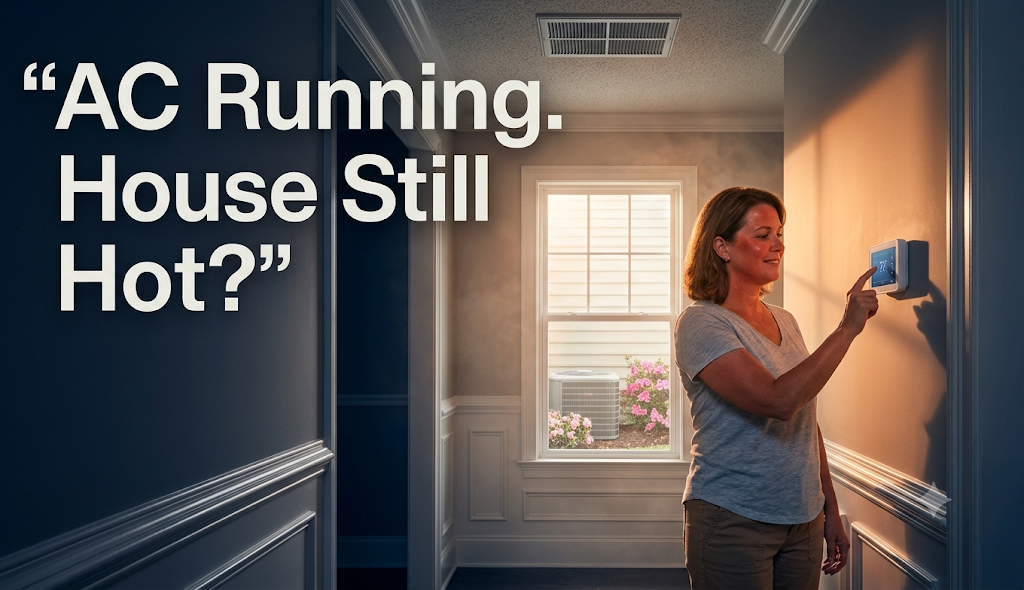
The thermostat says cooling. The outdoor unit is running. Air is coming from the vents. Yet the Charleston house keeps getting warmer, and every degree of discomfort makes the same thought louder: is this a simple filter problem, or is the system headed toward a major repair?
That uncertainty makes an ac not cooling problem stressful. A homeowner may be sweating through the afternoon while deciding whether to check a vent, call for service, or brace for replacement. A landlord may be dealing with an uncomfortable tenant and no clear idea whether the problem is maintenance, airflow, controls, or equipment.
An air conditioner can run without successfully cooling the building. Cooling depends on airflow, heat transfer, controls, duct delivery, and the home itself. A problem anywhere along that path can create the same hot-house symptom.
The first question should not be, “How much is a new AC?” It should be, “Where is the cooling process breaking down?”
Key Takeaways
- A running system can still have an airflow, duct, thermostat, refrigerant, or heat-transfer problem.
- The pattern of discomfort often gives the first useful clue.
- Basic checks can rule out simple causes, but technical testing matters when the cause is unclear.
- Replacement should follow diagnosis, not fear.
Why Is the AC Running but Your Charleston Home Still Hot?
An AC system has to do more than turn on. The thermostat must call for cooling. The blower must move enough air. The refrigeration cycle has to absorb indoor heat and release it outdoors. The duct system then has to deliver conditioned air where people actually live or work.
If any stage underperforms, the result can be ac not cooling but running.
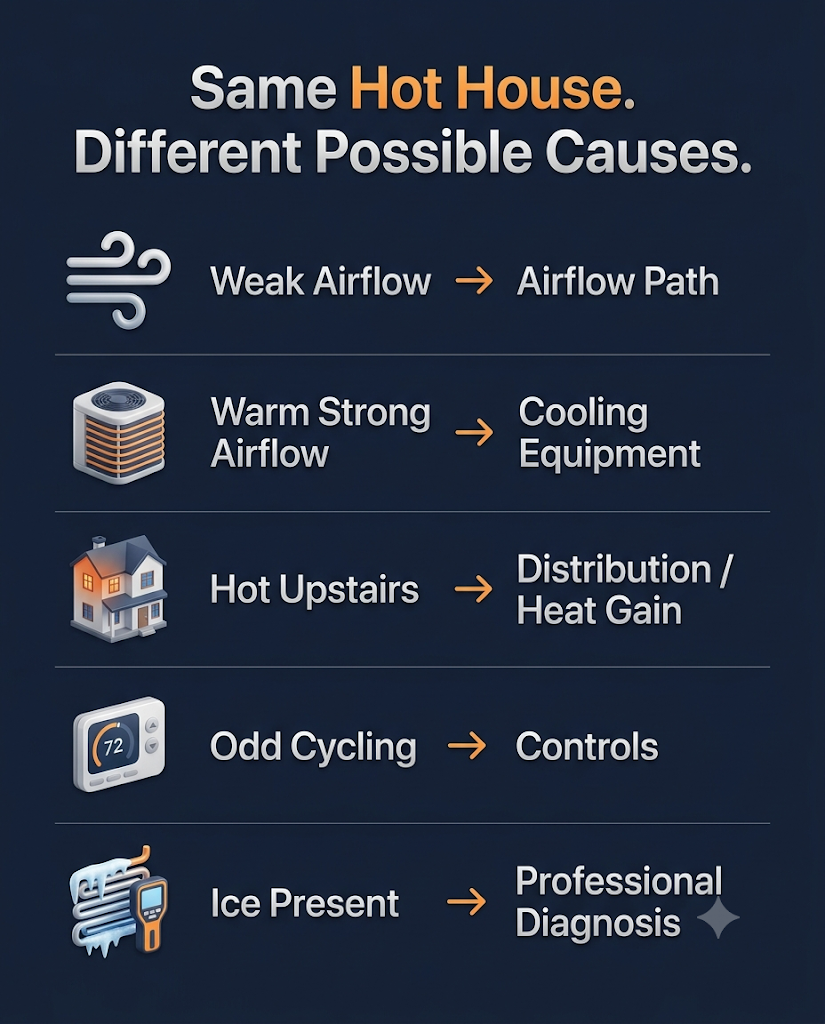
Strong airflow that feels warm is not the same as barely any airflow. A house that cools in the morning but falls behind later is not behaving like one that never produces cool air. A hot upstairs with a comfortable downstairs is different from a whole-house failure.
Those differences narrow the diagnosis. Before anyone talks about a compressor or replacement, the pattern should be clear: where the heat is, when it appears, how airflow feels, and whether the problem changed suddenly.
A technician can test equipment. The homeowner’s job is simpler: notice the pattern.
Poor Airflow Can Be the Real Reason Your Home Stays Hot
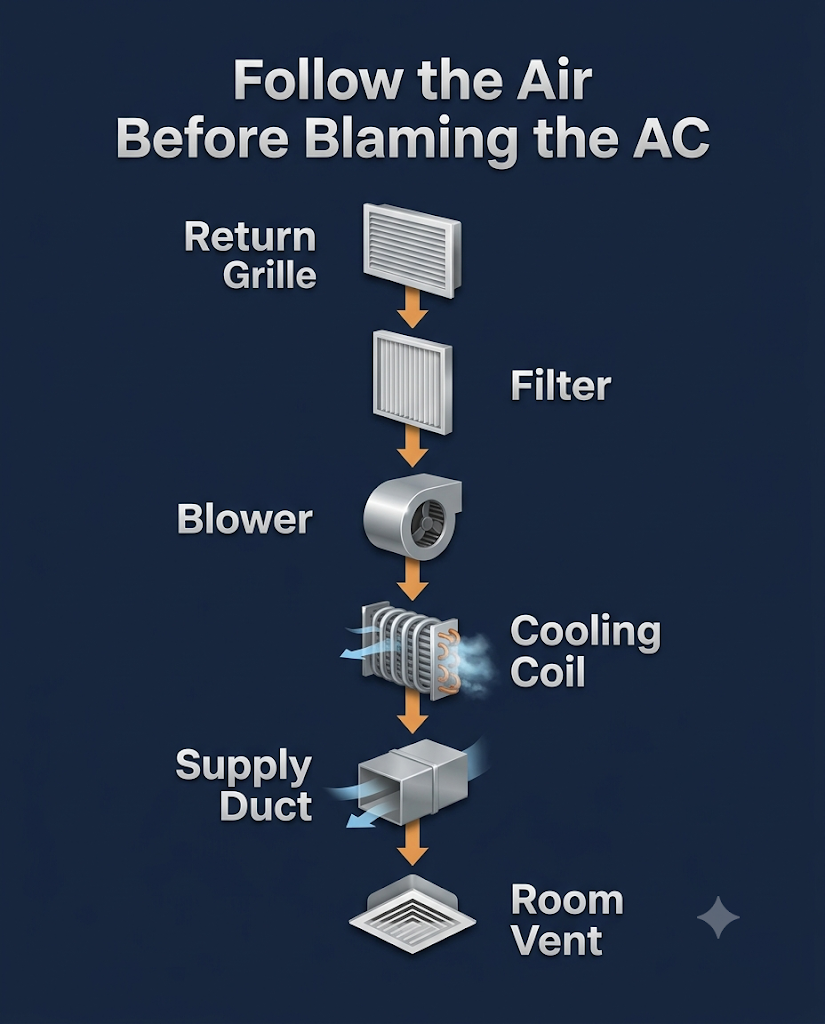
Cooling depends on moving air. If the system cannot pull enough indoor air through the return side and push enough conditioned air through the supply side, comfort suffers even when the cooling equipment can produce cold air.
A dirty air filter adds resistance and can reduce airflow. Blocked return grilles create similar problems. Supply registers hidden behind furniture, curtains, rugs, or storage can stop conditioned air from spreading through a room.
The pattern of weak airflow from vents is especially useful. If airflow is weak everywhere, the issue may be closer to the filter, blower, coil, return path, or a larger distribution problem. If most rooms have strong airflow but one bedroom does not, the problem may be isolated to that branch, damper, register, or room design.
This is where ac repair cost anxiety can mislead. One hot room can make an entire system seem dead even when the root problem is distribution.
A basic airflow check cannot diagnose every failure, but it can keep the most expensive possibility from becoming the first assumption.
Could a Dirty Filter or Blocked Vent Be the Whole Problem?
Sometimes it can be that simple, so the basics deserve a few minutes before the service call.
Confirm that the thermostat is set to cooling, not only fan mode. Inspect the filter for heavy loading. Make sure supply registers are open and returns have room to pull air freely.
Homeowners should also resist closing several vents in unused rooms to “push” more air elsewhere. Residential systems operate around expected airflow and pressure. Randomly closing registers changes that balance and does not guarantee useful cooling will reach another room.
If the filter is dirty, replace it with the correct type. If a vent is blocked, clear it. Then watch whether the cooling pattern changes.
If the air conditioner not cooling problem remains unchanged, the diagnosis needs to move beyond obvious maintenance issues.
Benjamin Franklin’s line still fits:
“An ounce of prevention is worth a pound of cure.”
Preventive maintenance cannot stop every breakdown, but early attention to restrictions and small performance problems can keep them from being ignored until comfort is already gone.
Why Is the Upstairs Hot While the Downstairs Feels Fine?
An upstairs ac not cooling complaint often makes homeowners think the equipment is too small. Capacity can matter, but upper-floor discomfort can also come from airflow distribution, insulation, solar heat gain, return-air limitations, or duct design.
Second-floor rooms often sit closer to attics and roofs that absorb intense afternoon sun. A west-facing bedroom can experience a different heat load from a shaded first-floor room. Large windows and weak insulation can add more heat for the HVAC system to fight.
Air distribution matters too. A long duct run may deliver less air than a short central run. A closed or poorly adjusted damper can reduce supply. A room with supply air but no effective return path can also struggle.
A familiar Charleston pattern is a comfortable downstairs in the morning and hot upstairs bedrooms by late afternoon. The system runs longer, and the first fear is AC failure. Yet weak upstairs airflow, strong sun, attic heat, and duct distribution may all deserve evaluation before equipment size becomes the only theory.
That is why uneven cooling is diagnostic evidence, not automatic proof that the air conditioner needs replacement.

Hidden Ductwork Can Steal Cooling Before It Reaches the Room
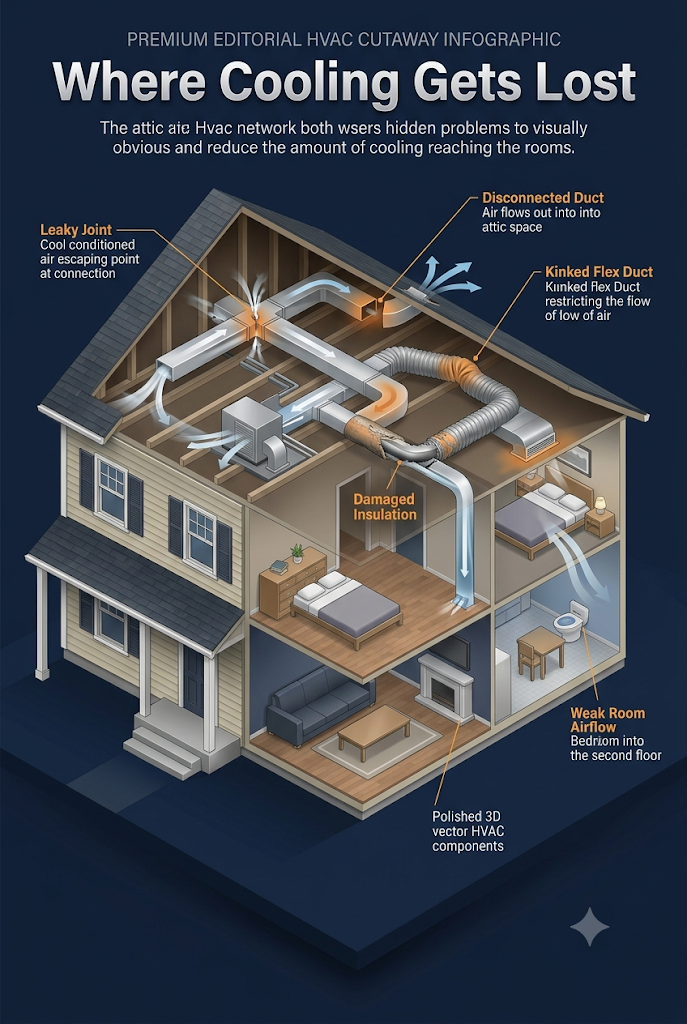
Most homeowners rarely see the duct system, but every cooled room depends on it. Ducts can leak at joints, pull apart, kink, lose insulation, or run through extremely hot spaces. The system may cool air correctly and still fail to deliver enough of it to the living area.
ENERGY STAR says that in a typical home, about 20% to 30% of the air moving through a duct system can be lost through leaks, holes, and poorly connected ducts. That can contribute to higher energy use and rooms that are difficult to keep comfortable.
Possible ductwork issues include rooms that consistently receive less airflow, visible crushed or disconnected duct sections, and spaces that never respond like neighboring rooms.
Duct problems matter especially when ducts pass through attics, crawl spaces, garages, or other unconditioned areas. Lost conditioned air there does nothing for occupied rooms.
This is one reason an ac repair charleston sc search should lead to diagnosis rather than an automatic equipment swap. If cooling is being lost between the air handler and the bedroom, replacing equipment alone may not solve the complaint.
Could the Thermostat Be Misleading the System?
Yes. A thermostat problem can look surprisingly similar to an equipment problem.
The thermostat tells the HVAC system when cooling is needed. If it is in the wrong mode, reading the room inaccurately, following an unexpected schedule, or influenced by direct sun or nearby electronics, system behavior may not match what the homeowner expects.
Confirm that cooling mode is selected and the setpoint is below the room temperature. If the fan is set to “on,” remember that the blower may keep moving air even when active cooling is not happening. Feeling air at a vent does not always mean the refrigeration side is operating.
Smart thermostats add schedules, remote sensors, occupancy settings, and energy-saving modes that can complicate troubleshooting. Control problems can also contribute to short cycling or an AC running constantly complaint.
This does not prove the thermostat is at fault. It means thermostat problems belong early in a logical diagnostic path because controls are part of the cooling chain.
If the settings are correct and the house keeps losing comfort, the investigation moves deeper.
When Do Refrigerant or AC Equipment Problems Become Likely?
Once airflow, filters, vents, and controls have been checked, technical causes deserve more attention.
A system producing AC blowing warm air with normal-looking airflow may have trouble on the refrigeration or outdoor-unit side. A dirty outdoor coil can reduce heat rejection. Electrical components can fail. Motors can weaken. The compressor or indoor coil can develop problems.
Low refrigerant can also reduce cooling, but refrigerant should not be treated as something an air conditioner normally “uses up.” In a sealed system, a low charge usually means the reason needs to be identified. Repeatedly adding refrigerant without finding the cause can turn diagnosis into a temporary patch.
Homeowners should not open electrical panels, handle refrigerant, or attempt compressor testing. What they can do is observe safely: Is the outdoor unit operating? Is vent air warm, cool, or barely moving? Is there visible ice? Has the sound changed? Did cooling fail suddenly?
Those clues help separate HVAC airflow problems from refrigeration or mechanical failures and help a technician choose the right tests.
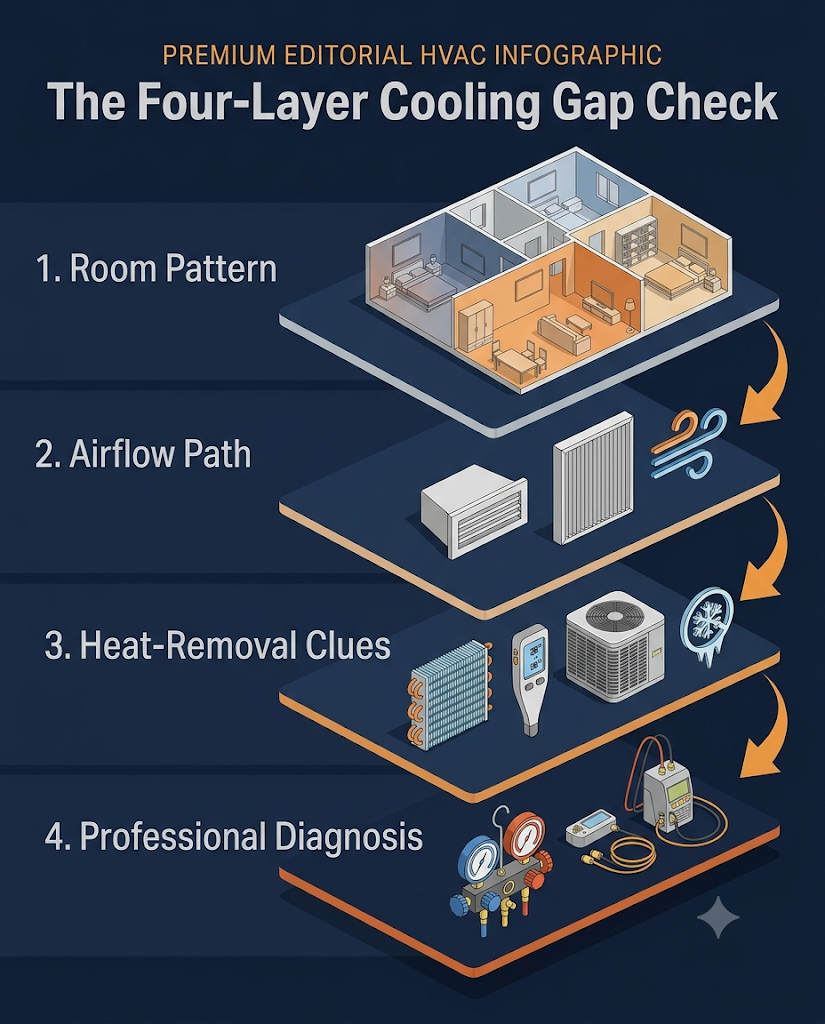
The 4-Step Cooling Gap Check Before You Call for Repair
A useful way to think about a hot house is to move from the room toward the equipment instead of jumping straight to parts.
1. Room pattern: Identify where discomfort occurs. Is the whole house hot, one floor hot, or one room always behind? Does the problem worsen later in the day?
2. Airflow path: Inspect the filter, open registers, clear returns, and compare airflow between rooms. Notice whether air is strong, weak, cool, or warm.
3. Heat-removal clues: Notice changes in sound, unusual outdoor-unit behavior, visible ice, unexpected water, or cooling that keeps fading while the system runs.
4. Professional diagnosis: When the first three layers do not explain the problem, performance testing should determine what the system is actually doing before major work is recommended.
| What the homeowner notices | Possible area to investigate | Safe first check | Why diagnosis matters |
| Weak air throughout the home | Filter, return restriction, blower, coil | Inspect filter and returns | Several causes feel similar |
| One room remains hot | Duct branch, balance, insulation, sun | Compare nearby vents | Equipment may be fine |
| Strong airflow feels warm | Controls, outdoor unit, refrigeration | Verify cooling mode | Technical testing is needed |
| Upstairs stays hotter | Airflow, ducts, attic heat, return path | Check vents and heat exposure | Bigger AC may not solve it |
| Long run times with little comfort change | Heat load, distribution, equipment | Note the pattern | Testing separates cause from symptom |
The homeowner does not need to become a technician. The framework simply creates better observations.
Smart AC Checks vs. Costly Cooling Mistakes
A hot house can make every HVAC problem feel urgent, but urgency should not replace a clear diagnosis.
Do this: Check the thermostat settings, air filter, supply vents, return grilles, and the room-by-room cooling pattern.
Not that: Assume every ac not cooling but running complaint means the compressor has failed.
Do this: Ask what was tested, what the technician found, and how the recommended work addresses the problem.
Not that: Make a repair or replacement decision based only on the first ac repair cost number presented.
Do this: Consider airflow, ductwork, equipment condition, recurring problems, and overall comfort before choosing the next step.
Not that: Replace equipment before confirming whether the real problem is mechanical, electrical, airflow-related, or somewhere else in the cooling system.
The Upstairs Hot Spot That Points to a Bigger Problem
Picture a Charleston homeowner coming home late in the afternoon. The downstairs feels reasonably comfortable, but the upstairs bedroom is hot enough to notice immediately. The thermostat shows that the AC has been running, so the first thought is expensive: the system must be failing.
A quick check tells a more useful story. The filter needs attention, but the downstairs vents still have decent airflow. Upstairs, the airflow feels weaker. The hottest room also receives strong afternoon sun and sits beneath the attic.
Instead of assuming the entire AC needs replacement, those clues give a technician a clearer starting point. Airflow distribution, duct condition, return-air movement, heat gain, and equipment performance can all be checked before deciding what needs repair.
The scenario shows why an upstairs ac not cooling problem should be diagnosed as a pattern, not treated as automatic proof that the whole system has reached the end of its life.
When Should a Charleston Homeowner Stop Troubleshooting?
Basic checks have a limit.
Professional service makes sense when the filter and vents are not the answer, airflow remains weak, the system blows warm air, visible ice appears, electrical or mechanical noises develop, outdoor equipment behaves abnormally, or the home keeps getting hotter despite long cooling cycles.
It is also time to call when the problem keeps returning. A system that briefly improves after a reset but repeatedly loses cooling needs more than another reset. A room that has been uncomfortable for years may need airflow or duct evaluation. Repeated refrigerant additions require the reason to be investigated.
A good diagnostic visit should turn vague discomfort into specific findings. Airflow, temperature differences, electrical components, refrigeration performance, duct conditions, and thermostat operation can all be evaluated.
That is what a search for ac repair charleston sc should produce: clarity about the failure, not pressure to choose the most expensive option before the cause is understood.
For landlords and property managers, a clear explanation of what was found, what was corrected, and what remains to watch can also make future service decisions easier.
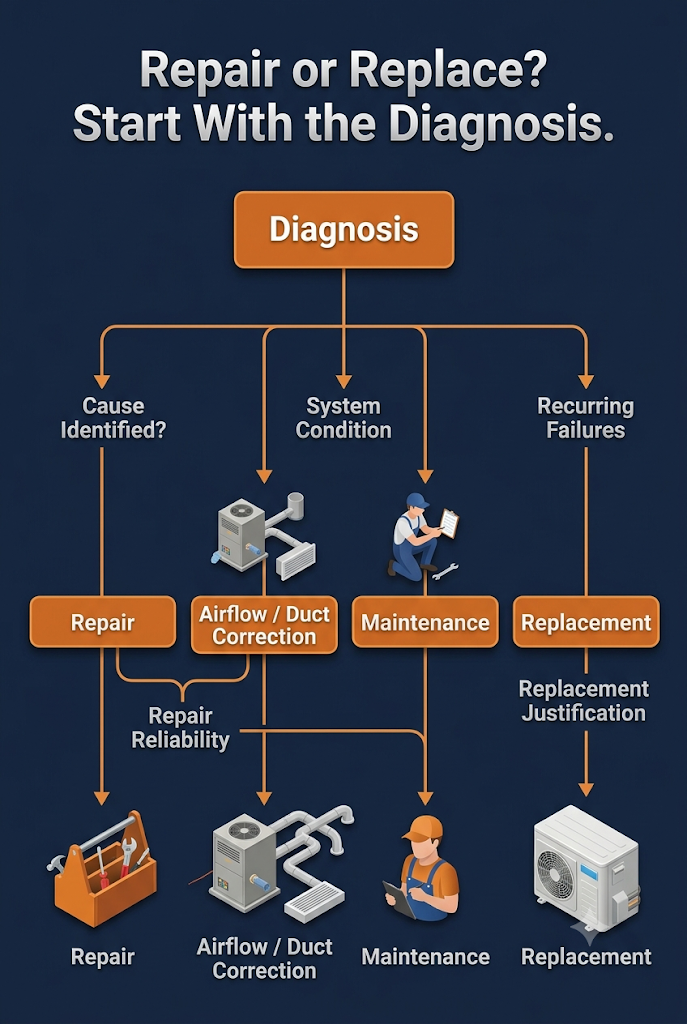
Repair vs. Replacement Starts With the Diagnosis
Repair and replacement are different solutions for different system conditions.
A repair can make sense when the failed component or airflow problem is identifiable, the rest of the system is in reasonable condition, and correcting the issue is expected to restore dependable cooling. Maintenance or balancing may be enough when the core equipment is sound.
Replacement deserves discussion when the system has broader reliability problems, repeated failures, major mechanical damage, poor overall performance, or repair needs that no longer make practical sense compared with the equipment’s condition.
The key is evidence. A repair recommendation should explain what failed, how that conclusion was reached, and what the repair is expected to change. A replacement recommendation should explain why new equipment addresses the actual problem.
If uneven cooling is mostly caused by duct distribution, poor return paths, or building heat gain, new equipment may leave the same room uncomfortable. If equipment has serious mechanical problems, repeatedly treating symptoms may only delay a larger decision.
Homeowners deserve to understand which situation they are in.
Conclusion: Diagnose the Gap Before Buying a New System
When the AC is running but a Charleston house is still hot, the discomfort is obvious. The cause may not be.
A dirty air filter, blocked return, weak airflow from vents, ductwork issues, thermostat problems, heat gain, low refrigerant, coil trouble, electrical failure, or aging equipment can create versions of the same complaint. That is why ac not cooling should begin a diagnostic process, not automatically become a replacement conversation.
The useful next step is to observe the pattern, complete the safe basic checks, and get professional testing when those checks do not restore comfort. Good service should explain why the system is failing, what options make sense, and whether repair, maintenance, airflow improvement, or replacement is the practical answer.
For Charleston homeowners, landlords, property managers, and businesses ready to get to the root of a cooling problem, Charleston Air Pros offers a diagnosis-first approach to HVAC service. From AC repair and system diagnostics to airflow improvements, duct support, thermostat service, maintenance, and repair-versus-replacement guidance, the focus stays on clear answers and practical long-term comfort. To request service, contact info@charlestonairpros.com or visit Charleston Air Pros.
FAQ
What Makes a Good AC Repair Diagnosis?
A good diagnosis checks symptoms, airflow, controls, and equipment performance before recommending work. The homeowner should understand what failed and why the proposed solution addresses it.
What Are the Best Practices When an AC Stops Cooling?
Check the thermostat, filter, vents, and returns first. Note whether the whole house or only certain rooms are hot before scheduling professional service.
How Can Homeowners Tell if Airflow Is the Problem?
Weak airflow from several vents can point toward restrictions, duct problems, or blower issues. Stronger airflow that feels warm may indicate a different cooling problem.
When Should a Homeowner Hire an HVAC Professional?
Call for professional help when basic checks do not restore cooling, airflow stays weak, warm air continues, ice appears, or unusual noises develop.
What Services May Fix an AC That Is Running but Not Cooling?
Depending on the diagnosis, solutions may include AC repair, thermostat service, airflow balancing, ductwork correction, maintenance, refrigerant-related repairs, or equipment replacement.
How Does a Professional Determine the Right AC Repair?
A technician can evaluate airflow, temperature differences, controls, electrical components, refrigeration performance, and system condition to identify the actual source of the cooling failure.
What Should Homeowners Know About AC Repair Cost?
Cost should be considered alongside the diagnosed problem, repair scope, system condition, expected reliability, and whether the work addresses the root cause.
What Is the Best Next Step When an AC Keeps Running?
Start with basic airflow and thermostat checks. If the house remains hot, professional testing can determine whether the issue involves maintenance, ducts, controls, refrigeration, or equipment.